
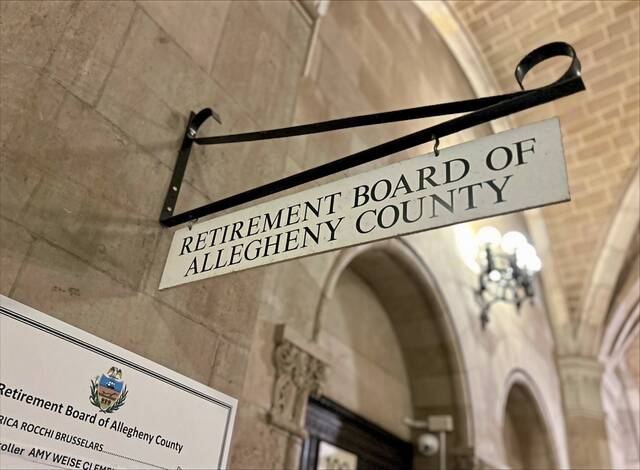
It should not take an official ruling to realize that a pension needs to be kept sound.
A pension is a contract between employer and employee. The employee does the work, putting in time and money for years so that, when the time rolls around, there is a financial cushion to fall back on. It’s the employer’s job to keep that cushion stuffed with the requisite money.
But this week, a judge had to spell that out.
The Allegheny County pension system is operating with a deficit of about $1.4 billion.
Frankly, any deficit in a pension fund can be a bit alarming for employees who have reached the point where retirement is on the near horizon. That pension is the return on a lifetime of punching a clock. If it were $1.4 million in the hole, you would worry. To know that it’s more than $1 billion — with a B? That’s where you wonder if you can retire at all.
And so Armstrong County Common Pleas Senior Judge Kenneth Valasek delivered a 16-page opinion, emphasizing Allegheny County is legally required to keep the pension system “actuarially sound.” That means it must have the capacity to do its job — to pay out the money due its retirees.
So that gives Allegheny County District Attorney Stephen A. Zappala Jr. part of what he wants. The DA sued the fund in December 2024 over its financial instability.
But the judge gave him only half a loaf.
Rather than requiring specific action to reduce the deficit, he required the county and the state work toward a fix over the next year.
The judge and Zappala disagree on a key point. While the DA believes state law requires the county to make additional payments to maintain actuarial soundness, the judge wouldn’t agree that the county is required to fill the deep hole that’s been dug.
The deficit has been more than 20 years in the making, and in its current state, the pension system is expected to become insolvent by 2043. That requires action sooner than later.
It isn’t that there have not been changes made. In 2024, the contribution rate was raised to 22%, with employees putting in 11% of their salary and the county kicking in the rest. The retirement board has the authority to increase contributions for workers and the county.
But it’s going to take another 20 years to correct the issue, based on a 2026 report. And that will only happen with dramatic increases in contributions. To bring back that soundness, the annual contributions will have to go up to about $140 million to $150 million — an increase of about 200%.
On the one hand, with 20 years’ work to do, does waiting a year really matter?
On the other, would starting to act now stop the county and state from working toward a long-term solution?
The judge gave Zappala a potentially hollow victory, but his timeline for the county and state to find a solution will make a difference only if he enforces the ruling come September 2027.