
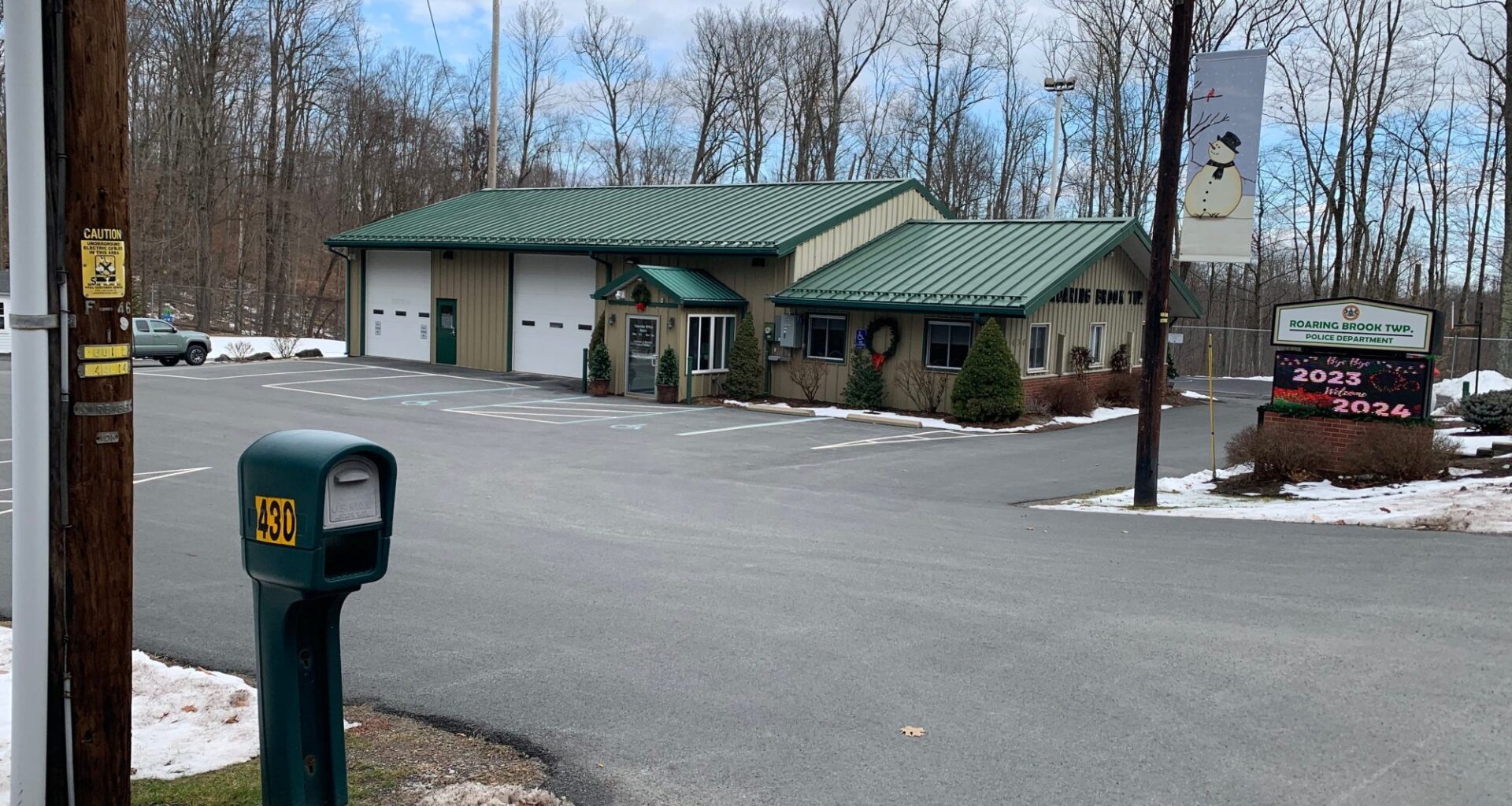
Roaring Brook Twp. won’t have to leave its municipal building or pay $300,000 to the property owner to stay there, a judge ruled in a lawsuit.
The decision also upheld a township lease renewal of the nearly two-acre property at 430 Blue Shutters Road for $1 a year for another 50 years.
The property owner, township resident Steve Ferlita, who primarily lives in Florida, sued in 2024 claiming the municipality violated a 50-year-old lease. He sought ejectment of the township from its municipal building or a payment of $300,000 to allow it to stay. The township denied violating the lease. After a bench trial Aug. 24, Lackawanna County Court Judge Terrence Nealon issued a ruling Aug. 28 in favor of the township.
A ruling in favor of Ferlita could have meant the rural-suburban North Pocono township of about 2,270 residents would incur significant costs and disruption of township operations in vacating and finding a new municipal and police department headquarters.
The land in question, 1.83 acres, is part of a 158.79 acre wooded tract acquired in 1956 by the Scranton Pocono Girl Scout Council. The council in 1974 started a lease of part of the tract — 200 feet along Blue Shutters Road and 400 feet deep — to Roaring Brook for $1 a year for 50 years.
The lease had conditions that included the property could be used “for a fire house or community building, but for no other reason,” and a structure was to have been built within five years. Absent any violation, the lease would renew upon expiration of the 50-year term on Aug. 1, 2024.
The township built a fire truck garage there 1978. It remained a satellite fire house of the Elmhurst-Roaring Brook Volunteer Fire Department until 2016, and it became the township building and police department headquarters.
The Girl Scout Council sold the tract in 2014 to RGM Hardwoods Inc., which conducted timbering and logging activities on part of the tract and became the successor owner to township lease of 430 Blue Shutters Road.
Ferlita, of 312 Blue Shutters Road, bought the tract in 2017 from RGM and likewise became the successor property owner to the township lease.
In January of 2024, Ferlita sued the township to eject it from the property. The lawsuit claimed the township violated the lease because a community building had not been constructed within five years of lease signing and other reasons. With the township building valued at $400,000 and the land at $100,000, Ferlita would accept $500,000 to drop the ejectment, according to the lawsuit.
Unlike eviction, an ejectment is a legal mechanism for certain situations that are not a typical landlord/tenant relationship. The lawsuit sought to bar the township from occupying the property and having the lease automatically renew on Aug. 1, 2024.
After the non-jury trial, Nealon ruled in favor of the township on several grounds, including:
• Ferlita failed to establish the township violated the lease. Along with being a fire station from 1978-2016, the property also contained meeting spaces for civic, social, recreational and governmental purposes. The township supervisors, zoning board, planning commission and sewer authority hold meetings in the municipal building, and the township police department operates there. Local homeowners’ associations and townhouse groups use the meeting room. Tax collections and recycling services occur there, and the building is used as a polling place and Red Cross evacuation shelter.
• “Thus, the building serves as the forum for many civic functions for the community,” Nealon’s ruling said. “The building acts as the township venue for public assembly, civic engagement, social welfare and recreational activities, and in the process serves the members of the community. The township officials described the building and leased parcel as the ‘heart’ of the community.”
• The Girl Scout Council or RGM never claimed the township violated the lease or sought to terminate it.
• Applicable statutes of limitations had expired long ago, including four years for a declaratory judgment on a lease violation and 21 years for an ejectment.
“As a consequence, plaintiff is not entitled to terminate the lease agreement, as a result of which the lease renewed on August 1, 2024 for an additional 50-year term,” Nealon’s decision said.