
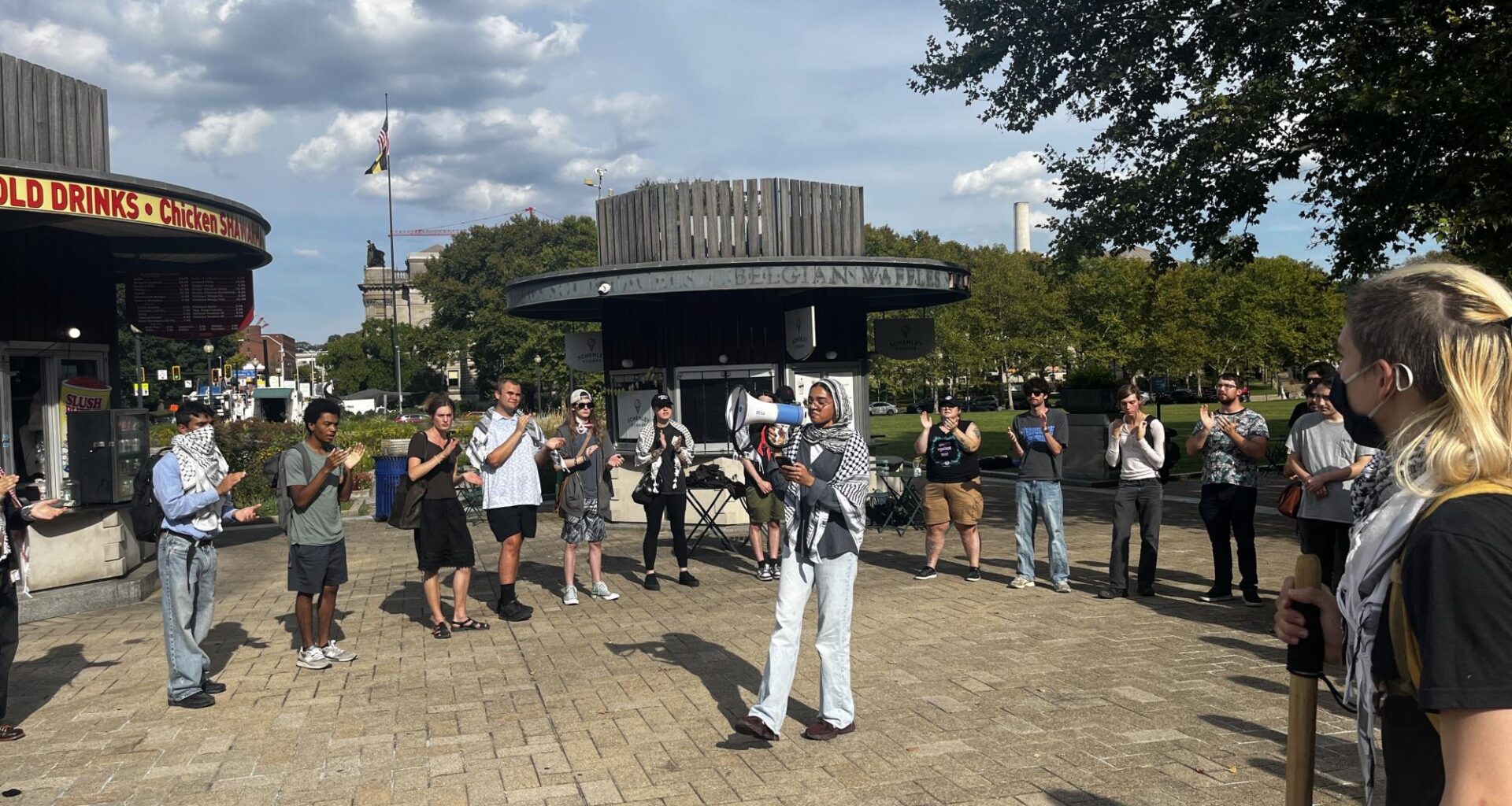
Pro-Palestine protestors rallied yesterday in Schenley Plaza against a recent bill that would limit colleges from boycotting Israel.
Advertised by Students for Justice in Palestine at Pitt, about 30 people circled up on Tuesday afternoon to protest the Protect Economic and Academic Freedom Act of 2026, which would block federal student aid to colleges who participate in boycotts of Israel. Speakers at the protest denounced the bill, with some saying it would limit universities’ actions toward Israel.
“The nature of this bill is clear,” Gizelle Salsa, a leader of SJP, told the crowd. “It works to serve the interests of a foreign government that is committing genocide over the actual needs of students here in the U.S.”
Passed by the U.S. House of Representatives on Sept. 3., the bill amends the Higher Education Act of 1965 to prohibit institutions from being eligible for certain funds under the act if they participate in a “nonexpressive commercial boycott” of Israel. It also prohibits institutions that participate in certain programs under the act to “certify that students are not unreasonably obstructed from participating in academic programs in Israel.”
The Higher Education Act provided financial assistance to post-secondary students, with a purpose of strengthening the educational resources of colleges.
In between chants of “While we chant in Schenley Plaza, there are no schools left in Gaza” and “Free, Free Palestine,” speakers said the bill would target the Boycott, Divestment and Sanctions movement and restrict pro-Palestinian activism. Some protestors insinuated Pitt is invested in Israel, calling for it to divest.
Pitt declined to comment on whether its endowment is invested in Israel.
When asked, three protest speakers did not identify themselves to The Pitt News.
Salsa told the crowd she believes the bill “entirely changes” what students are entitled to under the Higher Education Act of 1965, believing that federal aid would be tied to the political demands of an external foreign power.
“We have the right to freely organize and urge that the institutions representing us are aligning with our values,” Salsa said.
Salsa mentioned that 38 states, including Pennsylvania, have enacted restrictions on Israel boycotts, believing that these laws wrongly conflate Zionism and antisemitism. She said she believes the bill would extend this initiative to the scope of universities.
“Universities that are known for being the center for youth-led social movements and the collaboration of intellectual minds for action will now be the extension of the state’s efforts in surveillance, repression, and attenuating the efforts of those who condemn the actions of Israel and the effects of Zionism,” she said.
Salsa went on to say she believes the bill contradicts the U.S. Constitution, in which boycotts are a constitutionally-protected freedom of expression.
“This bill is a direct offense to the freedoms of boycotts,” Salsa said.
Attendee Rosalyn Tosh, a junior student at Carnegie Mellon University, said she can’t participate in any protests on CMU’s campus or help paint its fence because she was banned from being on campus except for the purpose of attending class.
Tosh said she is under investigation over messages on CMU’s fence about Palestine.
The message “Free Palestine by any means necessary” was painted on the fence in June and “Death to Zionism” several weeks later.
“So, I’m just trying to go to everything Palestine-related, because I think I, of course, have a bit of a stake in it,” Tosh said.
Protester Genaro Cuevas came from Wheeling, West Virginia to attend the rally. He said he believes the bill is a “definite attack” on the freedom of speech of civilians and the American people.
“With this bill they’re trying to pass, we have to show them what our position is,” Cuevas said.