
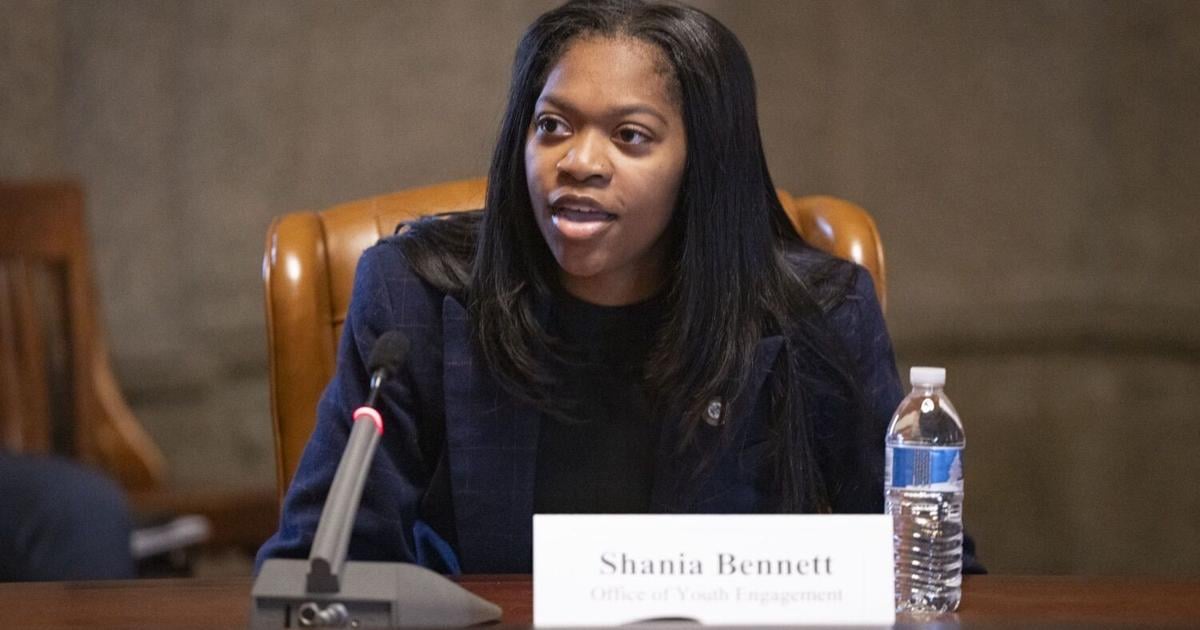
Shania Bennett does not intend to buy her way onto Philadelphia television screens if she can show up on thousands of phones for free.
The 26-year-old South Philadelphia native, a former member of Mayor Cherelle L. Parker’s administration and the first announced challenger in the 2027 mayoral race, is preparing a campaign built partly on a calculation that would have sounded improbable to an earlier generation of City Hall candidates.
Bennett believes she already has some of the most expensive things politicians buy: Attention. Content. Young people willing to share it. And the ability to speak directly to voters without waiting for a 30-second television spot.
“Most young people are already content creators,” Bennett said in an energetic, freewheeling interview with The Philadelphia Tribune. “They’re already familiar with me, so I don’t have to pay them. Most of them already share my content for free. You can’t pay for that.”
Bennett announced her candidacy Tuesday via the platform that is likely to become one of her campaign’s principal weapons: social media. She released a video announcing her run and scheduled a formal campaign kickoff for Sept. 26. She is the first candidate to publicly challenge Parker, who is eligible to seek a second term.
It begins what could become one of the more unconventional mayoral campaigns Philadelphia has seen, pairing a first-time citywide candidate with a former boss who holds City Hall and enjoys the advantages of incumbency.
Bennett does not pretend those differences do not exist. She disputes the idea that they should determine who is taken seriously. “I’m not paying for the same things you’re paying for,” she said.
Her strategy is not to abandon traditional campaigning. Bennett said she intends to knock on doors, attend events and have face-to-face conversations that remain essential in Philadelphia politics. Social media, she said, lets her reach people she might never otherwise reach.
“I know I’m not going to be able to talk to everybody, but I’m damn sure going to try,” she said.
Striking reversal
That language comes naturally to Bennett. During the interview with The Tribune, she spoke quickly and animatedly, laughing and swearing occasionally and repeatedly circling back to people she believes have grown tired of politics’ carefully managed language.
Her campaign also marks a striking reversal in her relationship with Parker.
In 2024, Parker appointed Bennett director of the Mayor’s Office of Youth Engagement. At the time, Bennett was the youngest member of the administration and tasked with helping connect City Hall with younger Philadelphians. She resigned in May.
Now she wants Parker’s job.
“That’s exactly what happened,” Bennett said when asked whether her experience inside the administration helped drive her decision to run. She described an “overall dissatisfaction” with what she saw and argued that government can become too concerned with presenting progress rather than confronting residents who believe it has not reached them.
“It’s easy to manicure and curate moments online to make it appear that you’re doing or keeping promises,” Bennett said. “The overwhelming majority of people shouldn’t have the same shared sentiment about trash.”
She also challenged the administration’s public-safety narrative. Homicides have fallen substantially during Parker’s tenure, but Bennett said residents’ daily encounters with crime and disorder cannot be captured by the homicide count alone.
“We talk about homicide being down, but crime itself, violence is not down,” she said, arguing that a mayor should be willing to use the office to draw attention to problems even when doing so risks angering powerful people or organizations.
The Parker administration has offered a markedly different assessment of its record. After the city’s $7.1 billion fiscal 2027 budget passed in June, Parker said her administration was “delivering results” through investments in safer neighborhoods, cleaner streets, housing, economic opportunity and city services.
Bennett’s political résumé began long before she entered Parker’s administration.
‘Why not it be me?’
At 18, while taking classes at Community College of Philadelphia, Bennett won a committee-person’s seat in South Philadelphia’s 48th Ward and was elected as ward treasurer. She later attended Penn State and graduated in 2020. She has worked for state Rep. Jordan Harris and state Sen. Nikil Saval and has founded Reach4Peace, an anti-violence initiative.
She now describes herself less as a product of that résumé than as an alternative to the type of candidate voters have come to expect.
“Why not it be me?” she said. “Young people don’t really have a candidate that they can see themselves in, and someone who is being impacted by the issues directly that we want to fight for.”
Asked what she considers the qualification she brings to the mayor’s office that is most lacking in government, Bennett did not name a degree, management credential, or previous office.
“You don’t need a degree in compassion,” she said.
Bennett said politicians can become detached from conditions they once knew firsthand. Residents living with gunfire, trash, discarded needles, drug activity or other neighborhood problems should not be dismissed for repeatedly complaining about them, she said.
“Of course, I’m going to articulate this problem because it’s in my face,” Bennett said, describing the experience of parents trying to get children out of a house while drug use or another disorder occurs nearby. “You gotta have compassion, even if the issue doesn’t affect you.”
Leadership, she said, also requires enough emotional intelligence to absorb residents’ anger without treating the anger as the problem.
“If people deserve to talk about it and, as a leader, if you can’t take people, you know, cussing you out respectfully,” Bennett said, laughing at the contradiction, “you gotta have compassion and also the emotional intelligence to deal with people when they’re frustrated with you.”
Whether that message can be converted into votes will test Bennett’s theory about campaigning in a city where organization and fundraising have long mattered enormously.
She argues that a younger candidate enters the equation differently.
Things money can’t buy
Campaigns spend heavily on television advertising, phone banks, paid canvassers, and increasingly on digital creators and influencers. Bennett said she expects volunteers and supporters in her generation to do some of that work organically, sharing videos, reminding friends about registration and election deadlines, and discussing politics within networks that campaigns often spend money to reach.
Her argument is not that campaign money has stopped mattering. It is that money may buy things she believes her campaign can obtain without it.
“I’m gonna have young people telling their friends or knocking on their friends’ doors, putting various messages like, ‘Hey, reminder, this is the deadline that you gotta vote. Make sure you know your polling location,’” Bennett said. “That’s the things money can’t buy.”
Bennett’s political development reflects that approach. Years before the mayoral announcement, she had already been profiled as an unusually young participant in Philadelphia politics. Community College of Philadelphia wrote about her political involvement at 18, and in 2024, 6ABC profiled her as the youthful force leading Parker’s Office of Youth Engagement.
Now Bennett wants to turn familiarity into something harder to produce: turnout.
She welcomes the possibility that other candidates will enter the race and rejects the notion that crowded elections are something to fear.
“We can’t talk about democracy without people wanting other people to participate in it,” Bennett said. “I don’t care if a million people decide to run. They should. The more the merrier. We need diverse candidates.”
‘Give me a chance’
She also knows what a 26-year-old seeking control of a city government with a multibillion-dollar budget will be asked: What makes her qualified?
Bennett’s answer is that Philadelphia should reconsider what it expects a qualified candidate to look and sound like.
“I have a mind of innovation that’s willing to not think like a traditional politician,” she said. “I’m coming with a fresh perspective. I’m coming with, I wanna listen to you. I want to shut up. I want to actually have meetings where people are a part of the plans that we set up.”
Bennett said treating an election as settled before voters participate can deepen the very disengagement political leaders say they want to cure.
Her request to voters, at least this early in a campaign that still has more than a year to travel, is simpler than asking them to commit to her.
“Give me a chance,” Bennett said. “You may vote for me. You may not. But to say, you know, to completely count me out, it doesn’t make sense in terms of democracy.”
Stay informed and connected — subscribe to The Philadelphia Tribune NOW! Click Here