
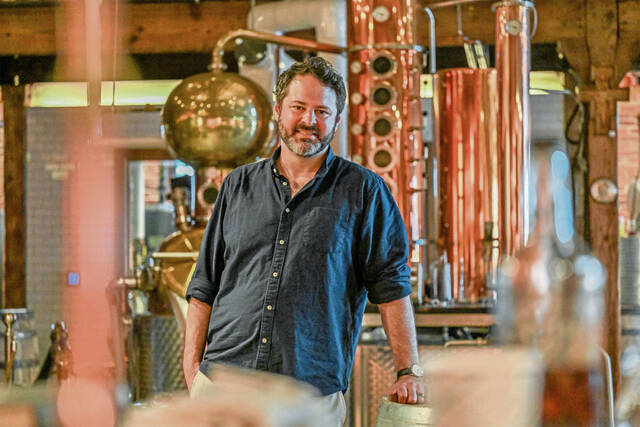
Matt Obernauer realized he wanted to resurrect his family’s business when his grandfather told him a story as a 12-year-old boy.
“He kind of took me aside and he gave me a little elbow in the ribs and said, ‘Hey, you want to see something cool?’ ” Obernauer said.
His grandfather took him to a hallway cabinet and pulled out an unopened bottle of H. Obernauer whiskey. He told Obernauer about the whiskey business founded and run by Obernauer’s great-great-grandfather, Herman Obernauer. The story, he said, remains a vivid memory from his childhood.
“I think, looking back, the thing that struck me so much was that my ancestor could have basically created something over 100 years ago, and then here I am as a kid, holding that thing,” Obernauer said.
Herman Obernauer was a rectifier.
“He would basically take product whiskeys created by other distillers and he would blend them according to his own particular signature recipes,” Obernauer said. “It was basically a different form of whiskey making. It kind of begins a little bit more at the end of the process.”
Obernauer is continuing his ancestor’s legacy by restarting H. Obernauer & Co. Originally founded in 1885, the whiskey rectifier was based in Pittsburgh until its closure in 1915.
“It’s honoring his process, how he did things,” Obernauer said.
The formula for rectifying is not something he sees as “formulaic.”
“We have general ideas of what we want out of our whiskey,” he said. “We want it to be something that is unique and approachable, something that people are going to try and have a little bit of an aha moment.”
As part of the brand revival, the company plans to open a tasting room along Smallman Street in Pittsburgh’s Strip District. The company’s products will include rye whiskey, American whiskey and bourbon. Erin Lee, who was a head distiller at FEW Spirits in Illinois, will be director of operations for H. Obernauer & Co.
Obernauer was a corporate lawyer in New York, then worked in the legal department of the Colorado Rockies baseball team before deciding to pull the trigger on his lifelong dream. He and his family relocated to Squirrel Hill in 2024 to open H. Obernauer.
“Over time, I decided I wanted to be in this industry and do something where I could kind of be the chief decision-maker,” Obernauer said.
After H. Obernauer’s initial closure, Matt Obernauer’s family worked near the spirit industry on the wholesale side.
“(Whiskey) was in the air in our family,” he said.
Despite following his passions during this new venture, Obernauer said he can’t help but feel a little daunted by the task of resurrecting his family’s business and continuing the legacy.
“On a day-to-day basis, it feels much more like a responsibility than a dream,” he said. “When you put your name on something like this and put it that far out there, there’s a standard that comes with that. There’s a responsibility that comes with that.”
The tasting room is expected to open by or before the end of the year. The company will carry out its production in Lawrenceville.
A growing spirit row
In terms of locally produced liquor, H. Obernauer & Co. won’t be lonely on Smallman Street.
“I think, to the extent that this can become kind of a spirit row environment, is really to the benefit of everyone here,” Obernauer said. “I’m just excited for the opportunity to do what I think is my part.”
The tasting room is taking over the former Kingfly Spirits space between Wigle Whiskey and Maggie’s Farm cocktail bar and barrelhouse.
Maggie’s Farm opened its first location in the Strip near the 31st Street Bridge in 2013. It produced the state’s first commercially available craft rum since Prohibition, according to its website. Distilling operations relocated to its Upper St. Clair facility in 2023.
The growth in the local industry is only good for other liquor producers, said Alex Moser, COO of Wigle Whiskey.
“We’re really excited to have (H. Obernauer) on the street,” Moser said. “The more people that come down to that part of the Strip, the better.”
Founded in 2012, Wigle Whiskey was named for Phillip Wigle, who, in the 1790s, advocated for his right to distill in a physical dispute with a tax collector and unwittingly helped spark the Whiskey Rebellion.
The original distillery owners, the Meyer-Grelli family, lobbied for a change in state law that would allow distilleries to sell their products on site rather than strictly through state stores.
“When we found the space, I think the Strip District appealed to us a lot because it’s a high-foot-traffic area that brings customers from all over the city and the surrounding suburban neighborhoods,” said Alex Grelli, former Wigle Whiskey co-owner and distinguished service professor of law and entrepreneurship at Carnegie Mellon University’s Tepper School of Business.
The Meyer-Grelli family sold the distillery in 2022.
“I think the current energy of the Strip or its trajectory aligns with all of these distilleries in terms of the culinary aspects, the restaurants, the focus on cocktails and the developments along that way, and restaurant groups that are populating the Strip District,” Grelli said. “It’s clearly seen as an important spot from a culinary and food and beverage standpoint.”
Economic evolution
The Strip District has evolved quite a bit over the years.
“The Strip District has kind of been growing in ways that are different than it used to be,” said Risa Kumazawa. “I’m kind of amazed that every time I’m down there, there seems to be a new restaurant, new store popping up.”
The growth has a potential to draw in tourism from locals and people from outside the city, Kumazawa said.
Kumazawa is the associate dean for academic systems and accreditation at Duquesne University as well as associate professor of economics at the Palumbo-Donahue School of Business. She’s also served as president of the Economic Club of Pittsburgh for the past eight years.
In the 1820s and 1830s, the Strip was home to iron mills, foundries and glass factories, according to Strip District Neighbors, a nonprofit organization that promotes economic development in the neighborhood. In the early 1900s, wholesale became the name of the game in the neighborhood. Produce merchants began to move to the Strip District near the Pennsylvania Railroad yards.
By the 1970s, only about two dozen wholesale produce dealers remained in the Strip. Remaining dealers began to expand their businesses by opening retail stores on Penn Avenue and Smallman Street. Dozens of retail shops opened, providing a variety of produce, ethnic foods and restaurants. By the ’90s, the area began to reflect how people know it today.
While it’s experienced a boom in development, Grelli said the neighborhood has been able to keep its historic qualities.
“I think that something as unique as the Strip District, where it’s this blend of wholesalers and manufacturing, as well as the new residential builds and the new businesses coming in. That’s what might be what’s attractive to … the distilleries or the breweries,” Grelli said. “It kind of fits into the ethos of that existing neighborhood under some storyline.”
The Strip today maintains some semblance of manufacturing in a place where industrialism used to reign supreme. This sustained history in the neighborhood is what lends to its vibrancy and the variety of shops and business types that have populated it over time, Grelli said.
In his time in the Strip, Moser said, he’s noticed growth in the area.
“I’ve only been here four years, but I know back in 2011 there wasn’t as much residential area. That’s grown a lot,” Moser said. “I know there wasn’t a building next to us. It was just an empty lot.”
Kumazawa expects the growth in local distilleries and tasting rooms to have a positive effect on the neighborhood. New businesses can create new jobs locally.
“I would say this impacts the local economy in a positive way,” Kumazawa said. “I think it also helps for local sourcing if they’re buying their ingredients from local farmers. You get to kind of keep the benefits local.”
Despite the new business being alcohol-focused, Kumazawa said, the businesses may attract a different type of clientele than a college bar or dive bar normally would.
“If I think about distilleries, maybe the customers are going to be focused more on the enjoyment side of things,” Kumazawa said. “They’re going to different tastings and whatnot. I feel like there’s going to be a more sophisticated customer base compared to random college kids screaming at 1 in the morning.”