
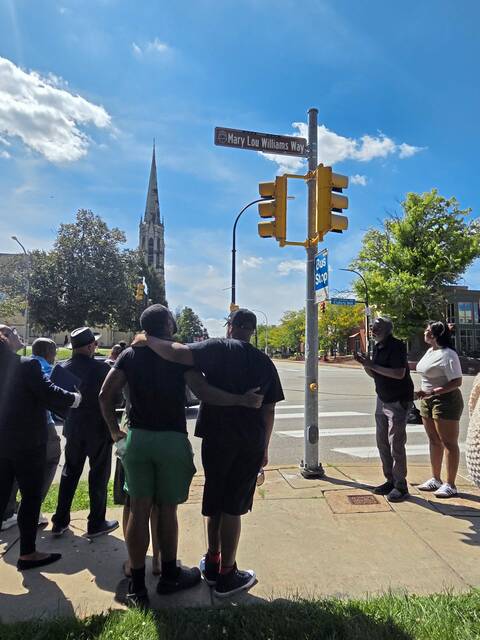
An unheralded African American jazz revolutionary from East Liberty whose progressive passages helped pave the way to the genre’s future had a stretch of street in her old neighborhood renamed Mary Lou Williams Way on Friday.
Dubbed “The First Lady of Jazz” — but known first by the moniker “The Little Piano Girl of East Liberty” — Williams was recognized as a self-taught child prodigy by the time she moved from Atlanta to East Liberty at age 4. By age 6, she began playing for nearby white families who had thrown bricks into her family home in a successful move to quell the chaos.
She’d blossom into an iconic jazz pianist who cut more than 100 records and a prolific arranger and composer who put her pen to more than 350 tunes for herself as well as for the likes of Duke Ellington, Benny Goodman and Dizzy Gillespie.
“We call jazz American classical music, and so Mary Lou is the Beethoven of American classical music,” said Sam Black, director of the African American Program at the Senator John Heinz History Center.
With 70 or so in attendance at the afternoon ceremony at the intersection of Larimer Avenue and East Liberty at Rain Garden — a crowd that included members of the late Williams’ family, jazz aficionados and historians, local politicians and community members — there was ample testimony that Black’s words were no exaggeration.
Over her 60-year career, Williams soulfully graced Ellington, Goodman, Louis Armstrong and other luminaries with her presence on stage, helped develop the blues-rich Kansas City Swing sound, used her funds to aid the poor and the addicted despite her own economic instability and mentored fellow genre legends in Gillespie, Miles Davis and Thelonius Monk.
Bob Studebaker, host of “JazzWorks” on 90.5 WESA, spoke of her years mentoring young musicians at Cafe Society, a hub of progressive music and politics in New York in the 1930s and 1940s. As he explained, she was “essential.”
“Mary went home and they followed her like the Pied Piper,” said Studebaker of the group of young jazz legends. “They talked about music. They traded ideas. Mary literally gave the giants of the next generation of jazz the foundational music lessons that made it possible for them to invent bebop.”
Her innovation was as layered as a jazz chord.
“She premiered some of the very first long-form jazz compositions ever created,” Studebaker said. “In the days when three minutes was the max that you could squeeze into a 78-rpm record, there wasn’t much call to perform or to write and create long-form jazz. Mary did that and broke it into different pieces. It’s just one of the many ways that she was always pushing music forward. She took music as she found it, and then said, ‘What can I do with it?’ And it was always something marvelous. Duke Ellington called her ‘perpetually contemporary.’”
Musician, composer, jazz historian and lifelong East Ender Nelson Harrison expanded on her impact.
“Anybody who was around her had to get mentored,” he said of her penchant for teaching. “Mary introduced the flattened fifth (chord). If you don’t believe it, she wrote a tune called ‘The Land of Oo-Bla-Dee.’ There’s nothing but flatted fifth chords in there. That’s a chord that they didn’t use in Europe at all. They called it the Devil’s Chord.”
According to Harrison, she helped spread its use through contemporary music.
“She introduced Monk to the flat five. Ahmad Jamal told me that Tommy Turrentine (a peer and collaborator of Monk’s) introduced him to the flat five at the Musicians Club on Wylie Avenue, the 471 Club,” said Harrison. “That chord was a revolution. Well, ‘The Land of Oo-Bla-Dee’ is telling you what that chord means. And that’s Mary’s composition.”
In 1964, she and jazz musician George Wein created Pittsburgh’s first jazz festival at Civic Arena. And in 1996, the Kennedy Center in Washington, D.C., began hosting the Mary Lou Williams Women in Jazz Festival. After converting to Catholicism in 1954 and taking a three-year hiatus, she returned to music with a deeply spiritual focus and eventually taught at Duke University, where she continued influencing the next generation.
“The best jazz musician is simply a matter of opinion, but influence, that means more,” said jazz musician Adam Lee Morgan. “Mary Lou not only did her thing, but also gave others the tools to do more, and that is the very essence of influence.”
Now, all who travel the stretch of street on East Liberty Boulevard — like Gillespie, Davis and Monk — will have the chance to follow the Mary Lou Williams way, too.
“Hopefully, this addition of her name to a community where her family has remained serves as an inspiration to all who pass by and to future generations,” said her niece Bobbie Ferguson, founder of the Mary Lou Williams Institute. “That, no matter what the challenges are or that one may face, with hard work, faith, the desire to achieve and the support of those who care, you can reach your pot of gold at the end of the rainbow.”
Williams died from bladder cancer at 71 in 1981.
“With sheer brilliance, extraordinary piano skill and unparalleled spiritual insight, she broke through barriers in a predominantly white, male-dominated industry,” City Councilman Khari Mosley said of her legacy. “Pittsburgh has historically been a reservoir of cultural richness, and Mary Lou Williams exemplifies the height of Pittsburgh’s momentous Black creative heritage. This renaming will serve as a constant source of inspiration for our young people, a daily reminder that genius flourished here and can continue to flourish here and that Black artistic excellence is synonymous with our city’s cultural legacy and heritage.
“It is quite apropos that the little piano girl from East Liberty, who once played for iconic Pittsburgh industrialists like the Mellons and the Olivers, is now immortalized as a giant that walks among Pittsburgh’s greatest sons and daughters, reflecting the best of who we are and what we can aspire to be.”