
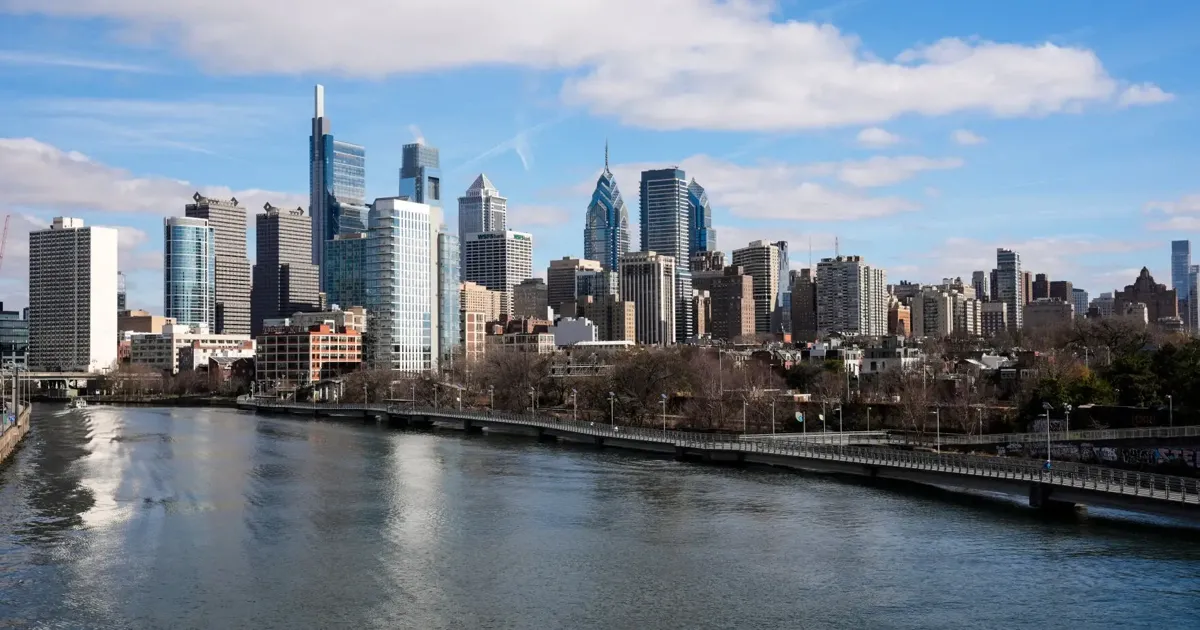
This is Part I of a two-part series examining what three decades and five mayors have meant for Philadelphia, from the city’s finances and neighborhoods to housing, jobs, poverty and public safety. Part II will examine the five administrations individually, the promises each mayor made and the problems that outlasted them.
Stephen Mullin remembers a Philadelphia that had become frighteningly easy to leave. That was in 1992.
Jobs were vanishing. Families were fleeing. Empty houses multiplied on blocks where children had once filled the sidewalks. City government was in such a miserable financial condition that the question inside City Hall was not how to finance some grand new vision, but whether the government itself could remain solvent.
Mullin, who served as finance and commerce director under Mayor Ed Rendell, who was in office from 1992 to 2000, remembers a sales pitch that would frighten many outsiders.
“Don’t come here because you won’t be able to get public services,” Mullin recalled. “You’ll be taxed to death.”
Walk around Philadelphia in 2026, and much of that city is difficult to find.
Center City extends far beyond the commercial core Philadelphians knew in the early 1990s. University City gleams with towers. Construction has remade once-vacant neighborhoods. Restaurants, apartments and expensive townhouses now occupy land that sat empty for years. Immigrants have breathed new life into commercial corridors. The government, once struggling to borrow money, now holds investment-grade credit ratings.
Five mayors presided over that journey: Rendell, John Street, (2000-2008), Michael Nutter, (2008-2016), Jim Kenney, (2016-2024) and Cherelle Parker, who took the helm in 2024.
Mullin has little difficulty answering whether Philadelphia is better than it was when Rendell assumed office. “It’s a hell of a lot better now,” he said.
Then comes the complication.
“But I would also note,” Mullin said in describing the makeup of Philadelphia residents today, “it’s not the same people.”
Thirty years, two Philadelphias
Immigrants arrived. College graduates came. Families left. The people reflected in today’s more encouraging landscape are not necessarily the same Philadelphians who endured the worst years.
Jay McCalla is even less inclined to celebrate.
McCalla worked on Rendell’s 1991 campaign, managed housing policy in Rendell’s administration, and later served as a deputy managing director under Street, leading the Neighborhood Transformation Initiative.
Asked where Philadelphia stands after all Rendell attempted to accomplish, McCalla answered without ceremony. “I think we’re in the same place as we were 30 years ago.”
He sees a city where basic municipal services remain uneven and where the experience of government varies by ZIP code or neighborhood.
“Services from the city, that is, street sweeping, drain cleaning, things like that, the basic services are still not distributed equally in the neighborhoods,” he explained.
The distance between Mullin’s “hell of a lot better” and McCalla’s “same place” is where Philadelphia’s last 30 years lie.
The positive side
Rendell entered office in January 1992 as the government staggered through a fiscal crisis. Kevin Feeley, Rendell’s deputy mayor for communications, remembers Philadelphia being about five days away from missing payroll.
The Philadelphia of 2026 bears almost no financial resemblance to that government.
Katie Martin, who leads Pew Charitable Trusts’ Philadelphia research team, calls the change one of the period’s clearest achievements. “On the positive side, it’s the city’s financial stability,” Martin said. “It’s the city government’s stability.”
Philadelphia now holds investment-grade ratings from the major credit-rating agencies. Its pension system, just 44.8% funded in fiscal 2016, had reached 65.4% by fiscal 2024 and has since surpassed 67%.
Jane Slusser, Kenney’s first chief of staff, remembers arriving in government with ambitious plans only to sit through the new cabinet’s first presentation by Finance Director Rob Dubow.
He explained, she recalled, “why there wasn’t money for anything.”
Funding pre-K and Rebuild required the controversial sweetened-beverage tax. Improving the pension fund required an agreement with municipal unions on contributions.
“I’m jealous of the budget they have today,” Slusser said. “We were dealing with no new money.”
The government that once worried about meeting payroll now debates multibillion-dollar housing initiatives.
Philadelphia’s transformation becomes more personal at the front door.
Adjusted for inflation, the median single-family home sold for about $90,000 in 2000. By 2021, it was approximately $265,000.
In 2000, half of Philadelphia homes sold for $100,000 or less. By 2021, only 3% did. Meanwhile, the share selling for $400,000 or more climbed from roughly 3% to about one quarter.
For longtime homeowners, that can represent extraordinary, accumulated wealth. For families trying to buy their first house, it can put neighborhoods beyond reach.
Additionally, Martin said Pew found relatively little change in the number of Black Philadelphians who owned homes, while the number receiving mortgages to purchase homes fell 25%.
Philadelphia’s houses became far more valuable while a traditional avenue to Black family wealth became harder to access.
The missing middle
Rendell once described the economic problem in a way Feeley remembers to this day.
If he could have one thing for Philadelphia, Feeley recalled Rendell saying, give him 75,000 decent-paying jobs for people without college degrees. “And that’s still true today,” Feeley said.
Factories that once provided generations of Philadelphians with that work are largely gone. Medicine, education, health care and professional services became pillars of the modern economy, but the sturdy middle of the employment ladder did not grow at the same pace.
About 23% of Philadelphia jobs fall into Pew’s middle-wage category.
“We’re seeing fewer people employed in jobs that provide middle wages,” Martin said.
Those jobs increasingly go to workers with college degrees, while only about one-third of Philadelphia adults have bachelor’s degrees.
Mullin knows who disappeared from the success story. “The people who I think were not as well served were people who were in jobs that we don’t see anymore, or we don’t see as much anymore,” he said.
The old Philadelphia bargain, steady work without a four-year degree, a rowhouse and the means to support a family, has become much harder to replicate.
‘A galloping horse’
Philadelphia lost population decade after decade, reaching its modern low in the 2000s. Then people began returning.
Slusser remembers arriving in Philadelphia 20 years ago to find far more abandoned buildings. Today, she sees “how vibrant the city is, how bustling Center City is” and credits immigrants with helping revive neighborhoods.
By the late 2010s, Mullin believed Philadelphia might gain another 200,000 residents by 2030.
Philadelphia had been riding “a galloping horse,” he said, when the pandemic struck like someone standing along the road with a two-by-four.
“Boom. What the hell just happened here?” Mullin said.
The city’s estimated 2025 population of 1.574 million remained below its 2020 census count of 1.604 million, but Philadelphia did not return to the long free fall that defined much of the previous century.
Homicides decline
Few Philadelphia statistics have swung as violently as homicide.
The city recorded 562 homicides in 2021, its highest total in more than six decades. Four years later, Philadelphia recorded 222, its lowest total since 1966. According to Pew, violent crime had already reached its lowest rate of the 21st century in 2024.
Martin resists turning that history into a neat political graph. “It’s not a linear story,” she said. “It’s a story about changes that are happening in the city over time.”
The geography of gunfire explains why the decline does not feel equally miraculous everywhere. Pew found 92% of shooting victims from 2022 through 2024 were Black or Hispanic, and 38% of shootings occurred in just 12 of Philadelphia’s 159 neighborhoods.
A city can reach a decades-low homicide count while families on a small collection of blocks experience gun violence most Philadelphians never encounter.
Poverty dips below 20%
Philadelphia carried another unwanted distinction for years: poorest big city in America. The poverty rate climbed to about 28% during the Great Recession, which affected Philadelphia from December 2007 to June 2009. Recent figures have pushed it below 20%.
“It’s going down a little bit each year,” Martin said.
Pew’s research notes that the Hispanic poverty rate fell dramatically, but the number of Hispanic residents living in poverty increased slightly as the population grew.
“Are people leaving poverty or are we just having more people with higher incomes moving into the city?” Martin asked. “And that is an outstanding question.”
Mullin’s warning returns: “It’s not the same people.”
The Parker administration argues that Philadelphia’s falling poverty rate reflects more than a changing population.
Orlando Rendon, executive director of the Office of Community Empowerment and Opportunity, points to the most recent Census data, which put the city’s poverty rate at 19.7%, the lowest in decades and far below the rate that once climbed above 28%.
He acknowledges that higher-income residents have moved into Philadelphia, but Rendon says wages have risen as well, meaning at least some of the movement came from Philadelphians earning their way above the poverty line.
Parker has made economic mobility part of her governing agenda, including $2.7 million in the fiscal 2027 budget for financial empowerment and economic-mobility services and the creation of an Economic Mobility Cabinet charged with coordinating that work across city government.
Yet 19.7% still means nearly one in every five Philadelphians lives below the poverty line. Thirty years after Rendell inherited a city struggling to pay its workers, Philadelphia dramatically strengthened the government’s finances, but the harder measurement is how completely that recovery traveled from City Hall into Philadelphia households.
What can a mayor control?
Richardson Dilworth, professor and head of Drexel University’s Department of Politics, is reluctant to draw a smooth upward line through 30 years of Philadelphia history.
“I don’t think there has been a clear trajectory,” Dilworth said. “My gut is to say the average Philadelphian is probably better off living in Philadelphia today than in the 1990s, but there are several significant caveats,” for example, when the comparison is made and where a Philadelphian lives.
Dilworth pointed to the recession and COVID-19 pandemic (March 2020-April 2022) in Philadelphia as periods when economic conditions deteriorated, as well as the surge in violent crime in 2020 and 2021. And while parts of Philadelphia have been dramatically transformed, he said the gains have never been evenly spread across the city.
“His focus was downtown,” Dilworth said of Rendell’s years in office. “The quality of life was uneven.” He pointed to parts of the Northeast and Southwest as places where “you see the lack of impact of city policy.”
“My answer is that mayors can only improve things at the margins,” he said.
Slusser, from Rendell’s administration, sees Philadelphia swinging between wanting a mayor who sells the city and one focused on the machinery of neighborhoods and government. She noted that Rendell was the exuberant salesman, Street brought a neighborhood focus, Nutter embraced the public role of championing Philadelphia, and Kenney focused more on governing.
Parker has swung the pendulum again. “Now Parker is clearly very Rendell-like in her enthusiasm for the job and the city,” Slusser said.
A view from inside City Hall
Joyce Wilkerson, Street’s former chief of staff and a former member of the Philadelphia Board of Education, cautions against confusing a mayor’s visibility with the job itself.
“Parker does a really good job of being a cheerleader, like Rendell, but it’s not the biggest job — they have a city to run,” Wilkerson said.
Lauren Cristella, president and CEO of the Committee of Seventy, sees physical changes that would astonish someone returning after decades away, such as the Avenue of the Arts and University City’s towers to Penn’s Landing. She also sees poverty, limited economic mobility, gun violence, and weaknesses in city government persisting election after election. “We have a deep poverty problem,” Cristella said. “That is a generational problem.”
Pedro Ramos, president and CEO of the Philadelphia Foundation and a veteran of the Street administration, describes the past three decades as “real, discernible change in the livability of Philadelphia,” citing fiscal stewardship, tourism, Center City, neighborhood investment, and sharply lower gun violence, while acknowledging unfinished work on jobs and schools.
The Philadelphia that feared insolvency is gone. So is much of the landscape of abandonment. The city is wealthier, its government is financially stronger, and homicides have fallen dramatically from the pandemic years.
Philadelphia also remains a city where poverty touches nearly one in five residents, a college degree increasingly determines access to a decent wage, Black homeownership has not shared equally in the housing boom, and a handful of neighborhoods absorb an enormous share of gunfire.
Five mayors did not spend 30 years standing still, but the harder question is who got to move with the city. “Philadelphia is a world-class city,” Feeley said. “And that’s the biggest change over the last 30 years.”
Part II will delve into what each of the five mayors inherited, what each changed, what survived after they left City Hall, and why some of Philadelphia’s oldest problems have endured through every administration.
Stay informed and connected — subscribe to The Philadelphia Tribune NOW! Click Here