
source: Billy Penn
According to Billy Penn at WHYY, Carpenters’ Hall at 320 Chestnut St. will host a free public event this Saturday, Sept. 13, from 11 a.m. to 1 p.m., spotlighting the First Continental Congress of 1774.
The gathering is part of the Philadelphia Historic District’s ongoing “52 Weeks of Firsts” series, which marks Philadelphia-tied moments in the run-up to the nation’s 250th anniversary.
While much of 2026 has centered on the Declaration of Independence, organizers want visitors to look back two years earlier, to when 56 delegates from 12 of the 13 colonies convened in Philadelphia for the first time.
What Happened at Carpenters’ Hall in 1774
Georgia did not send delegates. The rest arrived beginning Sept. 5, 1774, driven by anger over the Intolerable Acts, Britain’s retaliatory response to the Boston Tea Party.
The acts dissolved the Massachusetts legislature, closed the Port of Boston, and required residents to house and feed British troops.
Michael Norris, executive director of Carpenters’ Hall, told the Philadelphia Inquirer the colonists saw those measures as a direct threat to every colony, Massachusetts included.
The delegates drafted a Declaration of Rights and Grievances and adopted the Articles of Association, which committed the colonies to halting trade with Britain until the acts were repealed.
Norris described the tactic as using collective economic pressure to force Britain into negotiations.
The congress also produced something harder to document: trust among men who had never met.
Norris told Billy Penn that City Tavern, a short walk from Carpenters’ Hall, served as the informal gathering place where delegates built the relationships that made collective action possible.
Patrick Henry’s declaration during the opening sessions, reported by the Inquirer, captured the shift: he told fellow delegates that the distinctions separating Virginians, Pennsylvanians, New Yorkers, and New Englanders no longer existed.
The congress concluded Oct. 26, 1774, setting the stage for the Second Continental Congress at Independence Hall the following year.
Saturday’s Firstival Activities
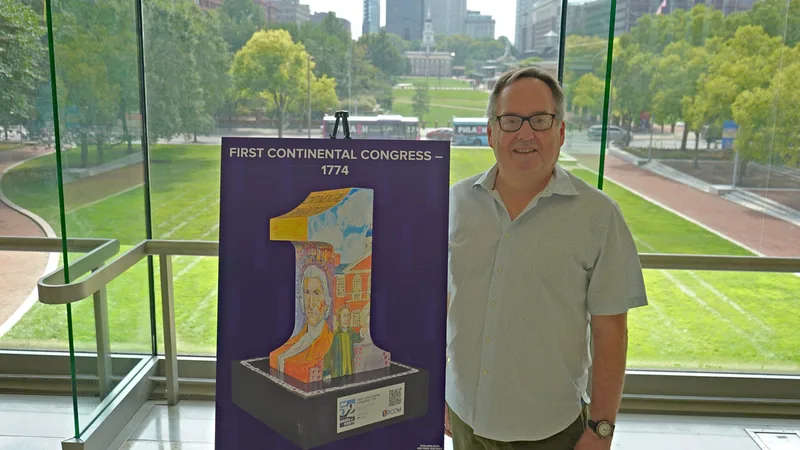
The centerpiece of Saturday’s event is the unveiling of a new sculpture by artist Gwenn Seemel, chosen by Mural Arts Philadelphia for this week’s entry in the “52 Weeks of Firsts” series.
The piece depicts Patrick Henry addressing John Adams and John Morton, with Charles Thomson shown alongside a reimagined version of Benjamin Franklin’s “Join, or Die” illustration and a rendering of the 13 colonies. Seemel is known for a polka-dot Cubist style.
Family activities include a Lego station where visitors can build a replica of Carpenters’ Hall, a coloring station also led by Seemel, and a storyteller from Historic Philly’s Once Upon a Nation program. The hall’s permanent exhibits remain open throughout.
Admission is free.
The Broader Semiquincentennial Context
Norris told Billy Penn that this summer’s record visitor numbers reinforced Philadelphia’s central place in the nation’s founding, a role shaped as much by 1774 as by 1776.
The late historian David McCullough, as reported by the Inquirer, referred to Carpenters’ Hall as the acorn of American democracy. Norris put it plainly: the seed of independence that grew into the United States took root there first.