
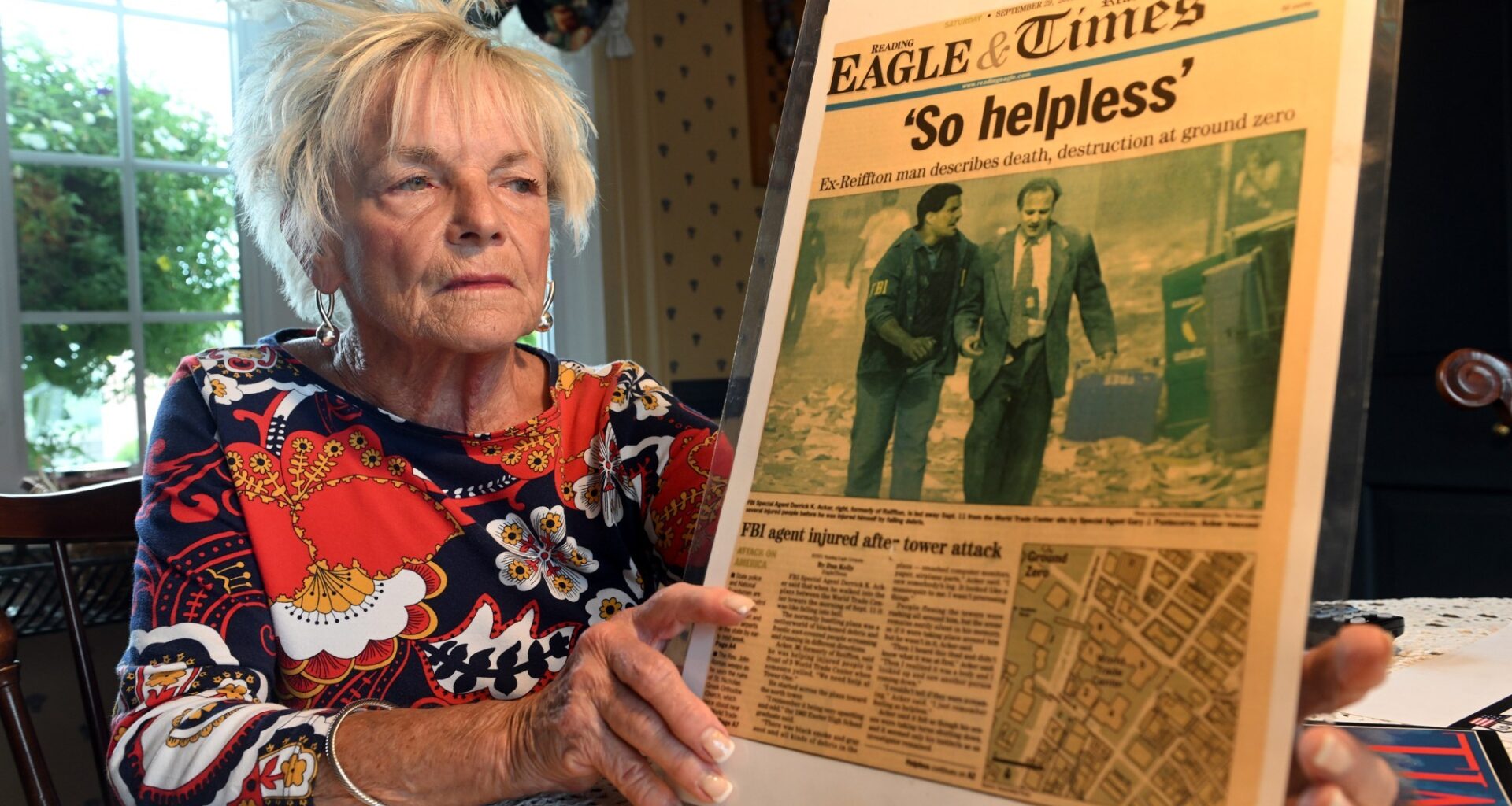
On the morning of Sept. 11, 2001, Derrick Acker — then a 36-year-old FBI special agent and formerly of Reiffton — was driving across the Brooklyn Bridge from Manhattan to Brooklyn to prepare to testify before a New York grand jury when he noticed paper drifting through the air above the East River.
Moments later, he saw the gaping wound in the north tower of the World Trade Center. “Black smoke was pouring out,” he told the Reading Eagle weeks after the attacks.
Back in Berks County, his mother, Nance Acker, had just returned from her daily walk when a home‑health client called and told her to turn on the TV. She watched the unfolding horror, unaware her son had been diverted from Brooklyn and sent directly into the chaos at the trade center.
Acker arrived amid what he later described as “utter pandemonium.” Crowds surged up from the mall beneath the towers. Sprinklers had soaked many of the injured; others choked on dust and smoke.
He helped guide people toward Broadway until someone shouted that assistance was needed at Tower One. After helping an injured man to safety, he looped back toward the plaza.
He was roughly 75 feet from the south tower when he saw a man look up and scream. Acker followed his gaze and saw steel and debris shearing off the building and plummeting toward the ground.
“We all yelled, ‘Run,’” he recalled. He sprinted up Cortlandt Street, diving into a recessed doorway just as a violent blast of wind hit his back. A torrent of debris roared past — beams, metal, even a massive concrete planter rolling down the street.
Then everything went black.
“I thought I was dead,” he said. He began choking on soot and concrete dust, realizing he was still alive but blinded; the blast had scuffed his corneas and blown away his glasses.
A New York police detective’s voice guided him through the darkness. Together with a woman who had also taken shelter, they pushed through the choking air toward daylight, passing the bodies of firefighters and paramedics.
They reached a line of police and firefighters heading toward the north tower just before it collapsed. Acker ran again, north on Broadway, through a second wave of dust.
Later, while carrying an oxygen tank for a doctor, he was grabbed by a friend, a fellow FBI agent, who rushed him to a bureau office and then to New York University Hospital. Doctors treated him for eye injuries and burns.
“The doctors had all come to work, but there were no patients,” he said. “Everyone was dead.”
Nance Acker, whose birthday coincides with 9/11, keeps a laminated copy of the Reading Eagle story that showed her son — suit and tie intact — being led from ground zero. She didn’t learn he was alive until late afternoon.
“Had I known he was there,” she said, “I would have been horrendously horrified.”
Now 61 and recently retired from the FBI, Acker said the memories have never faded.
“Something that traumatic, when you’re that close up to it, never fades,” he said. “I think about it almost every day.”
He still smells the jet fuel, the burning rubber, the dust. Some nights, he said, “that movie camera switches on in your head” and the day replays in full.
What stayed with him most was the ordinary nature of the victims’ morning — people simply going to work.
It reshaped his sense of empathy throughout his career working to investigate violent gangs.
“The first thing you have to have for anybody is empathy,” he said. “After 9/11, I really understood what that meant.”
25 years later, the dust of 9/11 still follows Berks native Acker
Readers recall 9/11 experiences 25 years later