
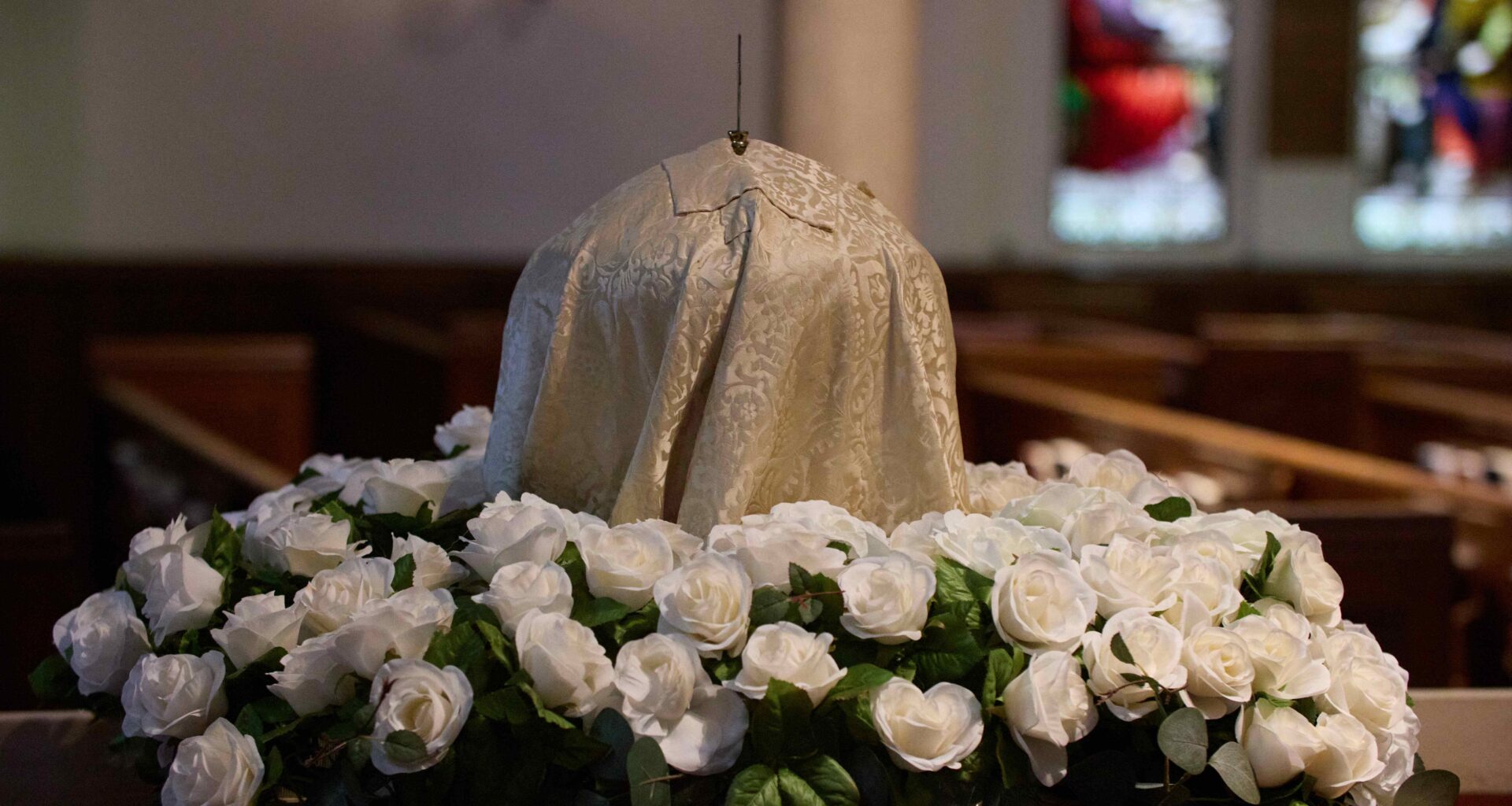
Imagination had to suffice to see the face of Jesus in the brocade veil installed as an object of veneration and wonder Saturday at the Cathedral Church of the Nativity in Bethlehem. The pale cloth is decorated with floral designs, vines, rune-like patterns and what might be a lamb, but of the Savior, there was no obvious sign.
That didn’t detract from the hushed sense of sanctity that attended the presence of the veil. Indeed, when worshipers at Holy Trinity Episcopal Church in Shamokin saw the image of Jesus in the veil nearly 50 years ago — sparking a years-long run of pilgrims, miracle-seekers and the merely curious to that Northumberland County coal city — church leaders were quick to assure them that not seeing Jesus didn’t mean their faith wasn’t strong.
“This veil is not magical,” said Scot Dressler, a youth minister at Nativity who preached at the special Saturday service where the Shamokin veil, perfumed in clouds of incense, was carried by four parishioners in a procession around the historic church and placed on permanent display.
What is it, then? Practically speaking, it was merely a cloth used to cover a tabernacle, the vessel where consecrated bread for communion is kept.
One Wednesday night in April 1977, just after an Easter week prayer service, a 9-year-old girl named Iris Reigle told her grandmother she could see the face of Jesus in the folds and shadows of the veil.
It might have been dismissed as a young girl’s fancy, but two dozen other parishioners at the church saw it, too, and it didn’t take long for word to spread that something unusual was happening at Holy Trinity.
“Jesus had come to Shamokin and was revealed himself in a miraculous way,” Dressler said.
A miraculous way, but not always in the same way.
“It was different to different people,” said the Very Rev. John Stratton, dean of Nativity. “Some saw it, some didn’t see it at all.”
A few saw more than the face, reporting they could discern the whole body of Christ with the wounds of his crucifixion. Others saw Jesus with the Virgin Mary.
Such episodes are more common in Catholicism, which has a long history of apparitions, bleeding statues, Communion hosts turning to flesh at the consecration, and other startling supernatural interventions in earthly life.
“I think it makes it even more interesting that it happened in a Protestant tradition,” Stratton said.
Perhaps it wasn’t mere chance that the first one to see the image was a young girl, he added. Many of the Catholic apparitions of Mary — at Lourdes and Fatima, for instance — were reported by children.
“Maybe God reveals himself to the innocent before anyone else,” Stratten mused.
Whatever the case, Shamokin was soon overrun, with its population of 12,000 swelling daily with visitors who came from 47 states and 37 countries, including Ireland, Japan and Vatican City.
“All walks of life and all faith traditions,” said Dressler, whose parents and grandparents were among the pilgrims.
“One day a band of bejeweled gypsies roared up in a red Rolls-Royce, crawled on their knees to the altar, and left 13 dozen red roses as they departed,” a reporter from Time magazine wrote, adding that five priests were stationed at the church to anoint visitors.
The veil was credited with miracles: cures for cancer, deafness, asthma, alcoholism. Some attested that it had cured them of what they called spiritual blindless, opening their eyes to faith.
In time, the hullaballoo faded. So did the congregation of Holy Trinity, which closed on 2017 after years of declining attendance.
The veil ended up in the archives of the Episcopal Diocese of Central Pennsylvania, which last year reunified with the Bethlehem diocese to form the Episcopal Diocese of the Susquehanna.
Stratton was visiting the offices of the new diocese when he learned the astonishing story of the veil and offered to give it a permanent and prominent home in Bethlehem.
Will it draw pilgrims to Nativity? Perhaps, said Betty Isaacs, who attended the installation service a day after marking the 25th anniversary of her close call in the Sept. 11, 2001, terrorist attacks.
Running late for work at her job at financial firm Marsh & McLennan in the south tower of the World Trade Center, Isaacs arrived to hear an explosion and see debris falling from the sky. When she drew closer to the trade center, she heard what had happened from a man weeping on a curb.
That same morning, Isaacs’ husband, McGehee Isaacs, was in Washington on business and just a half-mile from the Pentagon when the hijacked plane crashed there.
Those close calls might be reckoned miracles, Isaacs acknowledged.
“I think sometimes the Holy Spirit will touch you,” she said. “Your faith helps you walk through whatever good or evil comes your way.”
Daniel Patrick Sheehan is a freelance writer.