
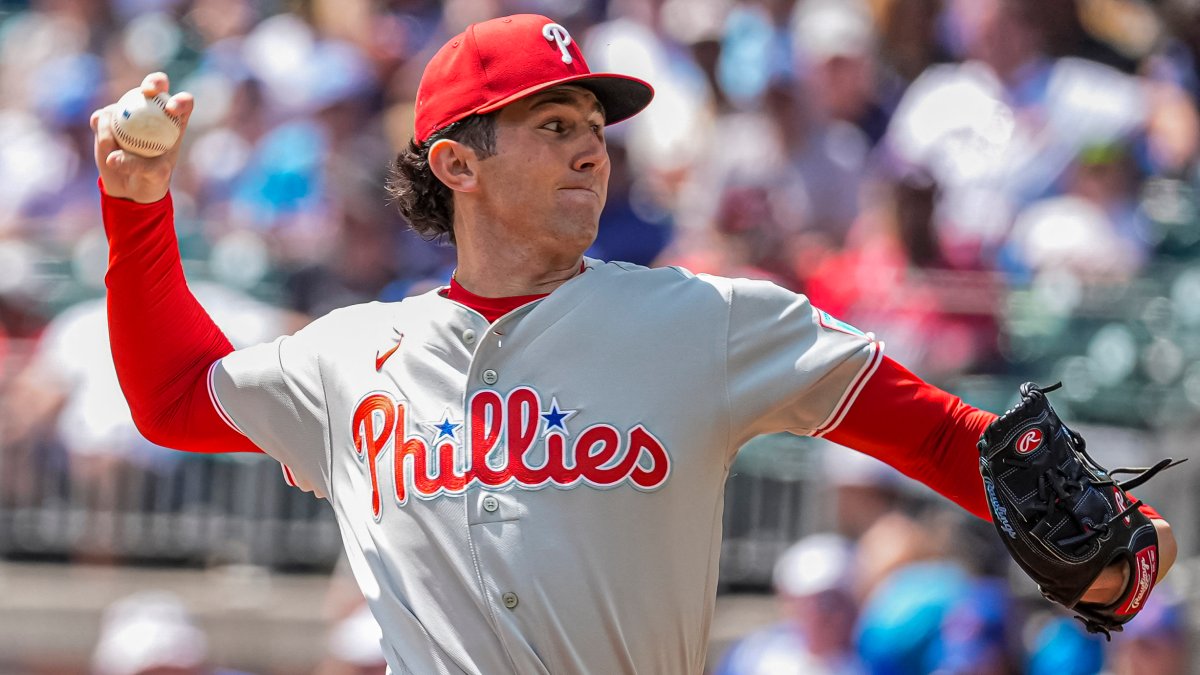
Andrew Painter’s path back to the Phillies was supposed to answer whether he could help their rotation down the stretch.
Nine starts into his second major league stint, he has done that — and created another question in the process.
If the Phillies get where they want to go in October, what is the best way to use him?
Painter has a 3.58 ERA and 1.15 WHIP since returning on July 31, holding opponents to a .690 OPS, the 11th-lowest mark among qualified starters over that span.
It has been a drastic turn from his first 14 major league outings, when he posted a 7.06 ERA, 1.66 WHIP and allowed a .901 OPS.
The stuff has changed, as have the results.
Painter spent time in the minors after being demoted in June, working on the shape of his four-seam fastball. The pitch has carried noticeably more ride since his return, averaging 18.2 inches of induced vertical break in one recent start after sitting much flatter earlier in the season.
Its velocity hasn’t gone anywhere, either. Painter has reached 99.6 mph with the four-seamer this season.
During his first stint, hitters missed on just over 10 percent of their swings against the fastball. Since his return, that number has climbed to just under 22 percent. The added ride makes it harder for hitters to get on top of the pitch, while his hard changeup gives him another offering that can come out of a similar tunnel before separating late.
It’s a much more complete repertoire than the one hitters faced earlier in the year.
The Phillies aren’t making October plans for Painter just yet. Don Mattingly made that clear when asked recently whether the rookie could eventually be deployed differently in the postseason.
“We don’t want to put the cart in front of the horse,” Mattingly said on Sunday.
He and president of baseball operations Dave Dombrowski have more immediate business to handle with the Phillies still trying to secure a postseason spot and position themselves once they get there.
Still, Mattingly didn’t dismiss the possibility.
“I think we have to look at all options,” he said. “Try to put your best guys together.”
Painter isn’t attached to one, either.
“I trust what this organization wants,” Painter said. “I’m bought in on whatever they want, so if that’s something that’s gonna help the team win, I’m willing to do it.”
If the Phillies get there, there are a few ways that could look.
THE RANGER ROLE
The most intriguing possibility might be turning Painter into a gun for hire.
Stay ready. Don’t attach him to a particular inning or even necessarily a particular start. When an October game reaches the point where the Phillies need one of their best arms, use him.
They’ve done it before.
Ranger Suárez became exactly that type of weapon during the Phillies’ 2022 run. He started Game 3 of the NLCS, then returned two days later to record the final two outs of the pennant-clinching Game 5. In the World Series, Suárez recorded two critical outs in relief in Game 1 before coming back four days later to throw five scoreless innings as the Game 3 starter.
Painter could give the Phillies a right-handed version of that flexibility.
Maybe a starter runs into trouble in the fourth inning and they need someone capable of taking the game through the sixth. Maybe they have a lead and don’t trust the middle of the bullpen with the most dangerous part of an opposing lineup. Maybe Painter works two innings in one game and remains an option to start later in the series.
His improved fastball makes the shorter bursts particularly interesting.
Painter wouldn’t need to manage his workload for five or six innings or worry about seeing a lineup for a third time. He could be focused on just two or three outs.
Painter has already thought about what that could feel like.
“I’d be able to rear back a little bit and let it eat a little bit more,” he said. “I’m sure velo would tick up a little bit. We’ll just be able to empty the tank early.”
That is essentially the Ranger role — don’t worry about defining the job before the series. Have one of your better arms ready when the game tells you it needs him.
THE FOURTH STARTER
The simplest option remains letting Painter do what he’s doing now.
Start.
He wouldn’t enter a three-game Wild Card Series as one of the Phillies’ first three rotation options. But advancing out of that round creates an entirely different puzzle because rest, usage and the opponent suddenly matter more than a regular-season rotation order.
The Phillies have dealt with that before. In 2022, they considered leaving their No. 4 starter off the Wild Card roster altogether so he would remain available to start Game 1 of the NLDS if the Wild Card Series went the full three games.
Painter could find himself in a similar opening.
It doesn’t necessarily have to be the fourth game of a series. Depending on how many Wild Card games the Phillies play and which starters they use, their fourth arm could be needed almost immediately in the next round.
Matchup and familiarity could become part of the calculation, too.
Aaron Nola, who’s throwing the ball well right now as well, has years of postseason experience and would likely own the trust advantage if both pitchers were available on equal rest. But October pitching decisions aren’t always as simple as lining up a depth chart. How recently has an opponent seen Nola? How many times has it faced him? Has it seen Painter at all? Which repertoire provides the better matchup?
Painter’s second stint has at least made that a legitimate conversation.
If his next few starts continue on the same track — especially with sharper command — there may be no need to get particularly creative.
THE PIGGYBACK
There is a third possibility that falls somewhere between giving Painter his own start and waiting to deploy him as a Ranger-style stopper.
Build a game around two pitchers from the beginning.
The Phillies did exactly that last October against the Dodgers.
Facing elimination in Game 3 of the 2025 NLDS, they started Nola but never intended to treat it like a conventional start. Nola attacked the Dodgers as if he only needed to see them once, facing eight hitters across two scoreless innings before Suárez took over to begin the third.
Suárez handled the bulk from there, allowing one run over five innings in an 8-2 Phillies win.
It was a planned one-two punch rather than a reaction to a starter struggling.
The Phillies could create something similar with Painter.
Left-hander Nestor Cortes presents one possibility if he’s built up enough by October. The veteran left-hander is only beginning to stretch back out, pitching an inning Tuesday with Single-A Clearwater and another Saturday with Triple-A Lehigh Valley.
Stylistically, the contrast would be difficult to miss. Cortes can disrupt timing with deception, angles and a completely different velocity band before handing the game to Painter’s upper-90s fastball and power changeup. The Phillies could also reverse them depending on the opposing lineup, allowing Painter to attack early before changing the look completely.
Nola could theoretically be part of a piggyback again, too. His current trajectory makes another intentionally abbreviated start less obvious than it was last October, when he entered that Dodgers game coming off an injury-riddled regular season. But the precedent is key.
They don’t have to make any of these decisions yet, though.
Painter still has two starts left in his regular-season rookie campaign. Cortes is still building up. The Phillies still have to earn their way into October before deciding how the pitching staff should look once they get there.
If they get there, they are no longer wondering whether Andrew Painter can help them.
They can decide how.