
What the data shows
OYO also monitors whether young people in residential facilities have access to education. Residents attend school on the facility grounds, with a curriculum governed by the local school district. However, the 2025 OYO placement data shows that young people are increasingly being placed further away from Philadelphia.
The report shows that only 33% of youth are placed within Philadelphia or 10 miles of it, a considerable decrease from 52% two years earlier. Meanwhile, 57% were placed 50 miles or more from Philadelphia, up from 37% in 2023.
With the shift in location and school district, it can often take months for youth to be placed in a steady public school program. Johnson said the gap in education negatively affects a child’s development and confidence. Additionally, she notes that moving young people far from Philadelphia can also sever connections to their previous schools.
Data collection is a core part of the OYO’s work, and they publish their data and survey reports annually. During visits to facilities, Johnson and her team began collecting information not traditionally tracked. They asked young people about their religious background, sexual orientation and gender identity.
“A lot of people look at age, race, and gender, and that’s it. But in our first year, we started looking at religion, and we started noticing that the majority of the young people in the facilities that we were going to were Muslim,” she said.
It was through this process that the OYO found that some Muslim residents were not provided with the accommodations they needed to practice their faith, including access to prayer rugs, Qurans and kufis. In one facility, Johnson’s team worked with leadership and a community partner to provide those materials to young people in time for Ramadan.
For Johnson, the experience showed the value of asking questions that traditional data collection can miss. By learning more about how residents identify, OYO was able to pinpoint needs that otherwise might have gone unnoticed. “We had to learn that through the facilities, and then we began to act on it,” she said.
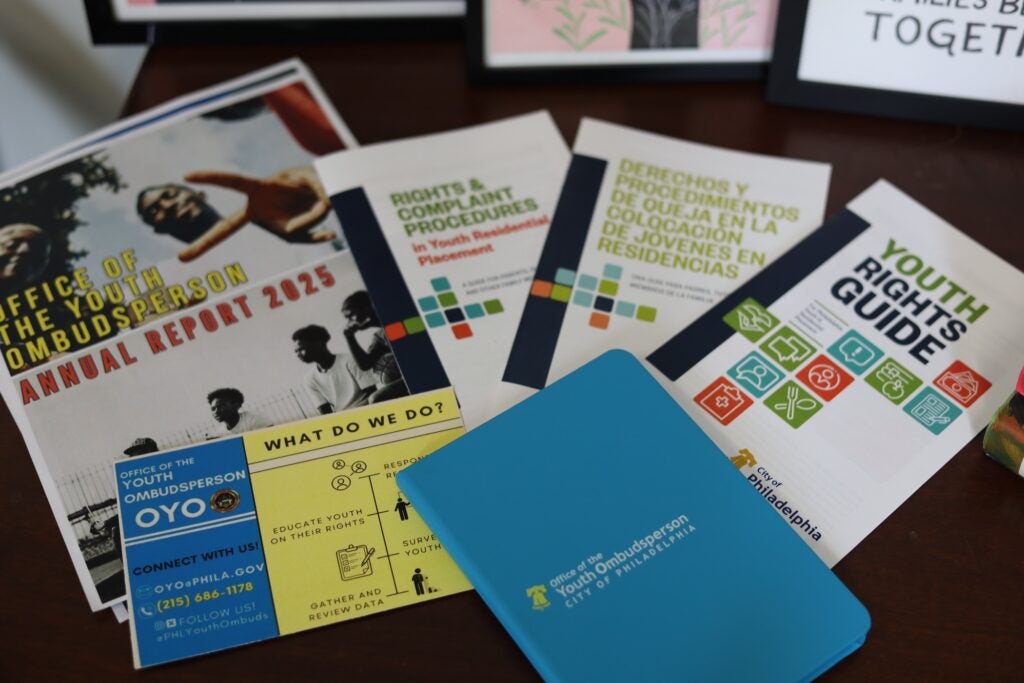 Resources provided to young people by the Philadelphia Office of the Youth Ombudsperson.(Rana Rastegari/WHYY)
Speaking up to spark change
In her three years as youth ombudsperson, Johnson has found that young people in residential facilities sometimes believe speaking up won’t change anything.
That sense of powerlessness and lack of agency is not unique to young people in residential facilities. Nationally, half of Americans age 18-29 say that people like them have no say in what the government does.
But Johnson and her team try to counter that belief by showing residents that their complaints can lead to change. Sometimes, Johnson said, young people later recognize that speaking up helped improve conditions for their peers.
In instances where residents at Philadelphia Juvenile Justice Services Center have raised concerns about seclusion, where a child is locked in a room for an extended period, OYO worked with DHS on changes intended to reduce its use.
Johnson said young people who have since moved to other facilities have told OYO staff that they noticed a decline in the use of seclusion. Staff then tell them their complaints helped bring about that change.
“That was our advocacy,” she said.
OYO’s reach, however, is limited by its budget. Johnson leads a four-person team with a $500,000 annual budget and “that barely covers our salary,” she said. “There’s so much more that we could be doing if we had the right capital investment in our work.”
OYO also wants to consult former residents to advise the office on changes they wish to see in the system. Sagastume, however, notes the importance of being able to “pay them a livable wage,” which is not possible given OYO’s current budget.
“If we had a budget of 1 million, 1.5, 2 million, we [could] start to build out a process of having a Youth Action Board or a Youth Advisory Committee,” Johnson said.
Johnson said the stakes extend beyond conditions inside residential facilities. When young people repeatedly speak up and see nothing happen, she said, they can come to believe that participation itself is pointless, leading to a lack of civic engagement and voter apathy.
“Sometimes you hear young people [say], ‘What’s the point of saying anything? No one’s going to do anything about it,’” Johnson said. “And we get to be the people to prove that wrong.”
Editor’s Note: This story is part of a series on Youth Civic Engagement funded by the William Penn Foundation. WHYY News produces independent, fact-based news content for audiences in Greater Philadelphia, Delaware and South Jersey.