
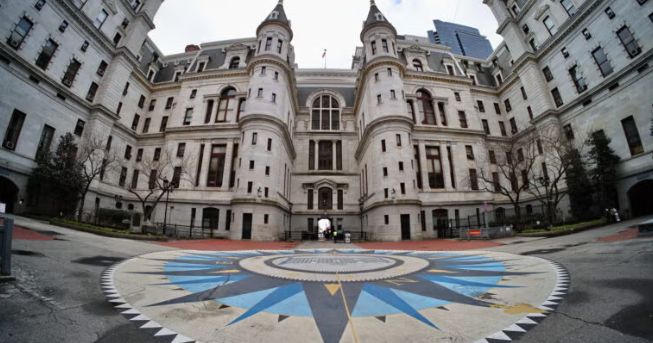
This is the second of two parts. Part I examined what three decades of change meant for the people who live in Philadelphia and found a city stronger by many measures, but one whose gains have reached neighborhoods and residents unevenly. Part II turns to the five mayors who governed during those years, examining what each inherited, what each changed, what survived after they left City Hall and why some of Philadelphia’s oldest problems have endured through every administration.
The names on the second floor of the Philadelphia mayor’s office may have changed over the past three decades, but some of the problems have not.
Ed Rendell (1992-2000) inherited a city flirting with insolvency. John Street (2000-2008) entered office to find some neighborhoods marred by abandonment; Michael Nutter (2008-2016) soon confronted a recession. Jim Kenney (2016-2024) found a growing city where deep poverty remained stubbornly entrenched, then governed through a pandemic. Cherelle Parker took charge in 2024 of a Philadelphia enjoying its strongest financial footing in generations, with a public increasingly impatient to see that strength reflected in life beyond City Hall.
Each tried, in his or her own way, to make Philadelphia safer, financially stronger, more attractive to employers and residents, and better able to deliver for neighborhoods that had spent years waiting for improvement.
Jay McCalla, who managed housing policy under Rendell and later served as a deputy managing director under Street, has seen those approaches up close enough to question how much the policies and programs pursued by successive administrations changed the conditions Philadelphians experienced in their neighborhoods.
His criticism is rooted in something less glamorous than skylines and credit ratings: whether government works equally well for the people who live here. He argues that Philadelphia has spent billions of dollars and cycled through administrations promising change, yet residents still do not receive the same level of basic city services from one neighborhood to another.
He points to street sweeping and drain cleaning as simple examples of services he says remain unevenly distributed, while larger infrastructure improvements have moved too slowly or not at all.
“Services from the city, that is, street sweeping, drain cleaning, things like that, the basic services are still not distributed equally in the neighborhoods,” he told the Tribune.
The Rendell rescue

Ed Rendell
Kevin Feeley, Rendell’s deputy mayor for communications, remembers January 1992 as almost unimaginable by today’s City Hall standards. Philadelphia was days away from missing its payroll.
The Rendell administration could dream of development later. First, it needed a functioning government.
Rendell cut costs, battled municipal unions, repaired Philadelphia’s access to credit, and sold the city with an energy that became inseparable from his political identity.
Center City became a centerpiece. The Convention Center, Avenue of the Arts, and the hospitality economy helped shape a downtown strategy whose fingerprints remain visible.
Richardson Dilworth, professor and head of Drexel University’s Department of Politics, recognizes both sides of that legacy. “His focus was downtown,” Dilworth said. “The quality of life was uneven.”
Stephen P. Mullin, principal at Econsult Solutions Inc., and a former Philadelphia finance and commerce director under Rendell, remembers an administration trying to reverse more than a budget crisis. The city was losing residents and jobs, and its ability to compete with surrounding communities had eroded.
The fiscal rescue gave later mayors something Rendell lacked when he arrived: room to argue about where government should invest rather than whether it could pay its bills.
Street work
John Street arrived at City Hall promising to direct more of the city’s attention and resources beyond Center City and into residential communities struggling with abandoned houses, vacant lots and years of disinvestment.
His Neighborhood Transformation Initiative became the physical embodiment of that promise, targeting abandoned and blighted properties and preparing land for redevelopment.
McCalla ran it. “We demolished tons of houses,” he recalled.
John Street
Joyce Wilkerson, Street’s former chief of staff and a former president of the Philadelphia Board of Education, remembers collaboration as central to the administration.
Wilkerson described collaboration and a sustained focus on communities outside Center City as hallmarks of the Street administration.
“He went into the neighborhoods and got kids off the streets, and his Neighborhood Transformation Initiative was a game changer,” Wilkerson said.
The initiative addressed a problem that had tormented Philadelphia for decades, she said pointing to empty, deteriorating buildings dragged down entire blocks, endangered neighboring properties, and advertised the city’s population loss in brick and plywood.
Clearing them helped create land suitable for development, she noted.
Years later, land that once attracted little private interest became increasingly valuable. In communities such as Point Breeze and Brewerytown, where disinvestment and vacant properties had long been part of the landscape, developers began competing for property, home values climbed, and longtime residents increasingly confronted the other side of neighborhood revival: whether they could afford to remain as the places they had lived through the lean years became desirable to newcomers.
Pedro A. Ramos, president and CEO of the Philadelphia Foundation and a veteran of the Street administration, views the broader movement toward neighborhood investment as part of Philadelphia’s improved livability.
Street helped attack the Philadelphia of abandonment. His successors would increasingly confront the Philadelphia of affordability.
Nutter, ethics and a recession
Michael Nutter arrived after campaigning on ethics, government reform, public safety, and a greener Philadelphia.
Lauren Cristella, president and CEO of the Committee of Seventy, credits the Nutter years with lasting ethical reforms, some developed in partnership with the Committee of Seventy. His Greenworks Philadelphia plan advanced sustainability deeper into city government, she said.
Michael Nutter
Sheila Simmons-Winstead, who served as communications director and press secretary for Nutter’s reelection campaign and later became chief of staff to state Rep. Malcolm Kenyatta, remembers another change: Philadelphia’s attitude toward itself.
The city, she said, shed some of its “inferiority complex” toward New York and other major cities and developed a stronger swagger on the national and international stage. Philadelphia became a reliable destination for major events, from the papal visit (2015), national political conventions (2016) and to major Parkway concerts.
“Nutter helped spark some of that,” Simmons-Winstead recalled.
Nutter also entered office promising to change a political culture in which government contracts, campaign contributions and access to City Hall had become recurring sources of public suspicion. Cristella credits his administration with strengthening ethics rules and restrictions on pay-to-play practices while pushing City Hall toward greater openness and transparency.
Public safety produced another consequential Nutter decision: the hiring of Charles H. Ramsey as police commissioner.
Simmons-Winstead said Ramsey’s experience and stature gave residents, city leaders, and police officers greater confidence in the department’s leadership. She believes his influence remains visible across parts of the department today.
“No matter the mayor, I think Philadelphia is a city that benefits from public safety structures that revolve around the community,” she said. “It’s still a city of neighborhoods.”
One measure of Philadelphia’s progress is difficult to dispute: fewer murders. The city recorded 562 homicides in 2021, the deadliest year in its modern history. By 2024, the number had fallen to 269, and in 2025 Philadelphia recorded 222 homicides, the fewest since 1966 and a decline of roughly 60% in four years. The improvement has continued in 2026, with homicides again running well below the previous year’s pace.
Labor wars
Nutter’s relationship with municipal labor grew particularly bitter. For five years, District Councils 33 and 47 worked without contracts. In March 2013, union protesters packed the City Council chambers, blew whistles, and drowned out Nutter as he attempted to deliver his budget address.
The contracts were eventually resolved without retroactive raises for the years when workers had gone without them.
The labor battles left scars, but Nutter’s tenure also became associated with an effort to restore confidence in City Hall after years in which corruption investigations had damaged Philadelphia’s political reputation. An FBI listening device discovered in Mayor John Street’s office in 2003 exposed a sweeping federal investigation into pay-to-play politics involving city contracts, campaign contributions and politically connected figures. Street was never charged, but the investigation ultimately produced roughly two dozen convictions, including that of City Treasurer Corey Kemp, and helped make government integrity a defining issue in the 2007 race to succeed him.
Nutter ran directly at that history, promising tighter ethics rules, greater transparency and a City Hall where businesses would not have to wonder whether political contributions or connections were the price of getting government work.
Kenney builds pre-K
Jim Kenney entered office with poverty near the center of his agenda.
Jim Kenney
Joseph Gidjunis
Jane Slusser, Kenney’s first chief of staff, considers PHLpreK the administration’s most tangible legacy. Launched in 2017 and funded by the Philadelphia Beverage Tax, PHLpreK provides free prekindergarten to Philadelphia 3- and 4-year-olds, regardless of family income or employment status, through participating early-childhood education providers across the city.
“Without a doubt, PHLpreK was the most impactful policy that directly affected Philadelphians,” Slusser said.
Building PHLpreK required Kenney to win one of the defining political fights of his first term: passage of the Philadelphia Beverage Tax. The levy on sweetened drinks provided the money to expand free prekindergarten while also supporting Rebuild, the administration’s effort to renovate parks, recreation centers and libraries across the city.
Kenney’s education agenda went further. His administration helped return the School District of Philadelphia to local control after nearly 17 years under the state-created School Reform Commission and substantially increased the city’s financial contribution to the district. At the same time, agreements with municipal unions helped strengthen a pension system that had burdened Philadelphia’s finances for decades.
COVID emptied downtown offices, crippled restaurants and tourism, disrupted schools, and battered city finances. Shootings and homicides soared.
Kenney’s second term became inseparable from crisis, most notably the opioid epidemic which his administration had already declared a public health emergency and launched the Philadelphia Resilience Project, bringing 35 city offices and agencies together to confront conditions in Kensington and Fairhill. The effort cleared major encampments, expanded access to treatment and housing services, increased police patrols and targeted drug trafficking, overdoses, homelessness and the trash and discarded needles that had overwhelmed parts of the neighborhood. The city later created an Overdose Response Unit to continue that work, while Kenney supported overdose prevention sites as another way to reduce deaths.
As shootings and homicides climbed, Kenney turned to the Roadmap to Safer Communities, a five-year violence-reduction strategy combining law enforcement with a public-health approach, community programs and services aimed at people considered most at risk of shooting or being shot.
His administration added Group Violence Intervention in 2020, offering employment and social services while warning those driving violence that continued shootings would bring focused law-enforcement attention. As the bloodshed worsened during the pandemic, the administration and City Council sharply increased spending on violence prevention.
Kenney’s battles with the Fraternal Order of Police became another defining feature of those years, particularly after the 2020 protests over police violence. His administration sought changes to police discipline, arbitration, residency requirements and the commissioner’s authority over officers.
A 2021 arbitration award gave the city some of what it wanted, including changes intended to make police discipline more transparent and accountable, but the relationship between the mayor and the union remained deeply strained.
The bargaining table
Every mayor eventually discovers that some of City Hall’s most consequential battles are fought at the bargaining table.
Rendell confronted workers while attempting to rescue a nearly insolvent government. Street endured prolonged negotiations. Nutter’s fights with organized labor became deeply personal. Kenney restored a more labor-friendly relationship.
Parker received her turn in July 2025 when District Council 33 workers walked off the job. Trash accumulated, and public facilities closed.
The strike ended with a contract that provided a 15% wage increase over its term, a $1,500 retention bonus, and a $20 million infusion into the union health and welfare fund.
Greg Boulware, president of AFSCME District Council 33, did not emerge jubilant when the tentative agreement was reached on July 9, 2025, ending an eight-day strike by roughly 9,000 city workers.
“The strike is over, and nobody’s happy,” Boulware said as he left the negotiations. “We felt our clock was running out.”
Under Pennsylvania law, police and firefighters cannot strike, so unresolved contract disputes go to binding arbitration.
Parker’s visibility
Parker did not enter City Hall confronting the financial emergency that greeted Ed Rendell in January 1992, when Philadelphia was near bankruptcy, shut out of the credit markets and scrambling to find enough cash to meet payroll. Instead, she inherited a city government on far stronger financial footing, but with a different kind of pressure: residents wanted that stability to translate into cleaner streets, safer neighborhoods, more affordable housing and city services they could see and feel where they lived.
Cherelle Parker
Violence was beginning to decline dramatically. Philadelphia was heading toward the nation’s 250th anniversary, major sporting events, and a global spotlight.
Parker has made visibility central to her governing style: neighborhood cleanups, public appearances, aggressive promotion of Philadelphia, and a promise to deliver a safer, cleaner, greener city.
Parker’s big bet
Housing is where she has placed one of her biggest bets.
Her H.O.M.E. initiative is a $2 billion multiyear effort to create or preserve 30,000 housing units, backed in part by $800 million in city bond authorization.
The scale reflects how dramatically Philadelphia’s problem has evolved.
Rendell and Street governed a city littered with houses no one wanted, while Parker now governs a city where too many people cannot afford the houses everyone suddenly wants.
Parker inherited that housing market, and her administration has placed a $2 billion bet on where it goes next.
Jesse Lawrence, who heads Philadelphia’s Department of Planning and Development, points to the mayor’s Housing Opportunities Made Easy (H.O.M.E.) initiative as the administration’s answer to both sides of Philadelphia’s housing problem: creating more places to live while helping existing residents hold onto their homes.
The four-year initiative seeks to build, preserve, or restore 30,000 housing units and includes $800 million in housing bonds. Its reach extends from new construction and first-time homeownership to repairs on aging houses, assistance for small landlords and programs intended to prevent residents from losing homes that have been in their families for generations.
The numbers already attached to some of those efforts illustrate the scale of the need. More than $20.1 million in Basic Systems Repair Program work was completed in 2025. Restore, Repair, Renew has closed 650 loans and invested $21.3 million in homeowners’ repairs. Turn the Key, which uses publicly owned land to produce homes for income-eligible first-time buyers, approved 117 applications in 2025.
A house worth roughly $90,000 in 2000 had become worth $265,000 two decades later. Homes worth $100,000 or less, once roughly half of Philadelphia’s housing market, have become exceedingly difficult to find.
Parker’s housing record cannot be measured the way Rendell’s, Street’s, Nutter’s, or Kenney’s can. Her administration is still in the middle of its attempt.
What can be measured is the city Parker found when she became mayor: financially stronger and considerably more expensive than the Philadelphia of three decades earlier. Home prices had risen in every neighborhood, incomes had failed to keep pace with housing costs, and nearly half of the city’s renters were spending at least 30% of their income on housing. Philadelphia had become a more valuable city, but for many of its residents, living in it had also become more expensive.
What’s next
The five administrations did not simply replace one another. Each left something on the next administration’s desk.
Rendell left a government capable of borrowing and investing again. Street attacked abandonment on a massive scale. Nutter strengthened ethics and fiscal discipline. Kenney expanded pre-K, rebuilt public facilities, and returned schools to local control before COVID transformed his second term.
Parker inherited pieces from each of the four.
But Simmons-Winstead is less convinced that Philadelphia’s comeback reached everyone who endured its decline. She points particularly to longtime residents who stayed through years when jobs disappeared and neighborhoods struggled, only to find themselves confronting a city where housing and other everyday costs have risen sharply.
Some of the numbers support her concern. More than 300,000 Philadelphians remain below the poverty line, and nearly half of the city’s renters spend at least 30% of their income on housing. For residents who lived through the city’s leanest years but have not shared equally in its recovery, Simmons-Winstead said, the struggle can still amount to “trying to keep their heads above water.”
Most agree that a mayor can inherit a crisis, attack it, reduce it, or leave Philadelphia far stronger than it was before. The next mayor still receives an inheritance, and Parker received perhaps the strongest of the modern era.
What she passes on will be hers.
“Sometimes we wanna cheer. Sometimes we wanna throw snowballs at Santa Claus,” Slusser deadpanned, referring to Eagles fans who once pelted Santa with snowballs during halftime of a home game.
Stay informed and connected — subscribe to The Philadelphia Tribune NOW! Click Here