
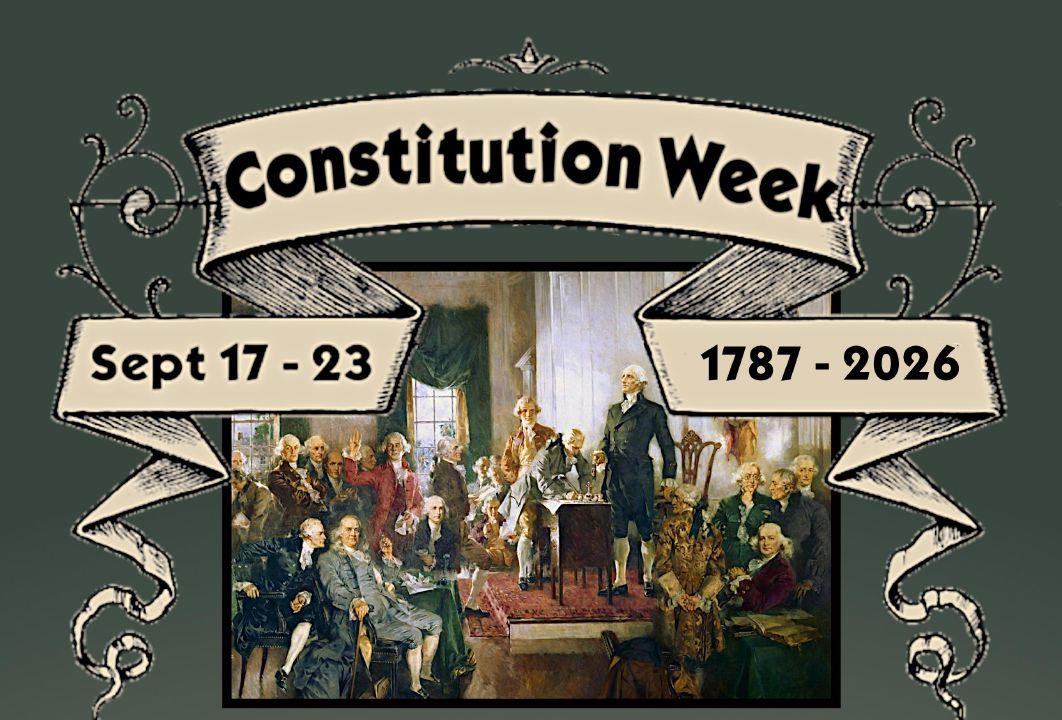
Guest column: US Constitution, from Philadelphia to the world
Published 7:35 am Wednesday, September 16, 2026
The US Constitution was signed on September 17, 1787, at Independence Hall in Philadelphia, Pennsylvania. Two hundred and thirty nine years later, we continue to celebrate our nation’s most significant political document during Constitution Week every September 17-23rd.
What makes our Constitution so special, is in the time it came into being, the world was ruled by absolute monarchies, traditional empires, and various types of aristocracies or oligarchies. Our founders wanted something different. They created a revolutionary document that says the government should be of the people, by the people, and for the people. At the time the document was adopted, it was certainly the exception, not the rule.
It was said by one of our founders — Thomas Jefferson, that our country was embarking on a “great experiment” in republican democracy. It would prove that man is capable of ‘living in a society governing itself, by laws self-imposed and securing to its members the enjoyment of life, liberty, prosperity, and peace.’
Our nations people were liberated from tyrannical rule, while ensuring individual freedom and limiting the government’s power. Checks and balances created a stable political environment that allowed for massive economic, technological and cultural growth. The US Constitution protects essential civil liberties like freedom of speech, assembly, and religion, while also setting a global standard for what a free society should look like.
Many emerging democracies during that time borrowed specific core elements directly from the Philadelphia model. Several countries across Latin America, Asia, and Europe adopted constitutions directly or partially modeled after the US Constitution. The combination of personal liberty and democratic governance serves as a powerful model, inspiring democratic movements and human rights advancements across the globe.
The US popularized the idea of putting all fundamental laws into one supreme, written document. Before 1787, most nations relied on unwritten traditions, scattered royal decrees, or parliamentary supremacy (like the British model), where ordinary laws could change fundamental rights at any time.

The US flipped this by making the Constitution the “Supreme Law of the Land.” Ordinary laws passed by a legislature must align with the written constitution, and if it conflicts, it is struck down.
Today, most countries in the world use a single, written constitution based on this American innovation.
The system of dividing government into distinct legislative, executive, and judicial branches, became a cornerstone of modern democracy because of how the US Constitution put it into practice. The concept was originally dreamed up by the French philosopher Montesquieu, but the US was the first nation to actually build a working government around it.
One of America’s most widely exported political innovation is the presidential system. By creating a single executive leader who derives their power directly from the people and not from a parliament, the US offered an entirely new blueprint for national leadership. Some 40-50 countries now practice a full presidential system while many others have systems that include a Prime Minister sharing the responsibilities of foreign and domestic affairs.
Many nations have adopted the separation of powers, splitting power between legislative, executive, and judicial branches, but most have unique circumstances. Federalism, where states or regions share power with a central national government, has also shown to be a popular prospect. There are between 25-28 countries that are formally recognized as federations.
The Bill of Rights contained in the Constitution, serves as the world’s pioneer blueprint for safeguarding individual freedoms from government overreach. By explicitly writing down a list of fundamental, inalienable rights, the US introduced a revolutionary concept that inspired constitutional draftsmen globally for over two centuries.
The US Constitution served as the primary global model for modern constitutional republics after its creation and continues to this day.
Rachel Nordenhök is Bend Constitution Week Committee Chair for the National Society Daughters of the American Revolution.