
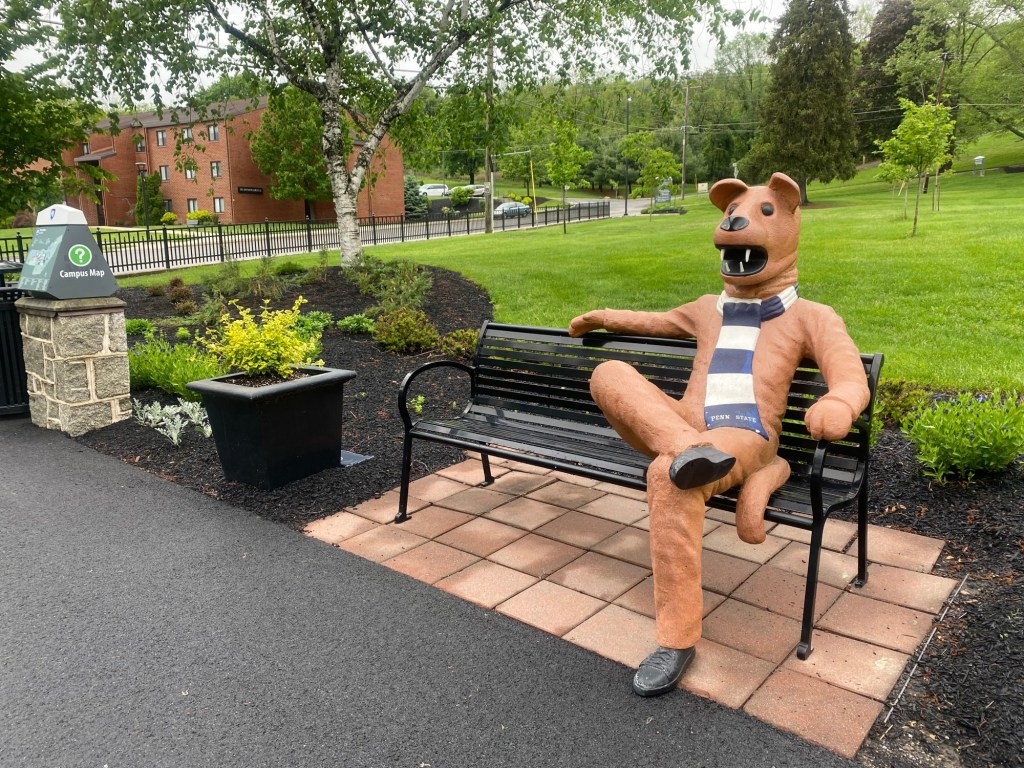
With a campus closure on the horizon, enrollment at Penn State campuses in Northeastern Pennsylvania have fallen in the last year, according to recently released university statistics.
Pennsylvania State University published its annual report on its fall enrollment statistics on Oct. 29. It showed the size of the enrolled student body as of fall 2025 was 86,557, marking a 1.6% decrease from fall 2024. The report also implies that Penn State enrollment has decreased approximately 3.7% from its fall 2020 enrollment.
Undergraduate enrollment in fall 2025 decreased year-to-year by 1.3%, while graduate enrollment fell 3.2%, law school enrollment fell 8.8% and medical school enrollment remained unchanged.
The fall 2025 enrollment at the Penn State Commonwealth Campuses, which are its campuses located away from the State College main campus and situated throughout the commonwealth, decreased 5.7% from fall 2024 to 21,931 students. The Commonwealth Campus student body has in fact fallen monotonically, dropping each of the last five years since fall 2021. University statistics imply the aggregate five-year decrease in Commonwealth Campus enrollment is around 17.4%.
This fall in enrollment has been especially precipitous at Penn State Wilkes-Barre. That campus, located in Lehman Twp., saw its enrollment drop from 329 students in fall 2024 to just 232 in fall 2025 – making for a proportional annual decrease of 29.5%. The campus enrolled its largest student body over the last five years in fall 2022 with 368 students, meaning its current enrollment is down 37% from its five-year peak; and enrolled its smallest student body in fall 2021 with 314 students, meaning its current enrollment is down 26.1% from even its second lowest point of the last five years.
With its student body so severely diminished, Penn State Wilkes-Barre now stands as the least attended of all Penn State Commonwealth Campuses, dropping below Penn State Shenango in Mercer County. It is also the second-least attended of all Penn State campuses, coming in above only Penn State Great Valley, a small graduate school located in Chester County.
The steep fall in the Penn State Wilkes-Barre enrollment is perhaps unsurprising given the campus’s impending closure. In May, the Penn State Board of Trustees voted 25-8 to close Penn State Wilkes-Barre, alongside six other Commonwealth Campuses, by the end of the spring 2027 semester.
Other Penn State campuses in Northeastern Pennsylvania, including Penn State Hazleton, Penn State Schuylkill, and Penn State Scranton are to remain open – and their enrollment has followed more of a mixed trend.
According to the Oct. 29 university report, Penn State Hazleton, located in Sugarloaf Twp., had a fall 2025 enrollment of 504 students. This marks a 2.1% from the campus’s fall 2024 enrollment of 515, but an increase of 3.7% from its fall 2021 enrollment total and a 6.6% increase from its fall 2022 total.
Penn State Schuylkill, located in Schuylkill Haven had a fall 2025 enrollment of 653 students. While that makes for an annual decrease of 6.4%, the enrollment is still 9.9% greater than its five-year trough of 594 students.
Penn State Scranton, conversely, has seen its enrollment monotonically decline over the last five years. The campus’s fall 2025 student body, standing at 744, has decreased 10% from fall 2024 and 21% from fall 2021, when it enrolled almost 200 students more than it does now.
While the university has slated Penn State Wilkes-Barre for closure, it has committed itself to “strategic, long-term investments” in these other three Northeastern Pennsylvanian campuses, according to a Penn State web page laying out its plans for the future of the Commonwealth Campuses.
Addressing plans for the Commonwealth Campuses, Fotis Sotiropoulos, the university’s executive vice president and provost, emphasized what he said was Penn State’s commitment to offer an accessible education to students statewide. He also noted that 78% of Commonwealth Campus students are Pennsylvania residents, 20% are from underrepresented backgrounds, and 38% are first-generation college students.
“Through targeted recruiting strategies and other initiatives designed to promote enrollment, we will continue to provide a Penn State education and experience to students across the commonwealth,” Sotiropoulos said in a university news release issued Oct. 29 to accompany the enrollment report.
The vote to close Penn State Wilkes-Barre and continue supporting the other three was pursuant to a university report that detailed structural issues facing a number of the Commonwealth Campuses. These issues included declines in enrollment, escalating operation costs, anemic state funding growth, and a shrinking high school population from which to recruit students. It said other colleges were buffeted by similar trends, citing the 2021 Pennsylvania State System for Higher Education consolidation and last year’s closure of the University of the Arts in Philadelphia. (Several other colleges in the Wyoming Valley, such as Wilkes University, have also warned of a coming, nationwide “demographic cliff” in which the small potential applicant pool could present increasingly vexing challenges for colleges across the country.)
The enrollment crisis at the Commonwealth Campuses, the report said, began in 2010 and has accelerated over 15 years. Aggregate Commonwealth Campus enrollment declined since fall 2014, by about 8,000 students, or 26%. That decline was even sharper at the 12 reviewed campuses, falling 35% since 2014 and 51% since 2010.
Penn State President Neeli Bendapudi had initially shared the report raising concerns about the future of the Commonwealth Campuses privately with university trustees. After the report leaked to several press outlets, Bendapudi said she had intended to keep the report private until the Board of Trustees ratified the planned closures of the state-related university’s campuses.
The university said after its closure announcements that students enrolled at Penn State Wilkes-Barre or another Commonwealth Campus slated for closure will be allowed to complete their degrees if they can satisfy the relevant academic requirements by the end of the spring semester 2027. Those students can also transfer to another Commonwealth Campus, They will not, however, generally allowed to transfer to University Park.
Students enrolled in a four-year degree program at a closing campus will also receive a grant compensating them for any tuition or fee discrepancy between their old and new Commonwealth Campus. The university said the grant will be available for a period of three years or until the student graduates (whichever comes first).