

Remember when you couldn’t walk down a Pittsburgh sidewalk without stepping over a spotted lanternfly?
In 2023, the insects coated tree trunks, clung to buildings and dive-bombed pedestrians. Pittsburghers stomped them on sidewalks, scraped egg masses from trees and watched them gather in astonishing numbers.
Three summers later, try finding one.
The spotted lanternflies haven’t disappeared, but 2026 is shaping up to be what Julie Urban, an associate research professor of entomology at Penn State, calls an “ebbing year” around Pittsburgh. Scientists have several possible explanations for the change, including depleted food resources, predators, pathogens, weather and the natural rise and fall of insect populations. But no single culprit has emerged.
“We don’t have a full picture,” Urban says.
Pittsburgh really is having a quieter year
Earlier this summer, there was still a chance Pittsburgh’s lanternflies were simply running late. As adults mature, they become more mobile and gather around favored plants, Urban says, which can make insects that were relatively inconspicuous earlier in the season suddenly difficult to miss.
But now, in mid-September, that late surge hasn’t materialized. A Penn State colleague who recently made two trips to Pittsburgh saw fewer lanternflies than in previous years. They are certainly still here — Urban’s colleague collected roughly 150 adults from the sites she visited in a single day — but they remain far less conspicuous than during Pittsburgh’s lanternfly boom years. At this point in the season, Urban doesn’t expect that picture to change dramatically before winter.
The pattern has precedent. Urban remembers similarly quieter years in Berks County around 2021 and 2022, following much heavier lanternfly years.
David Outomuro, a biology professor at the University of Pittsburgh, sees a possible explanation in a familiar ecological phenomenon: an “overshoot and die-off” cycle. Fast-growing populations can become so large that they exceed what their environment can support and then fall sharply.
“The population grows so fast that it quickly runs out of resources and collapses,” Outomuro says.
A collapse doesn’t necessarily mean extinction, he notes, and Pittsburgh’s lanternflies are still here. Boom-and-bust patterns occur in many species, Outomuro says, particularly those that grow and reproduce quickly.
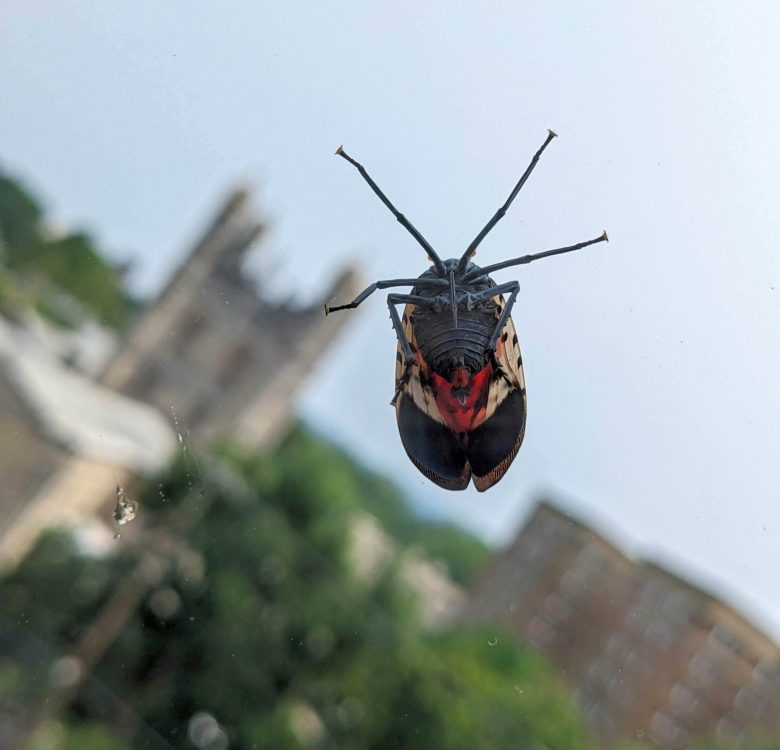 The underside of an adult spotted lanternfly on a sixth-floor window in Pittsburgh, August 2023. Photo courtesy of Wikipedia Commons.
Did they eat themselves out of house and home?
If Pittsburgh’s lanternflies did overshoot their resources, their favorite food may be part of the story.
Spotted lanternflies have a close relationship with Tree-of-Heaven, itself an invasive species and a familiar sight along Pittsburgh roadsides, vacant lots and other disturbed spaces. Outomuro says many Trees-of-Heaven died during the height of the lanternfly boom, anecdotal evidence that raises the possibility that the insects damaged one of their preferred resources.
But lanternflies can feed on numerous secondary hosts, including maples, Outomuro notes, so losing Tree-of-Heaven doesn’t leave them without food.
Urban says resource depletion is one hypothesis for the quieter years researchers have observed in Pennsylvania. Heavy lanternfly feeding may have depleted resources in local trees, she says, although the connection has not been systematically studied.
There is also a simpler possibility: This may be what insect populations do.
“With any insect, there are boom years and years where there are relatively fewer insects,” Urban says, pointing to Japanese beetles as an example. “Populations naturally cycle.”
Are Pittsburgh’s predators catching on?
Food isn’t the only factor that may be affecting lanternfly numbers.
Outomuro points to research showing that two native fungi species can cause mass mortality in spotted lanternflies. He also cites Penn State research documenting numerous predators feeding on the insects.
Tree-of-Heaven may shape those interactions, too. Outomuro cites research by Penn State scientists Anne Johnson and Kelli Hoover showing that lanternflies accumulate toxins when they feed on Tree-of-Heaven but not when they feed on a secondary host. Their experiments found that insect predators did not appear particularly deterred by whether lanternflies had been raised on Tree-of-Heaven or another host.
Longer-lived animals could become more accustomed to the newcomer as well. Birds and mammals can exhibit “dietary neophobia,” or a reluctance to try unfamiliar foods. Outomuro says repeated exposure to lanternflies over several summers could conceivably change those preferences.
“Being exposed to this new food season after season might have shifted some of those preferences,” he says.
Insect predators are different, Outomuro says, because their shorter lifetimes give them less opportunity for that kind of learning. Generalist predators may simply be more likely to use lanternflies as another food source.
Weather adds another variable. Outomuro says extreme conditions, such as very cold winters, can compromise the survival of eggs and young nymphs, while unusually long periods of warm weather could extend the insects’ growing and reproductive season.
 Photo by Tracy Certo.
How do you count a bug that’s always moving?
The problem with declaring that Pittsburgh’s lanternfly population has “crashed” is that there are no standardized counts showing exactly how many were here at the 2023 peak and how many remain in 2026.
Citizen reports do show fewer sightings, but Urban says they are a shaky way to compare the two years. When lanternflies first appeared in large numbers, people noticed the unfamiliar insect and were often alarmed enough to report it. Three years later, “people almost get somewhat used to them,” Urban says, and may see little reason to keep reporting an insect the state already knows is established.
Urban says she isn’t aware of standardized population data for Allegheny County that could fill that gap.
“If we knew how to measure that decline, we’d be measuring that decline,” she says.
Part of the difficulty is defining the population itself. Lanternflies move throughout their life cycle, and Urban says researchers don’t have a good approximation of the full range an individual may cover. Once the insects are established across a broad area, it becomes difficult to determine where one population stops and another begins.
Formal estimates are possible, Outomuro says, but would require long-term monitoring because lanternfly numbers fluctuate and the insects have a lengthy growing season.
No, they didn’t all move west
Another tempting explanation is that Pittsburgh’s lanternflies simply packed up and moved west.
That isn’t how the expansion works, Outomuro says. Spotted lanternflies are continuing to expand their range westward, but that does not mean the insects that crowded Pittsburgh in 2023 migrated en masse to the next place.
“This doesn’t mean that the lanternflies in the city are simply moving west,” he says. “The species is simply expanding their distribution range in the country.”
Instead, Outomuro sees Pittsburgh following a pattern observed in places colonized earlier: arrival, a population boom and then lower densities.
“What we have experienced is the arrival of the lanternflies to a new environment, a boom in their population and now a decrease in it,” he says.
He points to southeastern Pennsylvania, where lanternflies also boomed before densities subsequently remained lower. Based on that pattern, Outomuro doesn’t expect Pittsburgh to see another explosion on the scale of 2023, though he cautions that longer-term data are needed.
Urban says that even if Pittsburgh makes it through fall without anything approaching the numbers seen in 2023, she would not call it a significant population decline. Without measurements or evidence of a mechanism, she cannot distinguish such a decline from ordinary year-to-year variation.

The research is following the damage
That uncertainty partly reflects where researchers have been able to collect long-term data. With limited funding and personnel, Urban says, she and her Penn State colleagues have focused much of their work on vineyards, where grapevines are particularly vulnerable to lanternfly feeding and the economic stakes are greatest.
They are returning to the same vineyard sites over multiple years to track population fluctuations. This fall, Urban is particularly watching the number of egg masses laid in the highly vulnerable grape-growing region around Erie.
Pittsburgh has no comparable record. Urban says she doesn’t believe anyone has systematically sampled egg masses here. Starting now would provide a baseline for future years, but it couldn’t reconstruct what was happening at the height of the 2023 invasion.
Urban says researchers are also considering how to measure factors such as weather and host-plant health alongside lanternfly numbers, with some of those measurements potentially beginning in the coming year.
For the moment, fewer lanternflies is good news. Outomuro says lower abundance means less concern about ecological and agricultural costs, although the insects remain established here.
Pittsburghers, apparently, are less concerned.
Outomuro says he hasn’t heard many people asking where all the lanternflies went.
“I think many people are just happy they are not a nuisance anymore.”