
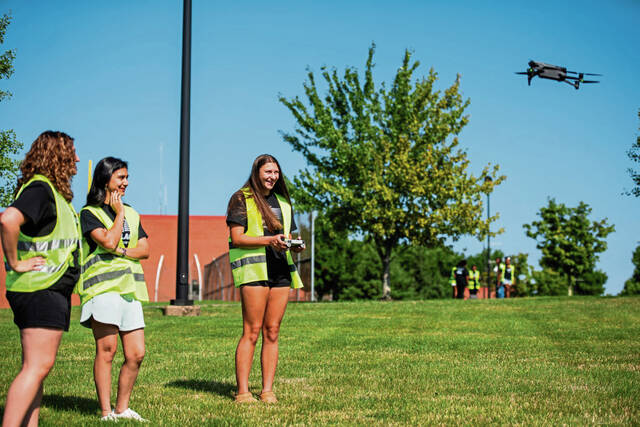
After-school programs in Allegheny County are including more STEM lessons than ever before, but access to those activities remain a challenge to many families.
A report released by Allegheny Partners for Out-of-School Time, or APOST, found that 92% of parents say STEM lessons are offered in their child’s after-school programs, an increase from 76% in 2014. Half of those parents say their child is engaged in a STEM lesson after school at least twice a week, the report said.
STEM stands for science, technology, engineering and math.
“I was really excited to see how programs are integrating STEM activities,” said Karen Dreyer, executive director of Allegheny Partners for Out-of-School Time. “High-quality STEM activities are about problem-solving, testing hypotheses and making sense of conclusions. Those are skills young people can use throughout their life.”
But the remaining gap in access is what Dreyer calls the “greatest disappointment.”
Nearly four in five Allegheny County children whose parents want after-school programs for them are not enrolled, the report said. That amounts to 92,451 children total.
“We must continue to work on that,” she said. “We must continue to say all kids need these bright spots, and continue to make sure all kids get access to high-quality, STEM learning.”
Accessibility, affordability and availability are the barriers families face when enrolling their children in after-school programs, said Nikki Yamashiro, vice president of research for the Afterschool Alliance, a national nonprofit. Yamashiro led the study.
“The next priority is expanding access,” Yamashiro said. “That will take a concerted effort from public and private institutions. Supply hasn’t been able to keep pace with the demand for programs.”
Nationally, children in families with low incomes are less likely to have multiple exposures to STEM in afterschool each week than those whose families have higher incomes, the report said. Less than half of parents with lower incomes reported their child engaging in STEM in afterschool multiple times per week, compared to 56% of parents with middle incomes and 60% of parents with high incomes.
In Pennsylvania, financial backing for afterschool programs through state funding has increased through the Building Opportunity Through Out-of-School Time program.
Since 2024, the state has awarded $23 million to after-school and summer programs across the state through that fund. Most recent awards include $500,000 to the Duquesne City School District, $282,000 to the Penn Hills Library, $33,500 to the Pittsburgh Community Science Workshop and roughly $333,900 to the Dragon’s Den, located in Homestead.
Local and state financial investments in after-school programs is the best place to fill accessibility gaps, Dreyer said. Across political affiliations, support for public funding for afterschool programs is 86% or higher, the report said.
“Programs are doing a really good job, but the report points to places where more can be done,” Yamashiro said.
Preparing the local workforce
Top locations of after-school STEM programs happened in schools, nonprofit organizations, the Boys & Girls Club and libraries, the report said.
Exact lessons vary: 89% offered math, 83% science, 81% engineering, 79% computer science and 78% technology, the report said.
That’s critical, especially with Pittsburgh’s workforce growing in robotics, health and technology fields, Dreyer said.
“Given what our region is known for, kids in our region need to access learning from national and international experts,” she said. “Right now, it is all about AI, and how we help young people know how to use it. We want to make sure AI is a tool and not taking over for thinking so they still get cognitive development.”
After-school programs provide an outlet for children to collaborate with each other and problem-solve, outside of a traditional, structured school setting, Dreyer said.
“One of the unique values of after-school programs is that they let kids engage in learning, making mistakes and learning from mistakes,” Yamashiro said.
The report said five in six parents in Allegheny County said afterschool programs help children gain skills and interest in STEM. It highlighted Tree Pittsburgh’s youth programs in environmental education and the benefit of trees in communities.
Joe Stavish, director of education at Tree Pittsburgh, said in a statement that the increase in support for STEM afterschool activities is exciting.
“It shows us that children’s learning styles have changed and that our program’s hands-on, interactive approach to STEM learning for youth is valuable to our communities, allowing them to gain real-life job skills for potential career paths that they may not have known existed,” he said.
The increased programs come at a time where more studies have been released raising alarms about electronic screen use and its impact on children. The American Psychological Association reports that spending too much time on screens may cause emotional and behavioral problems in children.
After-school STEM programs can provide an alternative. Dreyer said those programs may still include screen time, but are interactive with other people. Parents can also encourage their children to use electronics in “public spaces” in the home, where family members can see and hear what’s happening on the child’s device. They can have conversations about what the child is doing online, she said.
“Like all things, it’s the Goldilocks principle — what’s ‘just right,’ ” Dreyer said. “We know a lot of STEM is hands-on, experimental and creating something.”