

SCRANTON — Sharp increases in demand for housing in Lackawanna County intensified pressure on the market’s aging and limited supply in recent years and exacerbated affordability challenges for low-and-moderate-income households, renters, first-time buyers and seniors, a voluminous new study on the county’s housing needs found.
Commissioned by the county, the Greater Scranton Chamber of Commerce and the Greater Scranton Board of Realtors, the study by The Institute highlights those and other local challenges but also offers a wealth of recommendations aimed at bolstering supply, improving affordability and addressing housing barriers.
Officials and stakeholders hoping to tackle housing hurdles collaboratively see the nearly 250-page study as a blueprint for strategic action to improve the local housing landscape and expand homeownership opportunities for families and residents.

Lackawanna County Commissioner Thom Welby addresses a comprehensive study on the county’s housing stock on Wednesday, Sept. 23, 2026 at the Lackawanna County Government Center in Scranton. (CHAD SEBRING/STAFF PHOTO)

Lackawanna County Commissioner Chris Chermak addresses a comprehensive study on the county’s housing stock on Wednesday, Sept. 23, 2026 at the Lackawanna County Government Center in Scranton. (CHAD SEBRING/STAFF PHOTO)

Lackawanna County Commissioner Bill Gaughan addresses a comprehensive study on the county’s housing stock on Wednesday, Sept. 23, 2026 at the Lackawanna County Government Center in Scranton. (CHAD SEBRING/STAFF PHOTO)

Chris Fahy, political field representative for the Pennsylvania Association of Realtors, discusses a comprehensive study on the county’s housing stock on Wednesday, Sept. 23, 2026, at the Lackawanna County Government Center in Scranton. (CHAD SEBRING/STAFF PHOTO)

Lackawanna County Commissioner Thom Welby listens to a presentation about a comprehensive study on the county’s housing stock on Wednesday, Sept. 23, 2026 at the Lackawanna County Government Center in Scranton. (CHAD SEBRING/STAFF PHOTO)
Show Caption
1 of 5
Lackawanna County Commissioner Thom Welby addresses a comprehensive study on the county’s housing stock on Wednesday, Sept. 23, 2026 at the Lackawanna County Government Center in Scranton. (CHAD SEBRING/STAFF PHOTO)
“You talk about the opportunities to grow wealth, and the strongest and most consistent piece of that for individuals trying to raise themselves up from lower income … situations is a house,” Chamber President and CEO Bob Durkin said Wednesday at an event unveiling the study. “We think about our parents, right? The most important thing they owned was a house, and so we have to make sure those opportunities are continuing for the next generations. And this study gives us a foundation to be able to do that.”
Among other challenges, an executive summary notes renewed demand for housing since 2020 — demand that followed decades of population decline and relatively stable housing costs — “placed mounting pressure on an aging and constrained housing system.” The county’s current housing stock is “poorly positioned” to meet demand driven by changes in household composition, population growth and shifting age demographics, “particularly growth among older adults,” per the study.
The housing stock itself is “overwhelmingly dominated by single-family detached homes,” many of them built before 1960 and requiring extensive work that can make the prospect of rehabilitation prohibitively expensive for would-be owners. The cost of lead abatement or major system upgrades, for example, often exceeds what moderate-income households can finance, making properties that seem affordable at purchase “functionally unaffordable.”
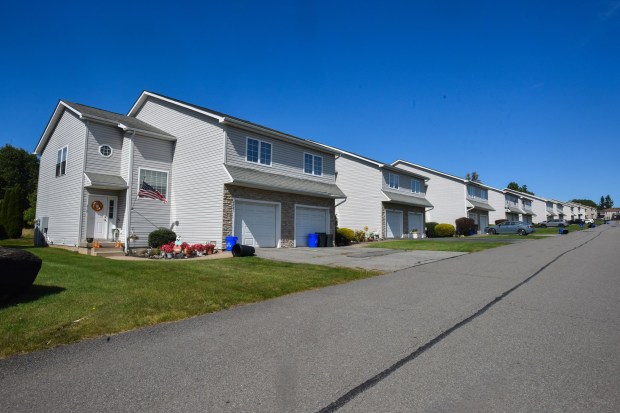 The Keyser Terrace townhomes can be seen off of South Keyser Avenue in Scranton Wednesday, September 23, 2026. (SEAN MCKEAG / STAFF PHOTOGRAPHER)
Limited supply of starter homes, competition, higher interest rates and insurance barriers associated with older homes also have forced many residents to remain renters for longer than they planned, with the housing assessment noting rising rents and limited options “disproportionately affect seniors, families with children, service-sector workers, and individuals with fixed or modest incomes.”
“Expanding pathways to homeownership and preserving starter home inventory will help these would-be and first-time buyers overcome barriers created by limited supply and rising costs,” it says.
New housing production also has been “limited and unevenly distributed across municipalities,” according to the study, which notes zoning patterns “strongly favor low-density, single-family development, while opportunities for duplexes, small multifamily buildings, and mixed-use housing remain scarce.”
It identifies “true multifamily zoning” as rare in the county and largely concentrated in Scranton and a “small number of boroughs.” Even where zoning permits higher-density development, infrastructure limitations, particularly sewer and water capacity, “often constrain feasibility.”
Among other recommendations, the study encourages officials to expand home repair, weatherization, lead abatement and similar programs to help preserve aging housing stock and to create or expand flexible financing tools for prospective buyers.
It also calls for the coordinated use of tax abatements and other incentives to encourage new housing construction, rehabilitation and development, and for zoning and land-use reforms allowing for more duplexes, multifamily housing and mixed-use residential development where appropriate.
Stakeholders who discussed the comprehensive report Wednesday emphasized the importance of collaborating to ameliorate issues it identified, and were receptive to the recommendation that they establish a task force of various partners to coordinate and advance strategies to improve the housing landscape.
“No one single government or organization or business or developer is going to be able to solve the housing challenges,” said Jill Avery-Stoss, president and CEO of The Institute. “It really all boils down to collaboration and coordination, so any strategy that’s going to be implemented successfully will be about bringing everyone to the table, and I think that’s already happening.”
Commissioner Thom Welby expressed a similar sentiment.
“Municipalities, developers, lenders, employers, realtors, nonprofits and community organizations need to work together,” he said. “Housing is more than a place to live. It’s connected to our workforce. It’s connected to our tax base, our neighborhoods and the future growth of Lackawanna County. This study gives us a roadmap to those ends. It’s now our responsibility to work together to turn these recommendations into action and make sure that Lackawanna County has housing opportunities for the people who live here today, but also for the people who we hope are going to call this their home in the future.”
The housing study is available online at lackawannacounty.org.