
This story continues our series and podcast, “Taking the Mic,” about women in Pittsburgh’s music industry. You can subscribe to the podcast on Spotify or Apple — and read the stories week by week at wesanews.org.
Click “Listen” above to hear INEZ’s interview with series creator Laura Fidalgo — or find it on Spotify or Apple.
Part of INEZ’s story was published in our September 10 series preview. Read it here.
For Pittsburgh R&B artist INEZ, everything about her formative years pointed toward a career in music. It just took a while for her to take the hint.
She grew up in a musical family in Pittsburgh’s Homewood neighborhood — a veritable incubator for Black Pittsburgh musical talent, from legendary jazz composer Billy Strayhorn to Broadway’s Billy Porter to 91.3 WYEP DJ and musician Clara Kent. INEZ’ mother, father and cousins all played instruments, sang and wrote their own music.
“We talk about nature versus nature,” INEZ explains. She benefited from both. “It was the environment. It was my genes and my genetics. [Music] literally shaped me.”
But if you’d asked a younger INEZ what she thought she’d do for the rest of her life, she wouldn’t have said music.
Kwabena Effah Raymond
/
INEZ
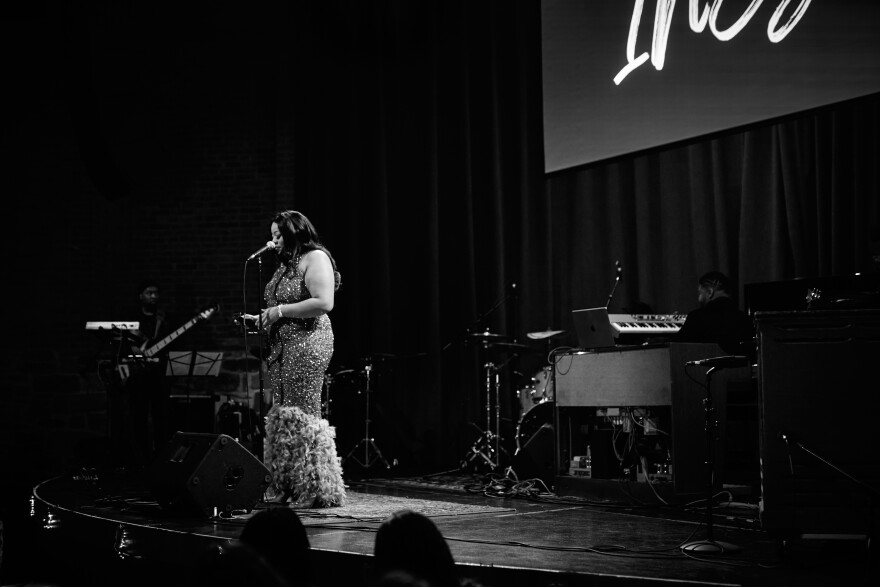
INEZ performing at Thunderbird Cafe for the show Soon as I Get Home
First, she wanted to be a chef. She recalls riding the bus through Downtown as a teenager, peering through the windows at Le Cordon Bleu, the French culinary institute that closed in 2012.
“You would see everybody at Le Cordon Bleu with their pastry containers or smoking a cigarette outside the school,” INEZ recalls. “And I was like, ‘You know what? I’ve always loved food and exploring food and flavors.’”
Then, she wanted to be an engineer. In high school, she became very active in the National Society of Black Engineers and resolved to study engineering, enrolling at the University of Pittsburgh to pursue her degree.
It was at Pitt that it finally dawned on her.
“You know those times when you’re doing a group project and there’s one person who’s just not pulling their weight?” INEZ says, recalling her Engineering I lab at Pitt.
Usually, she was a good project mate. But not this time.
“I’m holding this group back because I don’t think I’m supposed to be here,” she remembers thinking at the time. “ I’m trying to force this engineering thing, and it doesn’t feel like it’s supposed to happen for me.”
She realized what she really wanted was to pursue what had been in her and around her since her childhood in Homewood. Music had lived in her margins, but now she knew she wanted to be a musician.
These days, she’s a self-described “musical polymath,” with a degree from Berklee College of Music and an impressive range of vocal registers at her disposal. In one track, she can start a fight; in another, slip into a memoir of a song. She was named WYEP’s Pittsburgh Music Artist of the Year in 2020, and, earlier this year, headlined the Pittsburgh Cultural Trust’s America 250 program.
Artists deal with slights, infantilization and outright misogyny, but they find hope in underground spaces.
Despite her talent, technical skills and mounting list of awards and credentials, INEZ says she often deals with being underestimated as a woman musician. She recalls one sexist slight before a show several years ago, when a sound tech approached her as she was preparing for a show at Hartwood Acres.
“[He] was like, ‘Hey, do you know how to hold a mic?’ And he was serious. It wasn’t a joke,” INEZ says.
She remembers thinking, “I graduated cum laude from the Berklee College of Music in music production. I think I know how to hold a mic. But if you’re not sure about that, maybe I can show you.”
She had to tamp down her anger in order to perform.
INEZ, who is a light-skinned Black woman, says she has also felt frustrated by colorism, which compounds music-scene sexism. While she has booked shows with some of Pittsburgh’s marquee venues and most influential arts organizations, such as the Pittsburgh Cultural Trust and Thunderbird Café and Music Hall, she says it’s a privilege some of her darker-skinned peers do not have.
“ There’s so many people that look like me that should have access to the same things I have access to,” INEZ says.
But these frustrations don’t dampen INEZ’ creative output — or her belief in Pittsburgh’s potential as an inclusive, thriving creative community.
“We are capable of creating amazing things outside of just our sports teams,” she says.
“I want Pittsburgh to realize how beautiful Pittsburgh is.”
INEZ is working on a new album now, the follow-up to Voicemails and Conversations, released in 2019. And on her upcoming record, she’s going back to her roots, writing about the family that nurtured — and natured — her musical gifts to begin with. It’s an homage to her grandparents.