
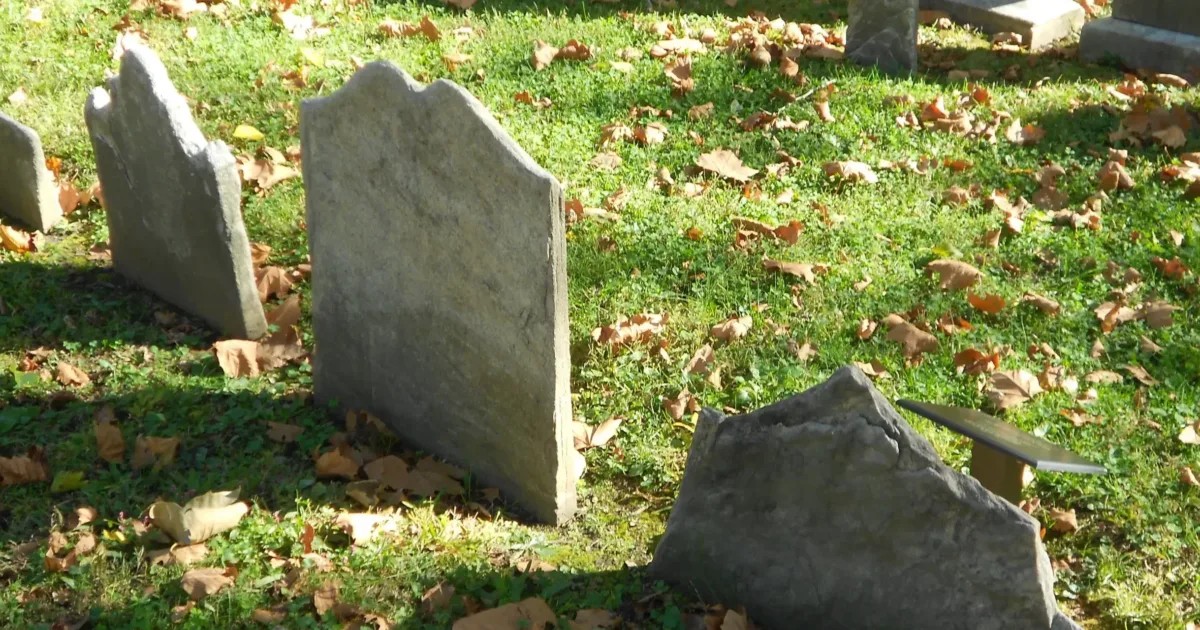
Is a cemetery a sacred space?
In today’s world, the answer to that question would be yes and no.
Yes, because the cemetery grounds contain the remains of people who used to walk the earth, and no, because to many people who describe themselves as atheist, a cemetery is just a collection of tombstones that sometimes resemble works of art. In other words, a memorial to those who have died but who are presently “nowhere.”
As one reader commented on a Reddit thread labeled, ‘Visiting graves as an atheist’: “No, I don’t think my sister who died is in some afterlife. She just isn’t around anymore. Her broken body is buried in the ground, and that’s all that’s left of her.”
Fantastic, now let’s have a party, meaning let’s raise a glass — “You might as well live,” as Dorothy Parker once stated — among some of Philadelphia’s most famous graves when Brew N’ History returns to Christ Church Burial Ground Oct. 2-4, 2026.
The Christ Church walking tour advertises five stops “with local craft beer samples paired with the historical figures and stories featured at each gravesite.”
When did the penchant for drinking beer in cemeteries align itself with the historic walking tour industry (HWTI)?
The HWTI has always been popular in the city: there are ghost tours, architectural tours, LGBT tours, colonial house tours, black history tours, garden tours, photography tours; in short, there’s a tour for every interest except, perhaps, tours of Kensington through drug-infested K and A.
As far back as October of 2015, Philadelphia Magazine published a story about a West Laurel Hill Cemetery event, “Beer barons to Homebrewers tour and tasting” under the title, “Hey, Wanna Get Drunk in the Cemetery?”
You might say, West Laurel Hill started this madness; this historic, beautiful cemetery (the extension of the original Laurel Hill, across the Schuylkill) has built a small money and publishing empire on the backs of its deceased citizens. You might call it a cemetery that has become obsessed with itself and its own fame: a cemetery that’s become lucrative cottage industry with a gift shop selling Halloween-style items like spider webs and human skull pillows to put on tombstones.
The Wildwood boardwalk comes to the cemetery!
How can one even begin to count the multiple books written about Laurel Hill? Every five years or so, another tome is published with a new twist on the same old theme. This is ingenious marketing, if nothing else. In the meantime, another Bala Cynwyd cemetery, Westminster, has failed to reach cult-marketing status, despite its being the burial place of Charles Hires, the inventor of Hires Root Beer, as well as James A. Bland (1854-1911), black minstrel show performer/songwriter who wrote “Oh, Dem Golden Slippers,” the theme of the Mummers Parade. Many Civil War commanders and Congressional Medal of Honor Awardees are also buried here.
I grew up near Memorial Park Cemetery in Frazer, Pennsylvania, a beautiful stretch of landscaped land, a cemetery without tombstones, that could double for a miniature Valley Forge Park. As children we were careful never to step on top of a grave there although when there are multiple graves crammed together that is sometimes impossible to do.
As a teen, I learned to drive in that cemetery. I regularly brought flowers to the grave of a family friend, an old woman with white hair my parents employed as a housekeeper and who converted to Catholicism in part because I showed her a long manuscript letter I received from Pope Pius XII in reply to a schoolboy scribble I mailed to Rome.
Memorial Park was a sacred space, although teens being teens it was sometimes used for untoward purposes, especially at night.
In 2024, I wrote a piece for Broad + Liberty about Har Jehuda Cemetery, a 27-acre Jewish cemetery on Lansdowne Avenue in Drexel Hill, Pennsylvania.
The cemetery was founded by Julius Moskowitz, a Russian Jew, in the 1890s as a burial ground for Eastern European Jews. A large portion of Har Jehuda borders the backyards of about fifteen row houses on Bond Avenue, the street where my father and mother began their married life.
In that piece, I mentioned how during one walk along the cemetery wall that bordered my house, I spotted an old woman kneeling by a tombstone:
“Her face was close to the earth; she wore a black scarf on her head and she was weeping copious tears. Curious, I studied her for a moment then walked away so as not to be noticed but when I returned a few minutes later, she was still sobbing. Not being able to feel or relate to that kind of pain at age five, I still felt a nagging, mild distress inside. The image of that old woman kneeling by a tombstone has stayed with me all my life.”
This basically sums up what cemeteries mean to me. They are sacred spaces, not party, picnic or beer hall venues for people in the prime of life who pay $25 to $40 in order to enjoy feeling sorry for the dead because they are unable to share in a cold brew because they’ve all turned to ashes or bones. The dead should not be viewed as morbid curiosities like a trip to Center City’s Mütter Museum.
So, you can keep your brew and suds graveyard walking tours, something that even AI takes a dim view of:
AI: You should avoid walking directly on top of graves, making loud noises, and littering when you visit a cemetery.
Keep quiet: Avoid shouting, loud laughing, or playing loud music from your car.
The dead, I believe, ought to be prayed for, not used as party favors in the name of “history.”