
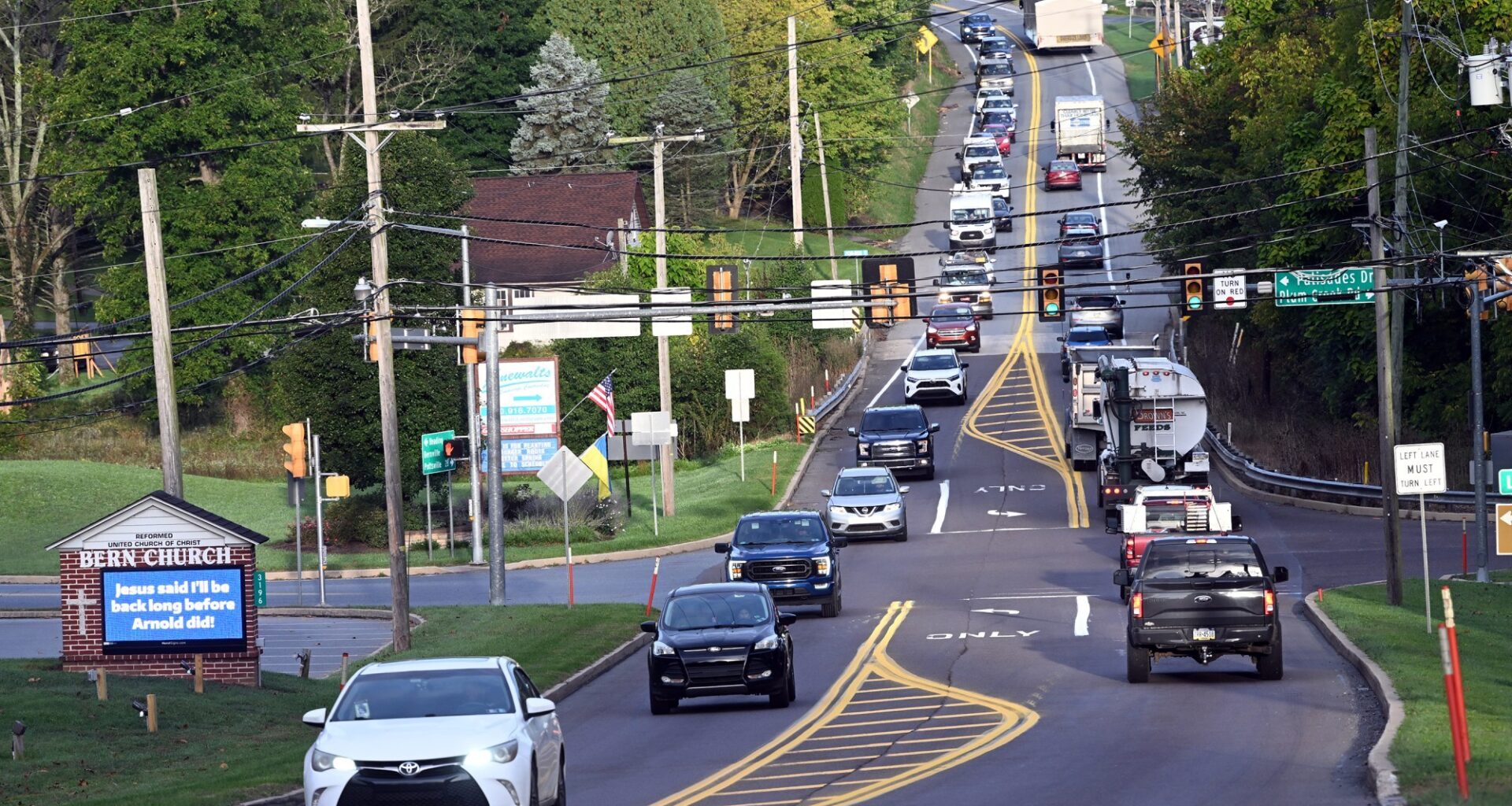
From downtown Reading where it becomes a one-way street to the steep slope of Blue Mountain in Upper Bern Township, the 22‑mile Route 183 corridor in Berks County couldn’t be more varied.
It carries an estimated 26,000 vehicles a day in its busiest section immediately north of the Route 222 interchange, according to PennDOT.
That section is notorious for bottlenecks during peak travel times because of its hourglass shape: the roadway expands to five lanes, narrows to two, then widens again approaching West Leesport Road before merging back to two. Eliminating that choke point is one of several projects PennDOT engineers are designing — but construction remains years away.
So do other major improvements aimed at traffic flow and safety along Bernville Road, as most of Route 183 is known north of Reading Regional Airport. That wasn’t the news many of the nearly 150 residents who filled the airport’s gate‑area seating Tuesday night wanted to hear.
The forum, hosted by state Rep. Eric Weaknecht, a Lower Heidelberg Township Republican, brought together PennDOT officials, county planners, state police, Bern Township police and municipal leaders.
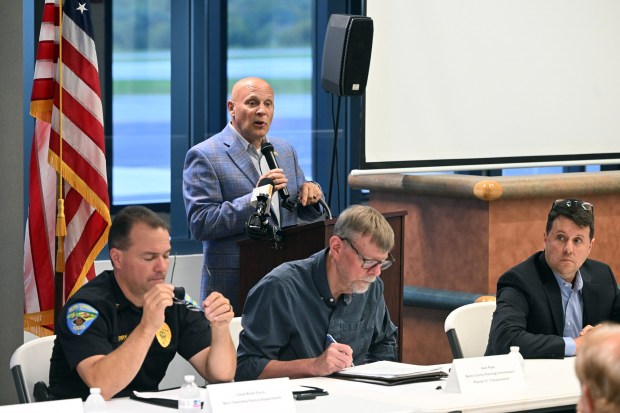 State Rep. Eric Weaknecht leads a public forum on Route 183 concerns at Reading Regional Airport on Tuesday, Sept. 22, 2026. Seated, from left, are Bern Township Police Chief Brett Forry, Berks County transportation planner Alan Piper and PennDOT consultant project manager Michael McGuire. (BILL UHRICH/READING EAGLE)
Weaknecht said he organized the event to cut through speculation and give residents direct answers.
“There’s a lot of rumors, there’s a lot of people not knowing what’s going on,” he said.
County transportation planner Alan Piper said the public interest on the topic is evidenced not only by Tuesday’s forum but by a 2022 forum put together by citizens. The 2022 forum at Penn-Bernville School in Penn Township actually caused transportation planners to reprioritize highway improvement projects in Berks, he said.
“We had some ideas for things that we wanted to do with this corridor back then, but they were kind of low-lying for us at that point in time,” Piper told the audience.
PennDOT projects outlined
PennDOT consultant project manager Michael McGuire walked residents through the slate of projects now in development. He noted that for years, most Berks highway funding has mainly focuses on Route 61 and Route 222.
“Going forward, corridors like 183 are going to get more of our attention,” he said.
One Route 183 project already underway — replacing the Schuylkill Avenue bridge over Norfolk Southern Railroad — began in 2023 and is expected to finish next summer. Aside from a major resurfacing job planned for next summer that will add edgeline and centerline rumble strips, McGuire said most significant work remains in the design phase.
In Upper Tulpehocken Township, two small bridges are slated for replacement, likely starting in 2029. Further south, PennDOT is planning several in Penn Township and Bernville, including a proposed traffic signal with turn lanes at Shartlesville Road near Penn‑Bernville School and a center-turn lane through most of Bernville.
Groans rippled through the crowd when McGuire mentioned a possible roundabout at North Heidelberg Road, just south of Bernville. PennDOT is also studying whether a traffic light or roundabout is appropriate at Route 183 and Old Route 22 in Strausstown, near the Interstate 78 interchange. That section sees about 10,000 vehicles a day.
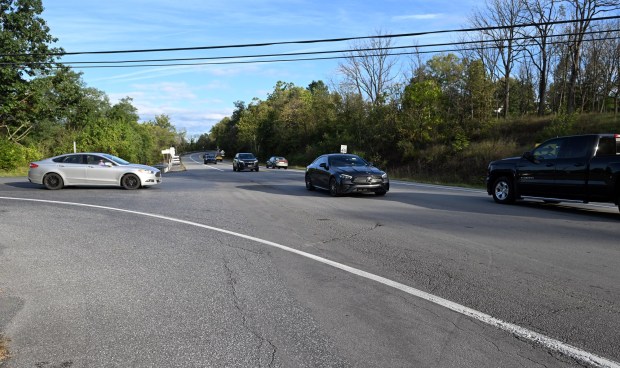 PennDOT is considering a roundabout at the intersection of Route 183 and North Heidelberg Road in Penn Township. Local residents say the speed and volume of traffic on Route 183 makes it difficult to pull out from North Heidelberg Road. (BILL UHRICH/READING EAGLE)
In Bern Township, PennDOT hopes to eliminate the bottleneck between the Route 222 interchange and West Leesport Road — the same hourglass section residents have long complained about.
“This project is essentially to correct that and keep a continuous four‑ or five‑lane section through there,” McGuire said.
He added that PennDOT will meet with township officials within two weeks to review findings from a recently completed study, but design work has not yet begun.
Altogether, Piper said, roughly $50 million in Route 183 projects are now moving through planning and design — a level of investment that didn’t exist a few years ago.
Residents push for immediate safety fixes
But long‑term plans didn’t satisfy many residents, who pressed officials on speeding, aggressive driving and illegal passing — problems they say make the corridor dangerous now.
One woman asked whether stop signs could be added at larger intersections.
“That would slow people down,” she said, drawing groans from the audience.
McGuire said stop signs would worsen congestion and increase rear‑end crashes.
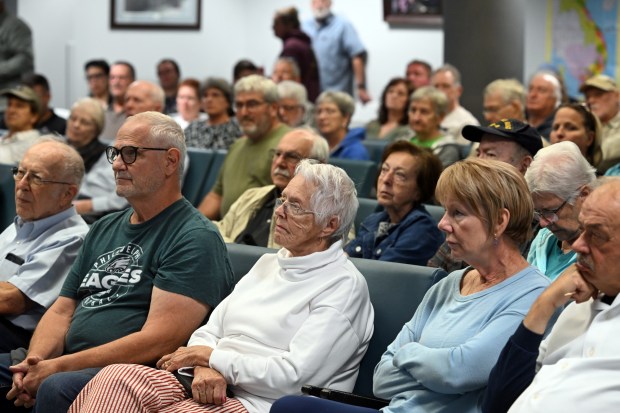 A large crowd turned out for a forum hosted by state Rep. Eric Weaknecht Tuesday night at Reading Regional Airport concerning traffic issues on Route 183. (BILL UHRICH/READING EAGLE)
She and others also asked about installing concrete median dividers like those on Routes 61 and 222 to prevent head‑on collisions. McGuire said such dividers aren’t appropriate for Route 183, a minor arterial road, because they would block left turns from driveways.
Bernville resident Patrick Dignan said the questions were valid, noting the difficulty of pulling out from Boyer’s Food Market.
“It’s not a simple solution, I get it,” he said. “But the primary thing is not congestion. It’s really speed.”
McGuire said next summer’s paving project — with rumble strips and updated guiderails — will help reduce crossover crashes.
Police detail enforcement challenges
Capt. Christopher Winesburg, commander of Pennsylvania State Police Troop L, said troopers patrol about 8 1/2 miles of Route 183 through Penn Township, Bernville and Jefferson Township. In that stretch, they have investigated 65 crashes so far this year, including one fatality. Last year, they handled 119 crashes and two fatalities. Speed remains the most common factor, he said, with impaired driving contributing to at least one fatal crash.
Troopers have tried to identify patterns — time of day, day of week, location — but no single pattern emerged, Winesburg said.
Only about four miles of the corridor offer safe pull‑off areas for traffic stops or commercial‑vehicle inspections, limiting enforcement options. Even so, troopers have conducted 107 traffic stops this year, issuing 115 citations and performing dozens of truck inspections.
Winesburg emphasized manpower constraints: Troop L’s Reading station has responded to 18,900 calls for service this year, including 761 crashes, making it difficult to assign troopers exclusively to Route 183.
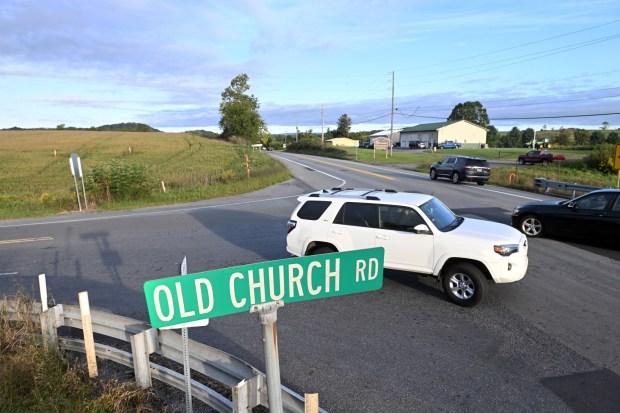 Route 183 through the Mount Pleasant area is difficult to cross by vehicle or on foot, residents say. (BILL UHRICH/READING EAGLE)
Bern Township Police Chief Brett Forry said his department faces similar limits but conducts targeted enforcement waves several times a year, funded partly through overtime. Bern Township covers about 5 1/2 miles of Route 183.
Forry said data from the township’s portable digital speed‑monitoring sign shows the highest speeds occur between 2 and 3 a.m., when traffic is light. The greatest volume of speeders appears during the morning and afternoon commute.
During an enforcement wave the week of April 13, officers issued 43 citations and 26 warnings; a second wave on Aug. 31 produced 47 citations and 13 warnings. Officers look for speeding, reckless driving, tailgating and illegal passing — behaviors residents repeatedly raised during the forum.
Forry acknowledged well‑known trouble spots, including the stretch near Wawa, and said township officers coordinate with state police and Penn Township police when possible. But staffing limits prevent sustained surges across the entire corridor.
“We do our best with the manpower that we have,” he said.