
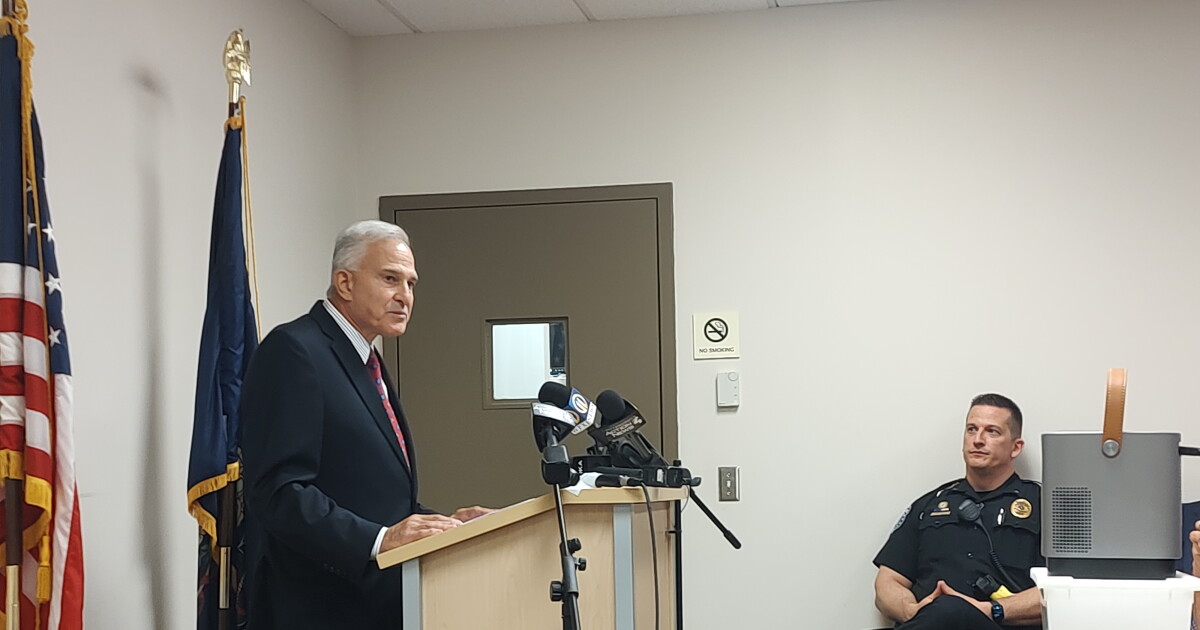
Allegheny County District Attorney Stephen A. Zappala Jr. met Friday with officials in Frazier Township, hailing progress it has made in improving road conditions around the troubled Pittsburgh Mills shopping mall.
But in a lengthy give-and-take with reporters, Zappala also made clear that officials in the administration of former Pittsburgh Mayor Ed Gainey still face a bumpy road ahead.
“We have charges, yes,” Zappala said. “People will be charged.”
Zappala’s remarks were his first public statement after the unsealing of a warrant application in a long-running investigation of the city’s financial and grant-making practices. The nine-page affidavit, which draws largely on testimony from City Council staff and foes of Gainey on City Council, alleges that under the administration, “procedures were being exploited” to fund favored groups — even as the administration sought to conceal mounting deficits.
But on Friday, actual charges still sounded a long way off. Zappala said his office expected two more “document dumps” from the city, and “[w]hen we’re done with them, we’ll go to the banks, and then we’ll go the targets.” The District Attorney’s office had not yet sought to speak with Gainey himself, Zappala said.
“We’re looking forward to that,” he added.
In the meantime, however, the affidavit itself has been a subject of intense debate. Gainey critics have seized on it as proof they were right to doubt him, while supporters have accused it of taking a kitchen-sink approach made up of scattershot allegations and factual errors.
Much of the document, which was used to secure a search warrant for city financial documents, concerned budgetary issues, such as Gainey’s decision to include revenue from a tax on professional athletes in financial projections while appealing court decisions that it was illegal. (The city ultimately lost its argument.) That approach was discussed at length in public at the time, and disputes about whether financial projections are too rosy are part of the give-and-take of any budget season.
When asked Friday whether he was at risk of criminalizing the kind of decisions politicians make all of the time, however, Zappala replied: “I think instinctively and given our experiences, we can pretty much eliminate strictly a political situation from something that may have merit criminally.”
“The city’s in bad shape, fiscally,” he said, referring to a potential $30 million deficit that current Mayor Corey O’Connor will have to reckon with at the end of the month, when he presents a draft spending plan for 2027.
The search warrant application is not a charging document: No one named within it has been indicted, let alone convicted. And the contents of the affidavit continue to be disputed by some of those named within it.
As WESA reported previously, for example, the affidavit names a law firm that it accuses of not compiling a telecommunications asset report for which it was paid — but WESA could find no record of such a contract, while the firm in question says it was never commissioned to carry out the task.
Other groups have also spoken out. On Friday, the progressive advocacy group Working Families Party rejected claims that it had shared an address with a politically powerful service workers’ union, and that it received donations from groups that had gotten funds from the Gainey administration.
The group said the allegations “are fairly obviously, completely false.” The group said it backed Gainey “for no reason other than that we felt he was the right choice.”
Zappala defended the accuracy of the affidavit Friday, saying any errors were addressed before the warrant application was submitted. Told of specific factual concerns, he said, “If people want to dispute that, we’ll see at the right time in the right way. We can argue about that.”
The application was sealed for months, due to what investigators called “a fear of retaliation, political or physical.” But the affidavit is largely based on information provided by City Council’s then-attorney, Dan Friedson, and City Councilors Anthony Coghill and Theresa Kail-Smith, who had been very public in their criticism of Gainey — often on topics identified as concerns in the report.
Asked what form the retaliation was expected to take, Zappala said his interest in sealing the affidavit had more to do with fears that “you’d tip off the target.” But he added that “when Coghill brought the issues that he brought to me to City Council, they stacked the room [with supporters of the grant program in a public meeting] and they called him a racist: ‘How dare you ask questions about the handling of these particular funds?’
Kail-Smith, he said, “was concerned about her safety and the safety of some of the staffers.”
Kail-Smith did not respond to a request for comment Friday; Coghill said he had “never” feared being subject to reprisal.
In any case, Zappala said that the search warrant “wasn’t even necessary” for the city to conduct its investigation. He said the probe began after concerns about the use of “p-cards,” essentially city-issued credit cards meant to be used to make smaller-dollar purchases. Use of the cards, and concerns about the city’s level of oversight on payments made with them, drew attention in 2024, when a city contractor later accused of engaging in anti-Israel vandalism, was paid with one.
Zappala said that when staff in his office sought documents related to the controversy, the Gainey administration demanded that they obtain a warrant first. That, Zappala said, spawned further scrutiny.
“The warrant’s not exciting or anything. It’s developed for purposes of … doing an accounting of the different funds that we think are at issue,” Zappala said. But “at some point, there are so many administrative problems and hurdles that the city was putting up, it didn’t make any sense.”
The affidavit released this week makes no mention of the p-cards, but Zappala said their use would resurface in the future “in a different way.”
“You guys will be fascinated by this, I’m telling you,” he said to reporters. “Stay tuned.”
Zappala also addressed his dispute with county officials about how best to address a projected $1.5 billion shortfall in the county pension fund. Zappala has sued the county over allowing the deficit to develop, and last week he called on current members of the county Retirement Board, which oversees the fund, to step down. He has also accused the board of longstanding ethical lapses that exacerbated the problem.
On Friday, he said that the county should speak with Harrisburg officials for help resolving the issue — an approach also backed by the pension board officials he criticized.
“We’re not coming together as a community on this pension issue,” Zappala lamented. He noted that many possible fixes — such as continuing a hotel tax and earmarking the revenue for a pension bailout, or putting the system under state management — would require action from Harrisburg.
But state leaders, he said, “are not hearing anything from the Allegheny County Caucus [of legislators] about this.”
Asked whether it helped the community to come together by urging that their leaders be removed from the pension board because they couldn’t be trusted, Zappala said, “You make a good point — if I thought they were benefiting us. I don’t see it.”
He accused pension board members of “scaring people and … scaring the hell out of the pensioners” with talk of potential tax increases to keep the system solvent. He said he urged them to step down because “if you don’t know what you’re doing, please get out of the way.”