
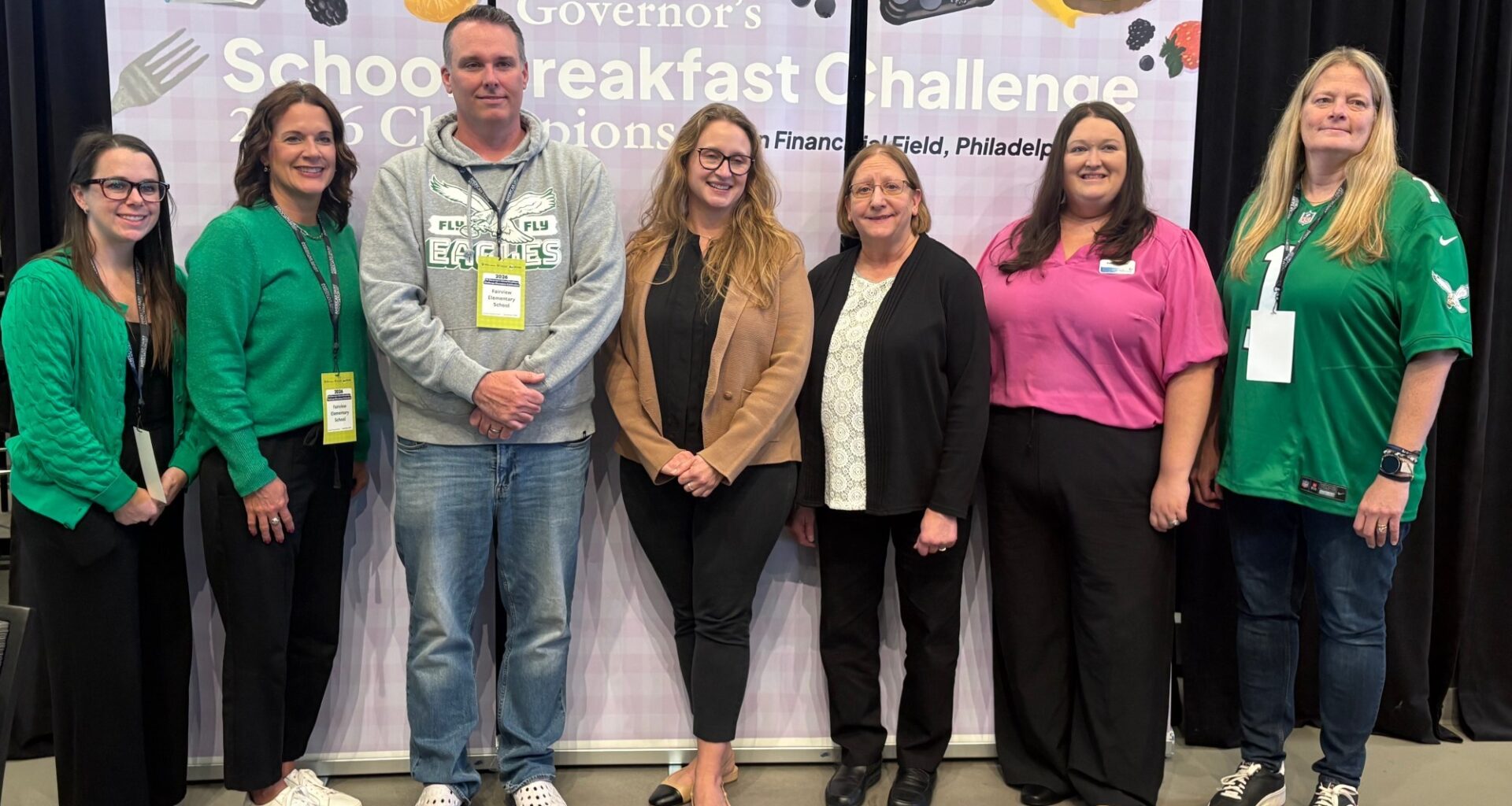
A bold approach to breakfast has won a Crestwood school praise from both the governor and the Philadelphia Eagles.
Fairview Elementary School was one of 10 schools honored at Lincoln Financial Field on Wednesday as the “Governor’s School Breakfast Challenge” champions. The challenge tasks schools to increase participation in their breakfast programs and include more nutritious foods on their menus.
Fairview Principal Sean McLaughlin said the recognition in Philadelphia reflected the value the school had placed on ensuring students are eating the most important meal of the day to “reach their highest potential.”
“That’s something that’s important for us here at Fairview, to have our kids start the day on the right note and having full stomachs and being ready to learn,” McLaughlin said. “Our teachers did an outstanding job with our students.”
The Nutrition Group is the service-management company that oversees the Crestwood breakfast program. Katie Galinsky, a Nutrition Group regional manager for Northeastern Pennsylvania, explained that last year, Crestwood’s program underwent significant change. Instead of having students mass in the cafeteria before school to eat breakfast before heading towards their classrooms, breakfast is now delivered to students’ classrooms directly.
That breakfast meets the National School Breakfast program guidelines, featuring the recommended servings of whole grains, fruit, milk, and 100% juice, as well as supplementary dairy, more protein-dense products, such as yogurt and low-fat string cheese.
“Every student has the ability to take all those items every day and eat that in the classroom where they’re settled,” Galinsky said. “And it’s really been a big change and a lot of people have worked together to streamline that change.”
Galinsky said Crestwood has also worked closely with parent groups at Fairview, as well as groups at Rice Elementary School, to tailor menus to students’ needs. She credited the efforts of those parents and guardians, as well as teachers and administrators, for embracing a major change in the school day.
“The best outcome for students is when the school district and parents are partnered,” Galinsky said.
Galinsky credited the cafeteria staff in particular, Galinsky said, for putting in herculean effort to reshape school breakfast.
“They really are the reason for its success,” Galinsky said.
The difference the new delivery method made has been stark, with Galinsky estimating that the proportion of Fairview students being served has increased to between 80% and 85%. She attributed the change in part to improved accessibility, with students no longer having to disrupt their mornings with a detour to the cafeteria.
“We were able to increase participation pretty significantly, and I think a lot of that is because it became readily available for students,” Galinsky said. “That really was the premise behind this, making that breakfast available and easy to access.”
Galinsky said there is bountiful, empirical evidence that increasing breakfast participation and ensuring students are well fed could help dramatically improve student performance.
In addition, Galinsky said the program had success in enhancing another important aspect of meal programs at school – improving student socialization and bringing them closer together with their classmates.
“Meal time is not just about eating and nourishing your body,” Galinsky said. “It’s also about that social aspect…so, when they’re in their classroom, it’s a really fun start of the day.”
Galinsky said holding school breakfasts in classrooms also served to normalize school breakfasts, destigmatizing the practice and combating stereotypes around students’ income or home life.
“I think it’s taking that stigma away,” Galinsky said. “Everybody’s kind of on the same playing field.”
Supporters of the program literally took to the same playing field at the ceremony at Lincoln Financial Field on Wednesday. Several state officials, including Education Secretary Carrie Rowe and Heidi Secord, a deputy secretary of agriculture, as did John Chrisman, the CEO of the American Dairy Association North East.
Hosting in their stadium, the Eagles also rolled out a welcome for the champion schools with a ceremony replete with Swoop and Eagles cheerleaders.
McLaughlin said he attended the event with cafeteria staff and the nutrition-management team, along with the three teachers with the highest breakfast-program participation rate. He said the group learned more about nutrition from assembled experts and also had a chance to meet retired Eagles wide receiver Jason Avant.
The challenge is meant to call attention to the commonwealth’s work to offer free school breakfasts to all Pennsylvanian students. Gov. Josh Shapiro has championed the universal free school breakfast program and featured in advertisements for his reelection campaign, and the General Assembly included funding in the budget it adopted this July to continue it for another year.
Galinsky said Crestwood would continue to work to capitalize on the state free breakfast program. Next year, she said Crestwood was hoping to open a second-chance breakfast program at the high school and to continue to add options at Fairview and Rice.
“It doesn’t matter what your background is or what your morning looks like,” Galinsky said. “We have breakfast waiting for you.”