
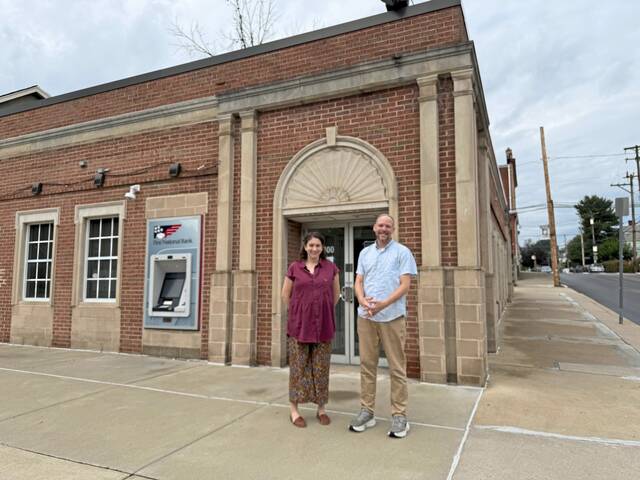
Every so often, someone still shows up to the old First National Bank in Greenfield with a check to deposit.
“A lady wandered in about an hour ago and was like, ‘Is this a bank?’ ” said Rabbi Mark Asher Goodman.
It happens enough that he and Frances Lasday taped a sign on the door reading “THIS IS NOT A BANK,” above an image of surrealist René Magritte’s famously captioned pipe, “Ceci n’est pas une pipe” (“This is not a pipe”).
The confusion is understandable. By early next year, the brick building at 4300 Murray Ave. will still resemble a bank but will have become something else entirely: a hybrid coffee shop and Jewish learning space called Shoresh.
By day, Shoresh will be a weekday coffee shop selling drinks and kosher baked goods.
By evening, it will double as a space for Talmud and Hebrew classes and community gatherings.
“It’s a dual-use organization: a Jewish education program that’s also running a coffee shop or a coffee shop that also serves as a Jewish educational space,” Goodman said.
Both Greenfield residents, Shoresh co-founders Goodman and Lasday knew firsthand that the neighborhood has lacked a coffee shop since Staghorn Garden Cafe closed in 2020.
In Greenfield Community Association surveys conducted in 2023 and 2024, a coffee shop or cafe was overwhelmingly the most requested business, mentioned by 61% of respondents.
“There’s no place between 7 a.m. and 4 p.m. to sit down and eat and drink and meet up with a friend,” Goodman said.
Though run by a rabbi and Jewish educator, Shoresh is intended as a neighborhood space beyond its religious programming, with plans for community meetings, book clubs and potentially coworking.
“We really want to be for this community,” Goodman said. “We want to be a resource that they can feel like they can come in and grab a cup of coffee and hang out.”
For Goodman, 49, the concept for Shoresh has been “percolating,” he joked, for “somewhere between five and 20 years,” back to when he became a rabbi.
Describing himself as “a bit of an odd duck,” Goodman has served congregations from Huntington Beach, Calif. — where his synagogue was close enough that “you could hit the beach with a rock” — to Steamboat Springs, Colo., where the former ski instructor led “ski with the rabbi” outings.
Goodman identifies with Conservative Judaism but has long aligned himself with its progressive wing. As a rabbinical student, he organized in support of ordaining openly gay, bisexual and lesbian rabbis, a policy the Conservative movement adopted around the time of his ordination.
“I very much like to meet people where they’re at,” Goodman said. “I’m very informal. I don’t wear a suit, and I never wear a tie. I feel like God is present when you are down to earth with people in all situations.”
After moving to Pittsburgh eight years ago, Goodman met Lasday through local Jewish programming. The two worked together on a grant-funded monthly gathering for Jewish adults before Goodman approached her about Shoresh.
“I was like, ‘It’s been great working with you. You’re really talented and smart. How would you like to go in on this crazy idea with me?’ ” Goodman recalled. “So I went in search of a big donor, and I wound up with Frances instead, which is better.”
Lasday, whose Pittsburgh family roots go back at least two generations, also describes herself as “mostly an educator.” Her résumé ranges from teaching about climate change while living on an “upside-down school bus that ran on vegetable oil” to a middle school science classroom.
“The whole time, I have been building community wherever I go,” she said.
Lasday, 32, grew up in the pluralistic Jewish youth movement, which she said left her comfortable in “lots of different Jewish spaces.”
“There are lots of ways to be Jewish in this world, and everyone’s just figuring out what works for them,” she said.
At first glance, a coffee shop doubling as a pluralistic Jewish learning center might seem like a 21st-century invention, but Goodman sees it as a case of everything old is new again.
Shoresh’s tagline is “a well-caffeinated shtibl,” a Yiddish word meaning “little room” or “little house” that refers to a small, informal place for Jewish prayer and gathering.
“In the old days, going back 200, 300 years, the Jewish community created a class or prayer space (by going) to the local dry goods store or the general store or the butcher shop,” Goodman said. After hours, “they would push all the tables off to the side, and set up for prayer and study.”
Unlike large, formal synagogues, shtibls were smaller and more intimate, often with prayer led by laypeople.
“They were scalable and low-cost, and we’ve kind of gotten away from that,” Goodman said.
Shoresh adapts that model in another way: Rather than relying on synagogue-style membership dues, the founders hope coffee sales will help cover the building’s rent and utilities. Goodman took inspiration from a similar concept called Lehrhaus, a nonprofit Jewish tavern, restaurant and “house of learning,” in Somerville, Mass.
The name Shoresh, derived from the Hebrew word for “root” or “source,” also points to his interest in Hasidic teachings about returning things to their spiritual origins.
Classes, events and holiday gatherings — including Shoresh’s first simcha (celebration), a bris for a Greenfield neighbor, and a recent Yom Kippur service — are already underway as the organization continues its build-out and fundraising.
As singular as Shoresh may be, its Pittsburgh building renovations are not.
“At the end of the day, it’s still an old bank,” Goodman said.
The former teller area is being demolished to make room for an L-shaped coffee bar, while the founders have searched Facebook Marketplace for someone interested in buying the old safe-deposit boxes.
Downstairs, they plan to keep the bank vault, though they may remove its massive door — no one remembers the combination — and turn the space into another classroom.
“My theory on this place is that it was very much a pass-through,” Goodman said. “It was very analog. Everything was run with a series of envelopes and drawers and keys.”
But it’s not theology, construction or even city permitting that worries Shoresh’s founders the most: It’s learning to make a good cup of coffee.
“I want our quality to be amazing,” Lasday said. “I want to be the best coffee shop in town.”
She and Goodman have been practicing on an Italian-made home espresso machine — tamping beans and using the steam wand — with a taped-up guide showing the proportions of espresso and milk needed for drinks like cappuccinos. They’re still shopping for the right commercial machine, have consulted a friend from De Fer Coffee & Tea and are looking for a cafe manager.
“The joke is we know how to run an organization, how to teach Jewish classes, how to do fundraising, how to work with people — we just don’t know a lot about the coffee industry,” Goodman said. “It’s probably easier to teach a barista how to be a rabbi than a rabbi how to be a barista.”