
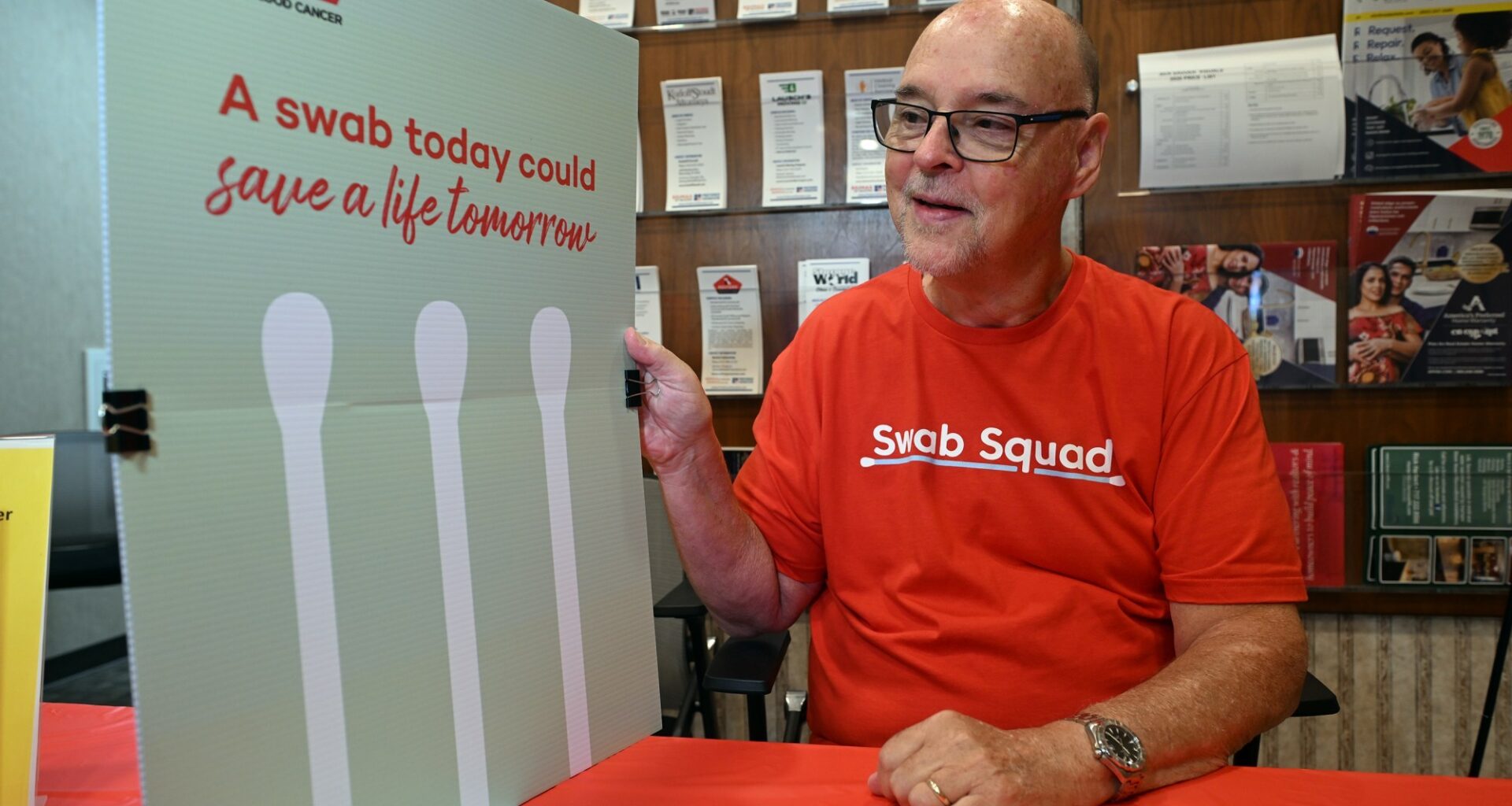
The first time Tom Hoch was diagnosed with cancer he was devastated and terrified. The second time, it was worse.
The 65-year-old Alsace Township man didn’t have any sense he was sick back in 2004. He was asymptomatic, other than a dull ache in his lower back.
At the urging of his wife, Cathy, he went to the doctor and ultimately underwent an ultrasound. The test detected testicular cancer.
“It’s like a punch in the gut when you hear that word — cancer,” Hoch said.
The good news was that the stage 3 cancer was treatable with a fairly high success rate. The bad news was that the treatment was harsh.
Hoch was able to manage the difficult treatment, ridding himself of the grapefruit-sized tumor in his abdomen.
“It cured me,” he said.
For a little while, Hoch was able to revel in his relief. He had fought cancer, and beat it.
But in 2006, the battle began again.
During a routine blood test, doctors detected something wrong. It was terminal leukemia.
“Terminal, that was a different ballgame,” Hoch said. “I heard it and was like, ‘I’m going to die from this.’”
Again, Hoch’s only option was a difficult one. This time, it was a stem cell transplant. He underwent the procedure in January 2007.
“The cure almost killed me,” Hoch said. “My body knew the cells weren’t mine, it wreaked havoc on my body.”
Hoch was hospitalized for about eight months, slipping in and out of consciousness as his body pushed back against the intruders.
“Three times they were ready to pronounce me dead,” Hoch said.
But he didn’t die. His body eventually accepted the stem cells, which did their job and attacked his cancer.
The procedure gave Hoch a second lease on life.
To celebrate his “rebirthday” when he got his transplant, Hoch hosted a special stem cell donor registration drive Saturday.
Held at RE/MAX of Reading in Wyomissing, the event invited people to stop by, have their cheeks swabbed and register to be on the national stem cell donor registry. It was done in partnership with DKMS, an organization dedicated to fighting blood cancers.
By joining the registry, donors can be called upon when a patient somewhere in the U.S. needs a stem cell transplant. If they agree to give, donation consists of having blood taken, which is then run through a machine that pulls out the stem cells before the blood is returned to the donor.
“When people hear the word ‘transplant’ they think surgery, but that’s not this,” Hoch said. “It’s so simple, but amazing what’s going on.”
And it’s because someone went through that “simple” process that Hoch is alive today.
A man named Tony from California was at a garlic festival when he came across a mobile stem cell donor registration station. He went in and signed up.
“He said it seemed like the right thing to do,” Hoch said, explaining that he was eventually able to meet Tony. “Without him I wouldn’t be here. When I saw him I said, ‘Tony, I don’t have the words. I just want to give you a hug and say thank you.’”
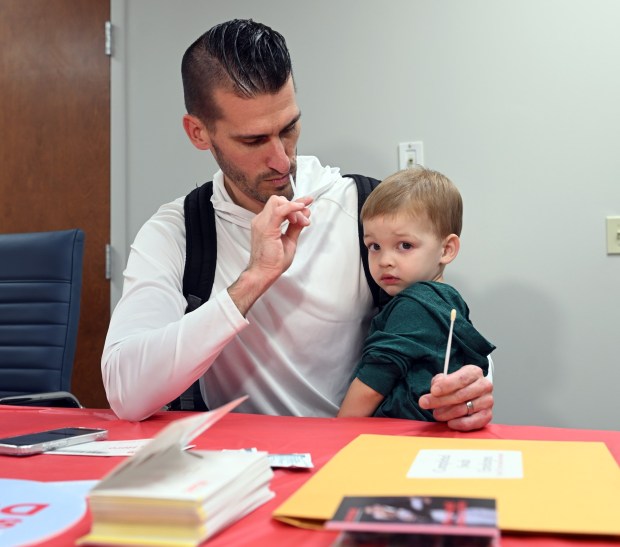 Josh Forry swabs while holding his son, Jayden, 2, during a stem cell donor registration drive at RE/MAX, 1290 Broadcasting Road, Wyomissing, on Saturday, Sept. 26, 2026. (BILL UHRICH/READING EAGLE)
Josh Forry hopes he can do for someone else what Tony did for Hoch.
He heard about Saturday’s drive through Hoch, a co-worker at RE/MAX. For him, signing up to donate just made sense.
“I give blood — I actually have an appointment Tuesday — and this isn’t all that different,” he said. “I donate because if I ever needed it I would be grateful for someone to give.”
Hoch said he was touched by people like Forry stepping up to help. He said that through his cancer journey has has received an unbelievable amount of support from friends, family, co-workers and the community.
“It give me chills to think about what people have done for me,” he said.
For more information on stem cell donation or to become a donor visit dkms.org.