
While robotics is known as a hot and trending field, some of its real-world applications as lesser known, said Wenshan Wang, a systems scientist at Carnegie Mellon University’s Robotics Institute.
“We are still waiting to see if robotics can make life easier,” said Wang. “We haven’t seen a lot of real-world development yet, but I think it’s coming soon.”
She said early stages of real-world robot development includes humanoid, AI-powered robots, autonomous vehicles, drones, and other tools to assist healthcare, public safety and manufacturing.
That will be on display this week at the International Conference on Intelligent Robots and Systems, held at the David L. Lawrence Convention Center in Downtown Pittsburgh.
The event is one of the world’s largest robotics research conferences, drawing more than 7,000 researchers, engineers, students and industry leaders, more than 80 workshops, tutorials and demonstrations, and more than 170 exhibitors.
“Pittsburgh is well-deserved for a conference like this,” Wang said. “This field is getting super hot. It’s always on the forefront. And with all of these hypes, all of these focuses, it’s how can we find a research question to explore?
“This conference allows us to talk to companies and research labs to come up with what’s the next big idea to ask.”
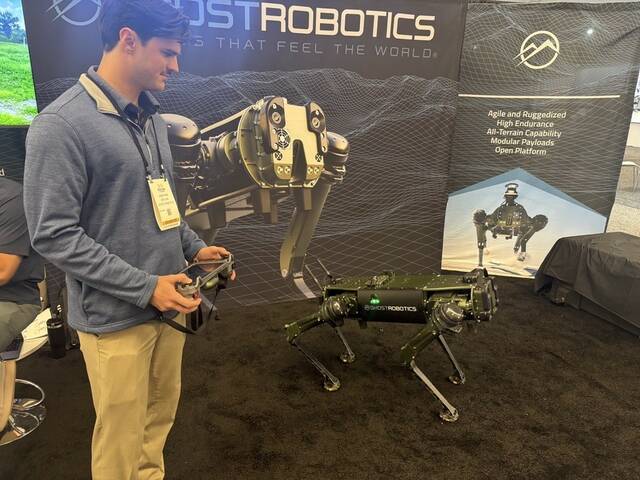
Philadelphia-based Ghost Robotics has developed “Vision 60” — a robot-dog that could be used to crawl into hazardous or dangerous spaces, said JT Boylan, a software engineer with the firm.
The dog has motorized legs, camera lenses, microphones, chemical and thermal sensors and GPS systems. It can be controlled through a human using a tablet, and has the ability to climb stairs and enter closed rooms through a video feed and sensors for situational awareness.
That can be key in emergency situations: Boylan said Vision 60 has been used in hostage situations and search-and-rescue missions.
“The main advantage is rigidity,” Boylan said. “It can go over a lot of different terrains.”
Ethan Fan, sales director for EngineAI based in China, showcased his company’s full-size, general humanoid robots.
“One of the uses is for entertainment,” Fan said. “We have a robust boxing show. We think it will be a huge market.”
Humanoid sports leagues are growing in China, Fan said. The robots can also dance and play soccer.
The Pittsburgh conference offers an opportunity to explore potential future uses with humanoid robots, he said.
“We want to see the development chain of humanoid robots, what it can bring us, and to show their abilities,” Fan said.
Jiaoyang Li, an assistant professor at Carnegie Mellon’s Robotics Institute, studies how robots can be used in manufacturing or industrial settings. Robots there can fill labor shortages and take jobs people don’t want to do, she said.
“Panels here are asking, what will be next?” she said. “I believe manufacturing will be the next one. There are robots and we have the opportunity to scale up. There’s a lot of growing space and need there.”
Li said the conference allows Pittsburgh students to interact and collaborate with developers and researchers. Researchers and companies also benefit from interacting with each other, said Boylan, the Philadelphia-based developer.
“It helps see what the state of the industry is, and what impact we can make,” he said. “It can open us to see new capabilities.”