
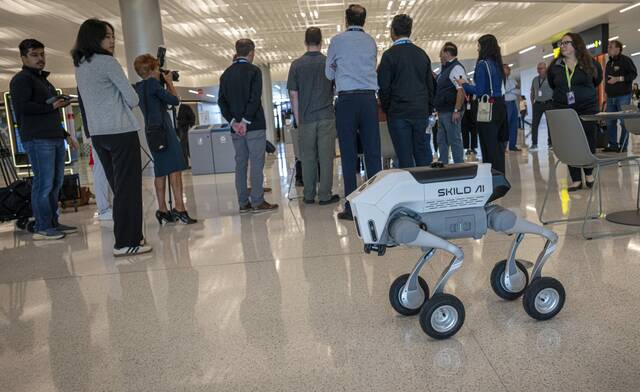
Pittsburgh International Airport’s newest robot helper resembles a dog, but it would rather use its face-mounted sensors to report a mess on the airport’s floor than create one of its own.
East Liberty robotics outfit Skild AI designed the “quadruped” robot through the airport’s xBridge innovation center, a kind of in-house startup incubator focused on high-tech solutions to common problems.
xBridge has partnered with dozens of local technology companies since its 2020 launch, resulting in products like autonomous wheelchairs and interactive digital maps.
Skild’s robot is equipped with an AI-powered “brain” that enables it to perform a variety of tasks instead of being limited to a specific usage like robots of old, said company engineer Robert Belle-Isle.
The quadrupeds will soon monitor Pittsburgh International’s air quality, check whether trash cans are full, and detect liquid spills on the floor.
“Robotics is at an inflection point right now, and projects like this are going to be the seedlings for what we believe will be a truly incredible future,” Belle-Isle said.
Pittsburgh International’s chief technology officer, Deepak Nayyar, said the airport will introduce four quadrupeds in the next month to begin their six-month trial period.
If they are successful, the airport will consider expanding the robots’ duties to autonomous food delivery and security.
“We want to start it slow and see where we can go,” Nayyar said.
But first, the quadrupeds need to master the airport’s layout — a learning curve for their AI brains.
A test subject used its leg joints to rise from a resting position during a live demonstration on Tuesday before rolling around on its leg-wheels in search of a trash can to scan.
Belle-Isle explained that the quadrupeds had wheels instead of feet because they are more energy efficient and minimize potential damage to the airport’s floors.
He trailed the robot as it took a few unexpected detours, weaving through the onlooking crowd using its sensors to reach its destination.
“[It’s] decided that this is the best approach,” Belle-Isle said apologetically.
Still, the quadruped was able to complete its task as advertised, scanning the overflowing trash can and generating a report that the airport could use to address it.
Skild’s four robots won’t be the only rookies at Pittsburgh International next month: Another xBridge partner, Arrow Analytics, plans to introduce its EZ-board system, which uses cameras to scan carry-on luggage and determine when a plane’s bin space reaches capacity.
Gate agents would then instruct passengers still in line to check their luggage, saving the time they would spend searching for nonexistent bin space, airport spokesman Bob Kerlik said.
Southwest Airlines will host the system for three months.
Nayyar confirmed that neither xBridge invention would replace human jobs at Pittsburgh International, even if their trials are successful enough to make them permanent fixtures.
“What we are testing is how it will help our people to make their jobs more efficient so that they can focus on the critical aspects of it, not doing spill detection,” he said.