
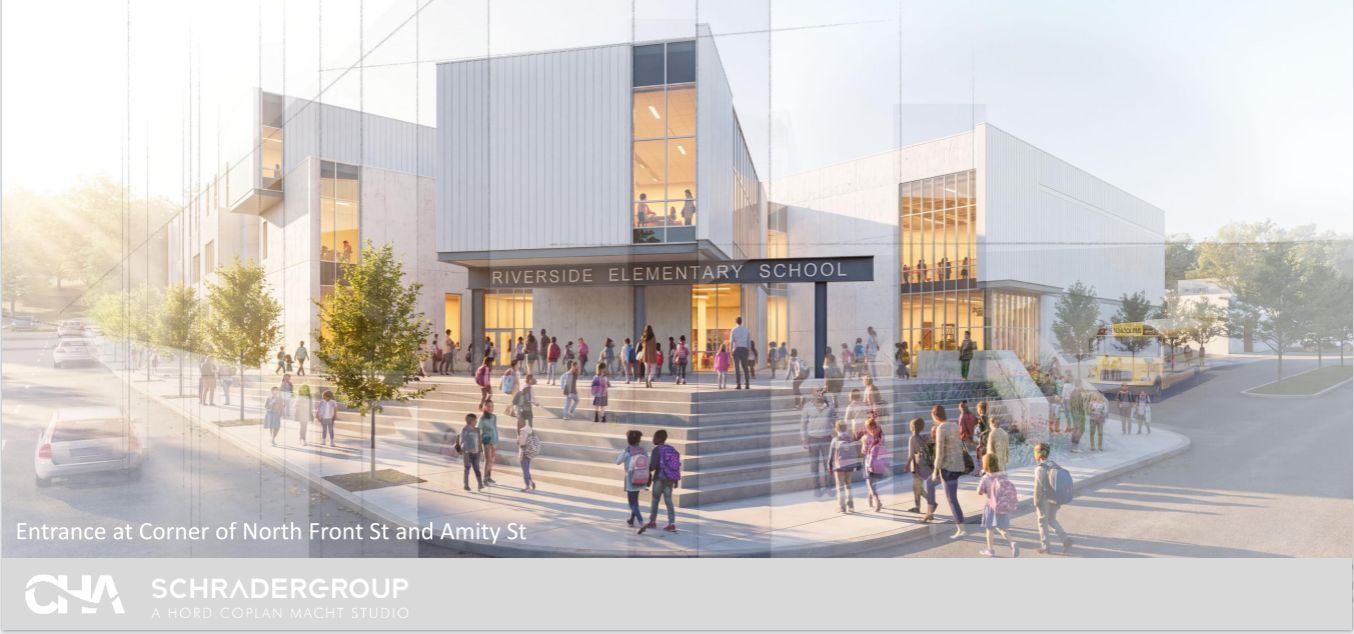
Reading School District officials are advancing plans for a nearly $87 million replacement for the Riverside Elementary School building.
Jamie Lynch of CHA, the district’s construction management team, updated the school board recently on the project that calls for building a new school on the existing Riverside property while keeping the current school open.
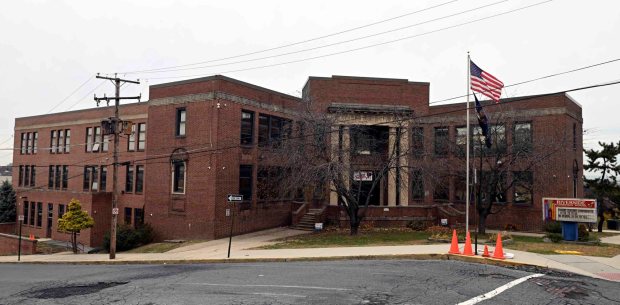 Riverside Elementary School, 1400 Centre Ave., was constructed in 1925 and enlarged in 1942. (BILL UHRICH/READING EAGLE)
Lynch said the planned three-story, 118,000-square-foot building will be designed to address traffic, safety and space limitations at the existing school and will serve as many as 850 students in prekindergarten through fourth grade.
The existing Riverside, which Lynch said is about 80,000 square feet and four stories, would then be demolished and the remainder of the site completed, including a two-level parking structure.
“Education first, construction second,” he said, describing the challenge of building in close proximity to an operating elementary school.
Officials said the new school is targeted to open for the 2029-30 school year, with the entire project expected to be finished in 2030.
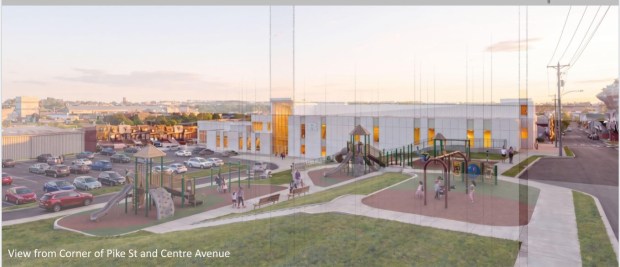 Conceptual plans for a new Riverside Elementary School were unveiled at the Reading School Board’s recent committee of the whole meeting. (Courtesy of Reading School District)
Lynch said the project is estimated at just under $87 million. That figure includes about $58 million for the building, $4 million in site costs and other construction costs. It also includes demolition of the existing school and a contingency fund of slightly more than $5 million.
The district hopes to put the project out for bids and award contracts in fall 2027, followed by roughly two years of construction, Lynch said.
The hillside site, which drops about 60 feet from Centre Avenue to North Front Street, is among the project’s biggest design and construction challenges, Lynch said.
Officials said the design seeks to improve traffic flow around the site and address safety concerns involving student drop-off and pickup.
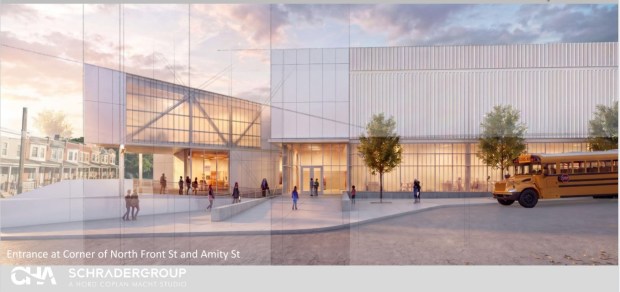 Conceptual plans for a new Riverside Elementary School were unveiled at the Reading School Board’s recent committee of the whole meeting. (Courtesy of Reading School District)
In 2015, children were injured in two separate accidents outside Riverside within about two months, according to Reading Eagle reports.
In January 2015, sisters ages 11 and 12 were struck by a car while crossing Centre Avenue in the school zone after getting off a BARTA bus. In March of that year, an SUV jumped the curb near Centre Avenue and Pike Street, striking an 8-year-old Riverside student who was walking with his sister.
Plans developed by SGA, the project architect, include a two-level parking structure that would provide about 90 secure staff spaces accessed from North Front Street. Its upper level, entered from Pike Street, would have about 60 spaces and a loop for parent drop-off. Buses would use a separate drop-off area along North Front Street.
Architect Eric Weiss said separating bus and parent traffic is intended to reduce congestion and improve student safety.
Board members raised concerns about speeding and traffic along North Front Street, particularly near Amity Street.
Lynch said a traffic study has not yet been conducted specifically for the development, but the issue will be examined during the city’s land development review. He said possible measures could include a stop sign, if warranted, or traffic-calming measures such as speed tables.
“That’s something we can prioritize in our land development process,” he said.
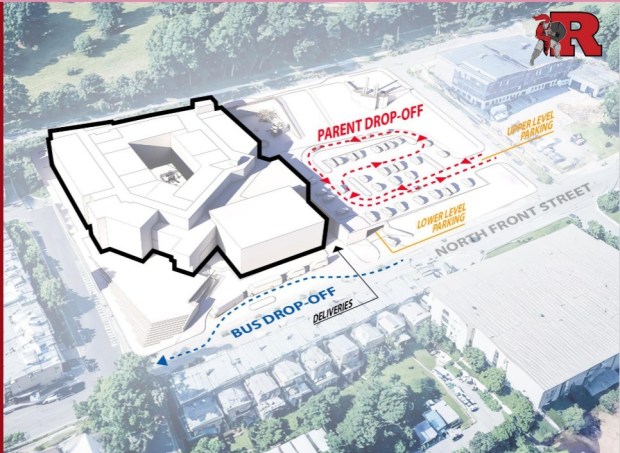 Conceptual plans for a new Riverside Elementary School show separate parent and school bus drop-off areas intended to improve traffic flow and increase student safety. (Courtesy of Reading School District)
Lynch said the building also is being designed with energy-efficiency measures, including LED lighting, daylight controls, high-efficiency boilers and water heaters and low-flow plumbing fixtures.
The structure would also be capable of supporting rooftop solar panels, he said. Lynch estimated a solar array would cost about $400,000 and could provide 20% to 25% of the school’s electricity during its first year. A state Solar for Schools grant could potentially cover about half the cost.
Board member Melissa Eggert and others reacted enthusiastically to the early designs.
Eggert, a retired educator, said she spent 30 years working at Riverside and praised the increased natural light and safety improvements.
“It looks terrific,” she said of the plans. “I think it’s really taken a lot of the issues into consideration to make it safer and just a more pleasant atmosphere.”