
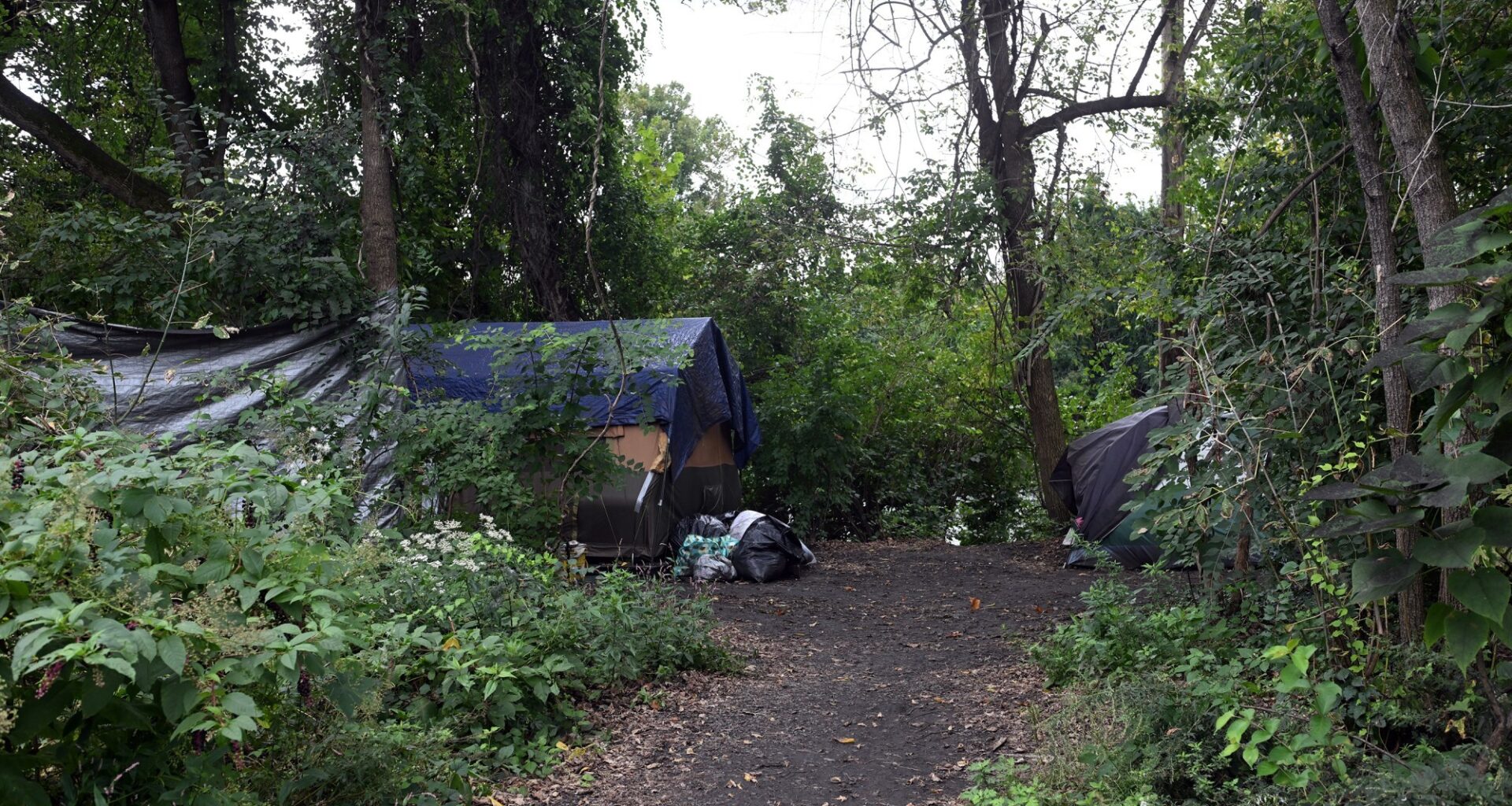
The Reading Police Department says it’s stepping up outreach to people living in tent encampments as winter approaches.
Deputy Chief Aaron Demko said police and city officials are working with homeless service providers and other community organizations to address the growing population established in camps along the Schuylkill River and elsewhere in the city.
“This is obviously a very delicate thing that we are approaching, and we, the police, are not the experts on that,” Demko told City Council at its recent committee of the whole meeting.
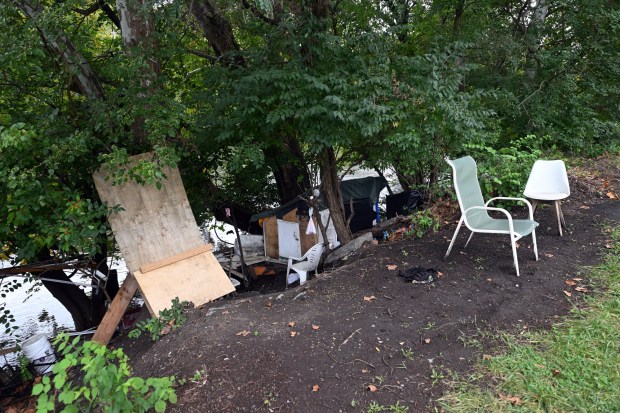 Reading police say outreach, rather than clearing homeless encampments, is the department’s primary focus. (BILL UHRICH/READING EAGLE)
Outreach, rather than clearing encampments, is the department’s primary focus, he stressed.
Demko estimated that well over 100 people are living in camps stretching along the Thun Trail from Baer Park to Canal Street, although he stressed that the Berks Coalition to End Homelessness maintains the official statistics.
Demko said he and former Community Development Director David Barr traveled through the area, visiting camps and talking with people living there.
The encampments range from large, established sites to small, isolated camps that can be reached only on foot, he noted.
Some crime occurs within the encampments, he said, but relatively little is reported to police.
“We have a responsibility to ensure public safety in the whole city, and that includes inside of these camps,” he said.
The department is working with its own social workers as well as the Berks Coalition to End Homelessness, Berks Counseling Center, Council on Chemical Abuse, Opportunity House, Hope Rescue Mission and other organizations to connect the unhoused with services.
Before the city considers clearing an encampment, he said, outreach workers attempt to connect residents with shelter and other services.
The city plans to clear one encampment beneath the Bingaman Street Bridge, where people continued living after a Sept. 4 arson fire left hazardous debris, he said, noting arrests have been made.
Demko said outreach will continue for weeks before the site is cleared, with workers attempting to find shelter for those living there.
“We’re trying to fix the problem where we can and get at the root cause of the problem instead of just being heavy-handed as a police department,” he said, noting addiction can often play a role.
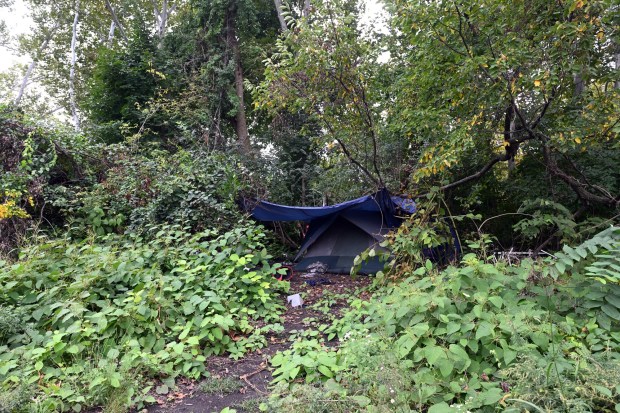 The city is working with Opportunity House and the Coalition to End Homelessness on an expanded inclement-weather strategy that would address extreme conditions during both winter and summer for the unhoused. (BILL UHRICH/READING EAGLE)
Councilman O. Christopher Miller cautioned against viewing homelessness primarily through the lens of addiction.
“It’s a multifaceted issue,” Miller said, pointing to mental health problems and shelter policies that can separate families or prevent people from bringing pets.
Demko agreed, noting that addiction can be both a cause and a consequence of homelessness.
“There’s certainly a lot of factors that lead to this,” he said. “And I didn’t say that to be dismissive of anyone’s situation.”
Managing Director Jack Gombach said the city is working with Opportunity House and the Coalition to End Homelessness on an expanded inclement-weather strategy that would address extreme conditions during both winter and summer.
He said the administration also plans to propose another significant investment with a partner to expand low- to no-barrier shelter space.
Gombach said the city should not bear the cost of addressing homelessness alone and called for greater involvement from Berks County, the business community and other partners.
Council President Donna Reed said surrounding municipalities should also be brought into the discussion, noting that homelessness is visible beyond Reading.
Asked by Councilman Jaime Baez Jr. what determines when the city clears an encampment, Demko said police have not cleared any recently and such decisions are made collectively with the administration and other city officials.
“We, the police, don’t make any arbitrary decisions on, ‘We’re going to go clear a camp out,’” he said.
Gombach said decisions are made case by case, in part because removing people without somewhere for them to go can create additional problems.
Demko said the department intends to continue its measured approach as colder weather arrives.
“The people in the camps are, of course, vulnerable,” he said. “They’re in a terrible situation, and we have to keep that in mind.”