
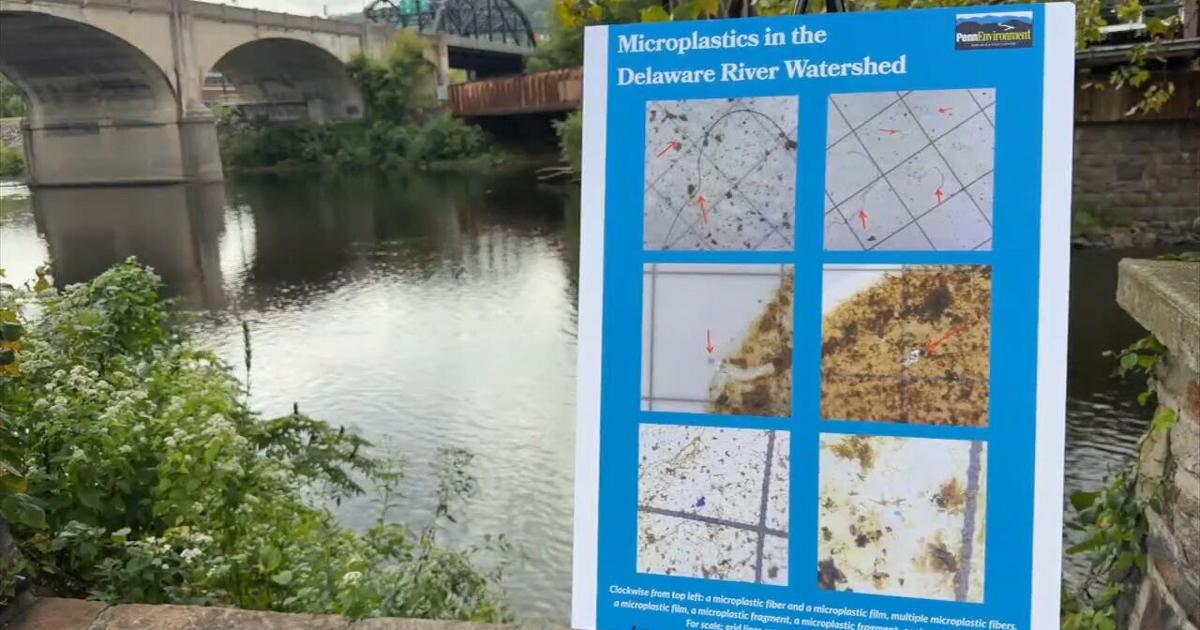
LEHIGHTON, Pa. — From the surface, the Lehigh River can look remarkably clean, but researchers looking at what can’t easily be seen found something else: microplastics.
PennEnvironment Research & Policy Center released results Wednesday from a two-year citizen-science project that tested 22 sites throughout the Delaware River watershed in Pennsylvania, New Jersey, New York and Delaware.
Microplastics were detected at all 22 sites tested, including the Lehigh River.
“Our citizen science here in Pennsylvania was some of the first microplastic testing in the state,” said Flora Cardoni, deputy director of PennEnvironment Research & Policy Center. “So really, we’re setting a baseline, I would say, of demonstrating that there is widespread microplastic pollution.”
Microplastics are generally defined as plastic particles smaller than five millimeters. Previous research has also documented microplastics in the Delaware River and its tributaries, including the Lehigh River.
What the study does — and doesn’t — show
While the new study found microplastics at every location sampled, it does not establish that levels in the Lehigh River are unusually high compared with other waterways or determine what the findings mean for human health.
There is also no state or federal regulatory standard establishing an acceptable level of microplastics in waterways.
Cardoni said PennEnvironment is not recommending that people stop using the rivers where microplastics were detected.
“Our recommendation is not to avoid the water because of it,” Cardoni said. “Our recommendation is to move away from all of the single-use plastic waste so that we can cut this pollution off at the source.”
Scientists continue to study how microplastics move and accumulate in the Delaware River system. Research published in 2026 found that factors including river flow, tides and salinity can affect where different types of microplastics accumulate in the Delaware River Estuary.
45 years on the Lehigh River
For longtime Lehigh River guide Jerry McAward, concerns about plastic aren’t confined to a laboratory.
69 News joined McAward in a canoe on the Lehigh River near Lehighton, where he talked about what he has observed during 45 years on the water.
“When you’re out here, you see ducklings,” McAward said. “You see the fishermen, and you see the plants.”
He also sees trash.
“The plastic is often everywhere, and all of us out here who make our living out here try to do our best to pick it up,” McAward said. “But we see plastic often.”
The plastic McAward can see is different from the microscopic particles examined in the PennEnvironment study, but he said pollution and water quality have become regular topics of conversation between river guides and the people they take onto the water.
Calls to reduce plastic at the source
PennEnvironment is calling for state and federal action aimed at reducing plastic pollution, particularly single-use plastics.
Northampton County Executive Tara Zrinski said she believes reducing plastic pollution will also require changes by manufacturers and other businesses.
“What we really need to do is get corporations to stop putting things in plastic,” Zrinski said. “To stop manufacturing plastic products so prolifically, use it more sparingly, and for things that are just necessary.”
For McAward, protecting the Lehigh is about more than what is found in the river today.
“There’s a respect that I think the politicians and industry needs to have to preserve it for future generations,” McAward said. “We’re just here for one lifetime. There’s so many lifetimes to go.”
The findings add to a growing body of research examining microplastics throughout the Delaware River system. The Delaware River Basin Commission has previously studied their distribution in the upper Delaware River Estuary and tributaries, while other researchers continue to investigate where the particles accumulate and their potential ecological effects.