
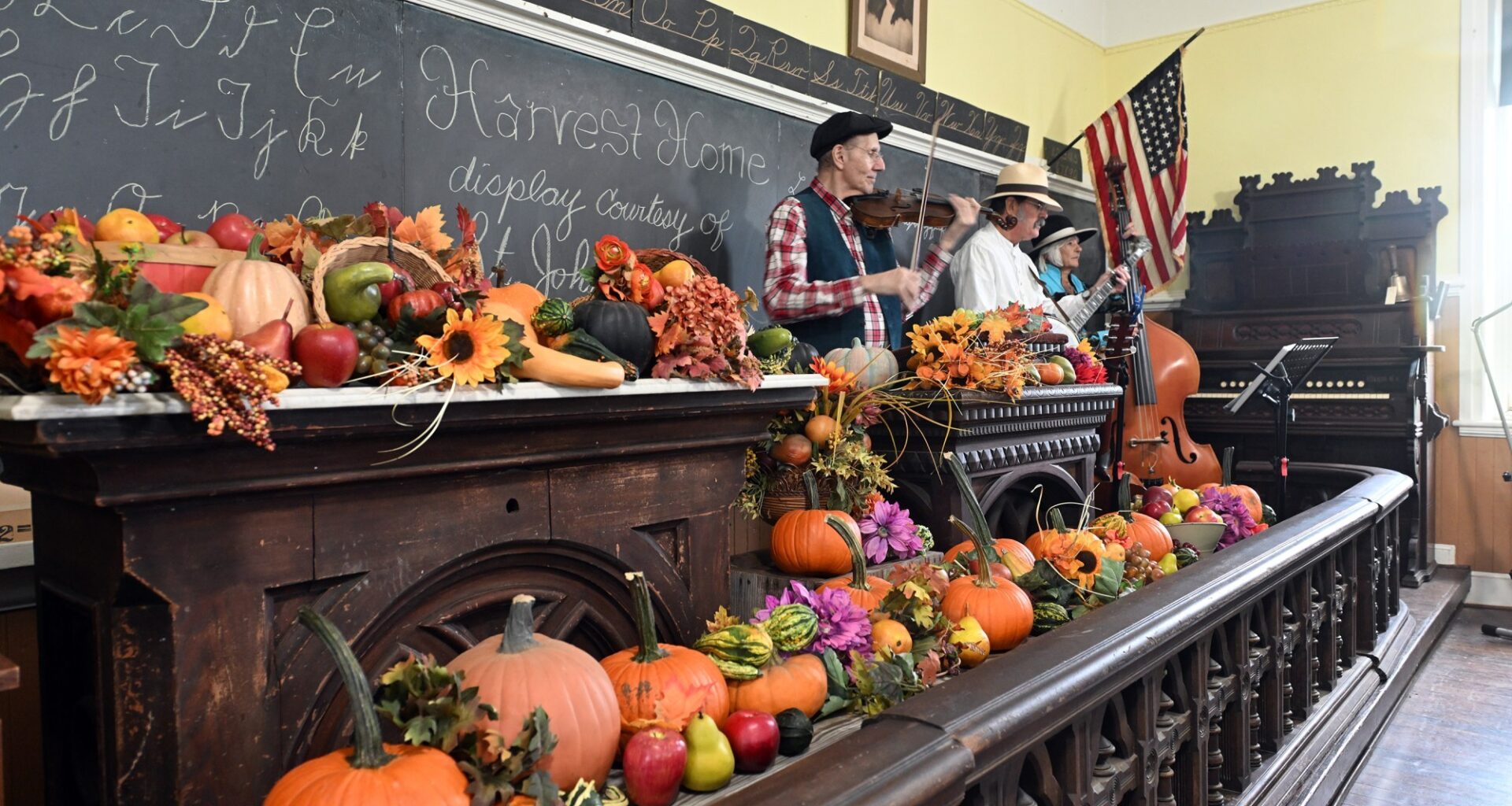
Heemet Fescht celebrated Pennsylvania Dutch folklife and America’s 250th with live music in the barnyard, traditional crafts, presentations, folklife demonstrations, open-hearth cooking, farm animals and children’s activities on Saturday, Sept. 26.
Held at the Pennsylvania German Cultural Heritage Center on the historic Sharadin Farmstead at Kutztown University, the free event was fun and educational for the whole family.
Heemet (pronounced HAY-met) means “home” in the Pennsylvania Dutch language. The term implies both a personal idea of “home” and a collective cultural understanding of one’s homeland and region, according to Patrick Donmoyer, director of the Heritage Center.
“Heemet Fescht is all about coming together to share in our region’s folk-cultural traditions that define our distinctly Pennsylvanian sense of ‘home’ where all are welcome,” said Donmoyer. “We highlight aspects of shared experience such as foodways, music and the arts, agriculture, and language as part of what makes our region unique.”
The event featured pumpkin painting, cutting paper Scherenschnitte, Puddin Heartland’s potbellied pigs, open-hearth cooking of traditional Pennsylvania Dutch food in the farmhouse kitchen, and traditional baked goods by Terry Berger on the wood stove in the summer kitchen.
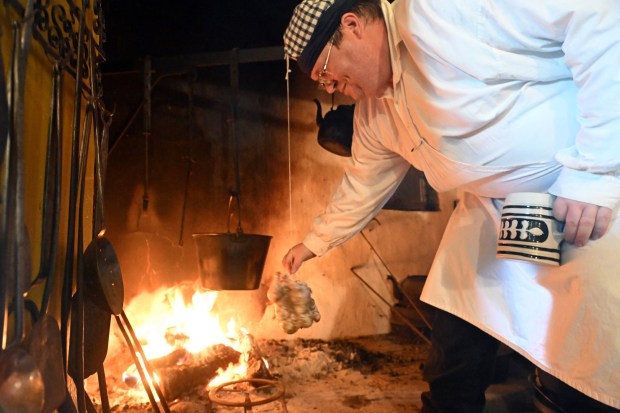 Daniel Silfies of Lancaster roasts a chicken in the fireplace at the Eichler-Frankenfield Home during the Heemet Fescht at the Pennsylvania German Cultural Heritage Center at Kutztown University on Saturday, Sept. 26, 2026. (BILL UHRICH/READING EAGLE)

Adalyn Mummolo, 10, of Lenhartsville, granddaughter of Rosemary Falk of Krumsville, left, tries out a yo-yo at the old-time toy display during the Heemet Fescht at the Pennsylvania German Cultural Heritage Center at Kutztown University on Saturday, Sept. 26, 2026. (BILL UHRICH/READING EAGLE)

Pat Oxenford of Douglassville creates decoratively painted book marks during the Heemet Fescht at the Pennsylvania German Cultural Heritage Center at Kutztown University on Saturday, Sept. 26, 2026. (BILL UHRICH/READING EAGLE)

Pat Oxenford of Douglassville creates decoratively painted book marks during the Heemet Fescht at the Pennsylvania German Cultural Heritage Center at Kutztown University on Saturday, Sept. 26, 2026. (BILL UHRICH/READING EAGLE)

Harp player Sarajane Williams performed at the historic Sharadin Farmstead in Kutztown during Heemet Fescht. (Photo courtesy of Kutztown University Relations)

David Adam of Orefield, Lehigh County, right, leads visitors in Pennsylvania German songs during the Heemet Fescht at the Pennsylvania German Cultural Heritage Center at Kutztown University on Saturday, Sept. 26, 2026. (BILL UHRICH/READING EAGLE)
Show Caption
1 of 5
Adalyn Mummolo, 10, of Lenhartsville, granddaughter of Rosemary Falk of Krumsville, left, tries out a yo-yo at the old-time toy display during the Heemet Fescht at the Pennsylvania German Cultural Heritage Center at Kutztown University on Saturday, Sept. 26, 2026. (BILL UHRICH/READING EAGLE)
Performances in the barnyard featured Pennsylvania Dutch and Palatine German folk music by Scott Reagan, traditional Berks County favorites from the Mike Hertzog Trio and Pennsylvania Dutch music by Keith Brintzenhoff.
Freyberger professor of Pennsylvania German studies Dr. William Donner gave a presentation in the schoolhouse about the history of Pennsylvania German education.
Traditional artisans from the Reading-Berks Chapter of the Pennsylvania Guild of Craftsmen shared their expertise in fine crafts in the historic log cabins on-site. Throughout the farm, folklife demonstrators showcased woodworking, tinsmithing and blacksmithing.
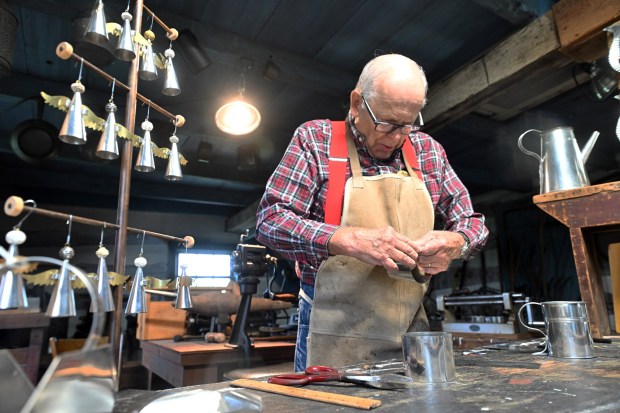 Tinsmith Ray Oxenford of Douglassville creates a tin cup at the shop in the former 1750 Thompson cabin that was relocated from Exeter Township during the Heemet Fescht at the Pennsylvania German Cultural Heritage Center at Kutztown University on Saturday, Sept. 26, 2026. (BILL UHRICH/READING EAGLE)
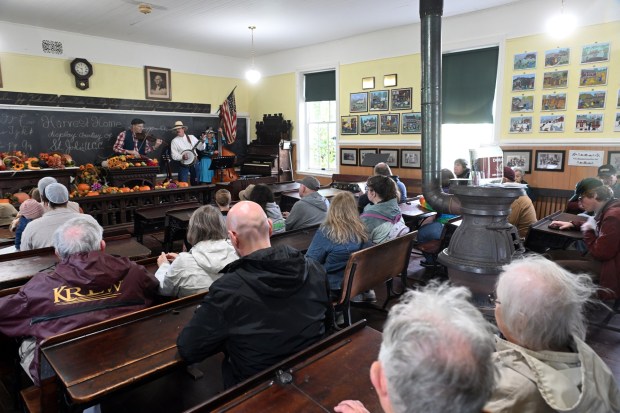 The Mike Hertzog Trio performs in the Freyberger one-room schoolhouse during the Heemet Fescht at the Pennsylvania German Cultural Heritage Center at Kutztown University on Saturday, Sept. 26, 2026. (BILL UHRICH/READING EAGLE)
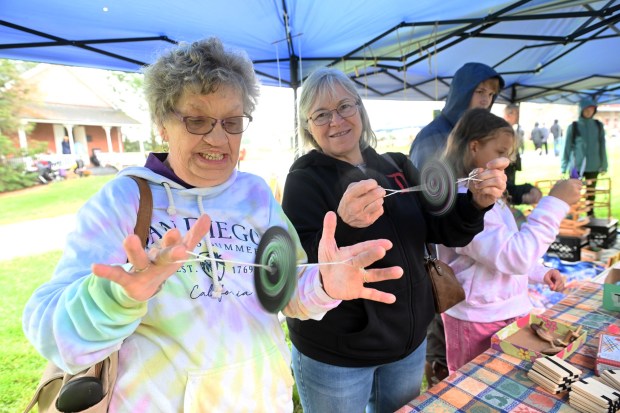 Elaine Brobst of Breinigsville, left, and Rosemary Falk of Krumsville try out spinners at an old-time toy display during the Heemet Fescht at the Pennsylvania German Cultural Heritage Center at Kutztown University on Saturday, Sept. 26, 2026. (BILL UHRICH/READING EAGLE)
Eric Claypoole, who has painted barn stars and hex signs on more than 100 barns throughout Southeastern Pennsylvania, demonstrated his traditional barn art.
“I hope that the community enjoyed the opportunity to gather together to celebrate the folk-cultural traditions that make our region unique,” said Donmoyer. “You don’t have to be Pennsylvania German to enjoy our region’s traditions and art, and these traditions have become part of a shared experience for all people living in our area. Our traditions are how we connect with one another in meaningful ways, and emphasize how we grow, change, and diversify as a region.”
The center’s headquarters at the DeLight E. Breidegam Building also featured an exhibition highlighting the healing traditions from the era of the American Revolution, “Healing Herbs and Vibrant Roots: Transatlantic Botanical Traditions Among the Pennsylvania Dutch.”
“The Pennsylvania Germans (also called Pennsylvania Dutch) are a unique American culture that developed here in Pennsylvania from a distinctive blend of traditions, language, and customs here in this region, which has been called the cultural hearth region of the Pennsylvania Dutch,” said Donmoyer.
Donmoyer explained that despite what one may find on the Internet, the terms “Pennsylvania Dutch” and “Pennsylvania German” are synonymous and historically sound ways to refer to the culture — “Dutch” being an English term that once historically described a wider range of German-speaking people, and the preferred term among everyday people in the region even today, and “German” being a loan-word from Latin that tends to find wider use in institutional and official settings.
“The Pennsylvania Germans are one part of a broader mosaic of cultures that collectively established Pennsylvania as the most diverse of the 13 colonies, as a fulfillment of William Penn’s vision of a society founded on pluralism and religious tolerance,” said Donmoyer.
Berks Commissioner Christian Leinbach visited the Heritage Center for Heemet Fescht.
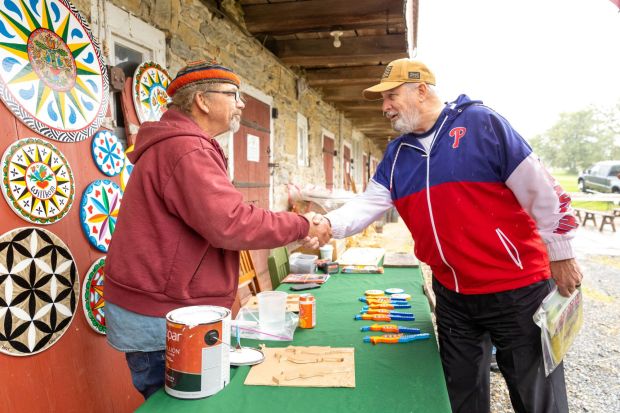 Berks Commissioner Christian Leinbach, right, greets Eric Claypoole, who demonstrated his traditional barn art during Heemet Fesch at the historic Sharadin Farmstead in Kutztown on Sept. 26. (Photo courtesy of Kutztown University Relations)
Grateful that Leinbach visited the center during the event, Donmoyer said the commissioner had the “opportunity to learn more about our public outreach in support of our mission to preserve and celebrate the folk culture, history, and language of the Pennsylvania Germans and the broader region at a unique educational setting at Kutztown University.”
Leinbach is the organizer of the America 250 Berks County celebration, which included Heemet Fescht as part of the county’s schedule of events.
During Heemet Fescht, two presentations celebrated America’s 250th — “Pennsylvania Germans and the Revolution” by Patrick Donmoyer and “Popular Songs from the Revolution to Vietnam” by Keith Brintzenhoff.
Heemet Fescht also promoted the center’s upcoming conference entitled “Pennsylvania Germans & the Revolution” that will be held on Nov. 13 and 14 at Kutztown University. A group of 10 scholars will be speaking on the experiences of Pennsylvania Germans as a culture that both shaped and was shaped by the American experiment. Learn more at www.pagerman.org/revolution/.
“We are also looking forward to collaborating with Commissioner Leinbach for the celebration of the 275th anniversary of Berks County this coming spring,” said Donmoyer.
For more information, follow the Pennsylvania German Cultural Heritage Center on Facebook and Instagram, visit https://www.pagerman.org/ or call 610-683-1589.