
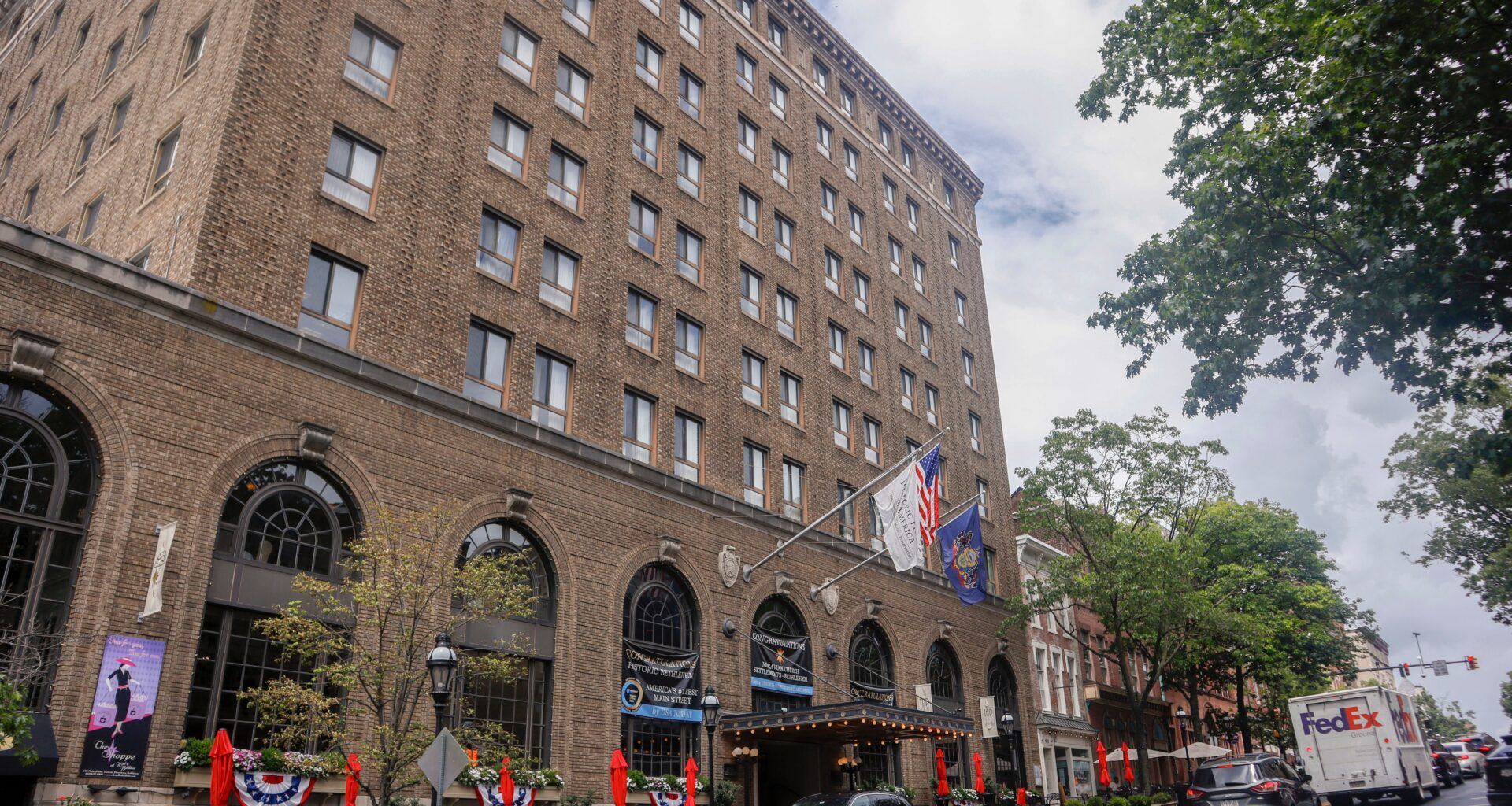
When someone calls Hotel Bethlehem to make a room reservation, it will be taken by a live person and not a computer.
The iconic hotel announced Wednesday morning that it is implementing the REAL People Promise, a plan to avoid the use of artificial intelligence and bot-based customer service. It’s another feature for the 104-year-old Hotel Bethlehem, which has won the top spot in USA Today’s 10Best Historic Hotel/Resort contest for six consecutive years.
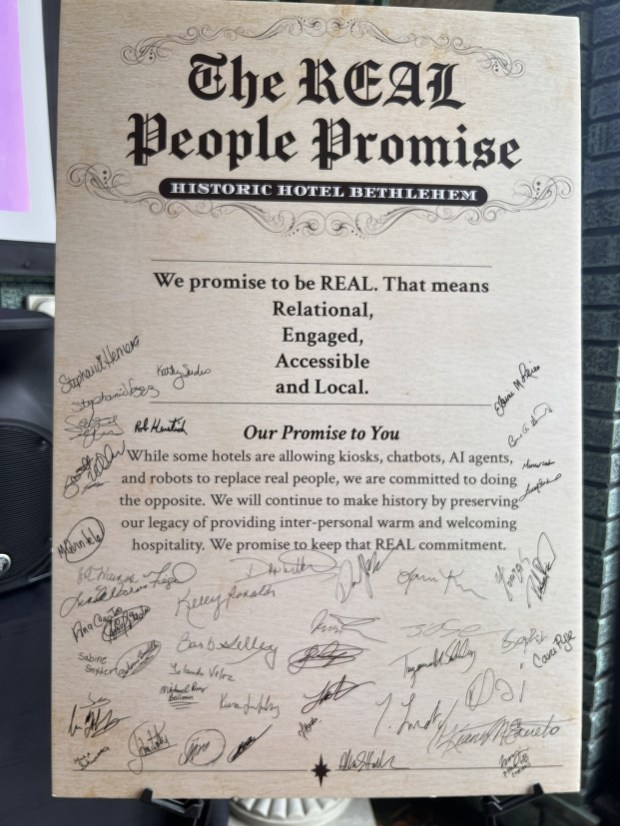 The Hotel Bethlehem’s REAL People Promise, signed by staff members on Wednesday, Sept. 30, 2026. (Courtesy of Strong Mountain Media)
“Have you made that phone call to your credit card company, to your bank, to a store, to try to get some help, and get totally frustrated because you can’t get through to a real person?” General Manager Kelly Ronalds asked at a news conference filled with hotel employees at 1741 on The Terrace. “It’s painful and extremely frustrating.”
Ronalds said the use of AI for customer service in the hotel industry “removes the word hospitality from our business.”
“While much of our industry is racing to replace real people with kiosks, chatbots, AI agents and robots, Historic Hotel Bethlehem is committed to doing the exact opposite,” she said.
A guest who’s curious about tourist attractions in downtown Bethlehem can simply ask any employee where to go, whether it’s someone at the front desk or in housekeeping.
For the promise, REAL stands for Relational, Engaged, Accessible, Local. The first main component is to eschew the use of AI when engaging with customers, meaning a live operator will answer any call and guests will not need a kiosk to check in. Late-night callers will not be sent to an offsite call center. Instead, they will be prompted to leave a voicemail and a Hotel Bethlehem staff member will return the call first thing in the morning.
The second is a proprietary concierge training program for the hotel’s 230 employees that includes etiquette lessons, interpersonal communication skill building and role-playing practice.
They will tour every part of the hotel and learn about its historic legacy along the way. There is also a course to study about local travel routes, dining options, attractions, activities and services.
Ronalds said it’s an investment in both the Hotel Bethlehem’s people and the downtown attractions.
“As a woman of my years, it’s odd for me to think that I’m living in a world where personalized service has become an exception,” she said. “But we’re committed to remaining the exception.”
A recent study from the New York University School of Professional Studies Jonathan M. Tisch Center of Hospitality found that more than half of hotels worldwide now use or are obtaining generative AI, but fewer than 10% say it has reduced their manual work by a significant amount.
“Most hotels are seeing small gains rather than a change in how their teams operate,” the report said.
The report also found that despite having tools for direct bookings, most consumers prefer online travel agencies such as Expedia. It said that while AI-originated searches contribute a measurable share of reservations, about 55% of hotels report either no change or minor changes to their plans to attract customers.
“Buying AI is easy. Getting value from it is not, and this report shows most of the industry is still stuck between the two,” said Bhanu Chopra, founder and managing director of RateGain, which collaborated with NYU on the study. “The advantage will not go to the hotels with the most tools. It will go to the ones that turn their technology into better decisions and give their teams their time back. That shift has not happened yet, and it is the single biggest opportunity in front of the industry.”
Ronalds said the REAL People Promise has been something the Hotel Bethlehem has been developing for several months. There was even a social media post on April Fool’s Day that showed a picture of several “new” employees that included famous robots from TV shows, movies and a regional supermarket chain.
It also cuts back on the chances that guests may get bad information from a search engine. Ronalds said people have arrived thinking the hotel has a pool or there is a certain item at the restaurant that’s not on the menu.
Ronalds also said the personal touch is vital, remembering staff from a hotel in New Orleans led her to a delicious meal at a restaurant frequented by locals.
“You can have the best carpet, you can have the most beautiful wallpaper and decor, but it’s you that makes the difference,” Ronalds told the gathered employees. “You associates, managers, supervisors. … You’re the secret sauce.
“When you ask for the best local restaurant recommendations, you’ll get the inside scoop from someone who lives here. If you’re talking to the real people who are in the real building, you’re getting real, good information.”
Morning Call reporter Evan Jones can be reached at ejones@mcall.com.