
There’s a phrase that educators often use in the Pittsburgh area: Learning happens everywhere.
In southwestern PA, our learning ecosystem brings together K-12 schools, youth-serving nonprofits, museums, cultural institutions and many more organizations, along with families — all of whom want the kids of this region to truly thrive.
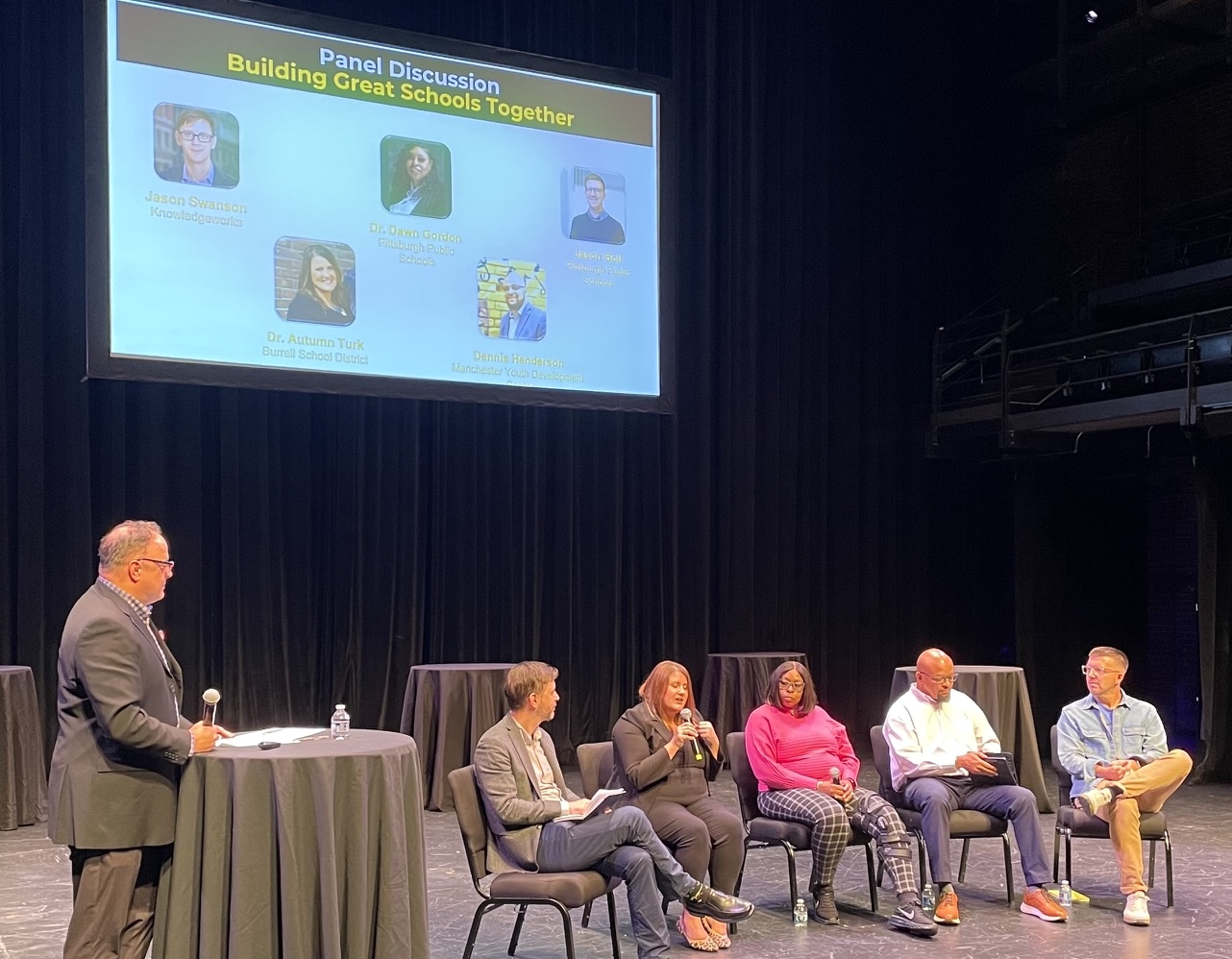
On Sept. 21, that learning ecosystem was on display, as families from Pittsburgh’s Northside spent the evening collaborating with teachers, education leaders and folks from youth-serving organizations to explore one ambitious question: What would it take to build great schools for every child on Pittsburgh’s Northside?
This public gathering, presented by the New Hazlett Theatre and One Northside, was all about possibilities, collaboration and discussing practical ideas for helping every child in the community. It was meant to be the first of many Community Conversations exploring topics like education and mental health.
Although this particular conversation focused on the Northside, A+ Schools executive director James Fogarty said “our hope is to raise these conversations and support conversations — whether it’s A+ Schools or other local community and place-based foundations — to make sure that these conversations are happening across the city.”
 Sept. 21, 2026, Community Conversation photo by Chris Sweeney courtesy of A+ Schools.
The main event on this particular evening was a discussion that Fogarty moderated, exploring what strong schools can look like, what children and families need in order to succeed, and how schools and communities can collaborate to create meaningful opportunities for students.
That discussion featured the voices of:
Dr. Dawn Gordon, Principal at King PreK-8, who shared about her school’s efforts to address the the challenges like food insecurity, housing instability and trauma that students may face. How does a school where those issues are concentrated meet the needs of students, so they can be fully present to learn? And how can a school also meet the needs of staff members, who are doing their own resilience work in order to be fully present for students?
Jason Boll, an educator at Perry High School, a Northside resident and a Pittsburgh Public Schools parent, who spoke about this moment of transition, where folks are grieving the loss of schools that are closing but have an opportunity to envision what’s next. This is especially important for the Northside, as the community aims to set a vision of excellence for what a Northside middle school could look like.
Dennis Henderson, Executive Director of the Manchester Youth Development Center, who shared about the work his organization does and the many connections that they’ve made in the rich learning ecosystem that exists in the Northside (see graphic below).
Jason Swanson, who serves as Education Futurist at KnowledgeWorks, who explored the possibilities and challenges facing schools in the future, and the opportunities that lie ahead.
Dr. Autumn Turk, Director of Curriculum and Development at Burrell School District, who spoke about the innovative work her district is doing, including embracing a “studio model” where students do deep-dives into multi-week immersive challenges, multi-disciplinary coaching teams work with students, and student agency drives outcome.
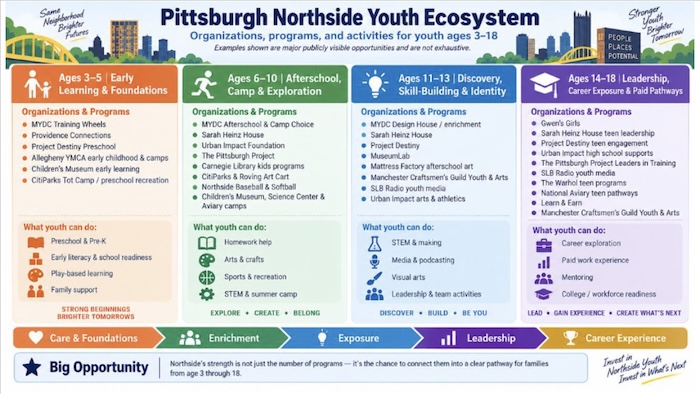 Graphic courtesy of A+ Schools.
Along with this discussion, there was time for connection and conversation. Perhaps most valuable, there was a clear acknowledgement that it isn’t always easy for parents to attend an event like this on a weeknight: To help with that challenge, the organizers made sure to include free food, refreshments and even free childcare.
A roster of community partners were also on hand to help Northside residents tap into local resources related to topics like early childhood learning and literacy.
“The night was about ‘Let’s set a vision,’ knowing that this is going to be hard, and that there are lots of questions around implementation,” Fogarty said. “But what if this time, rather than putting all of the onus on district staff to make decisions or set the vision, we do that in cooperation with them, and we do that in the light of really supporting better for kids?”