
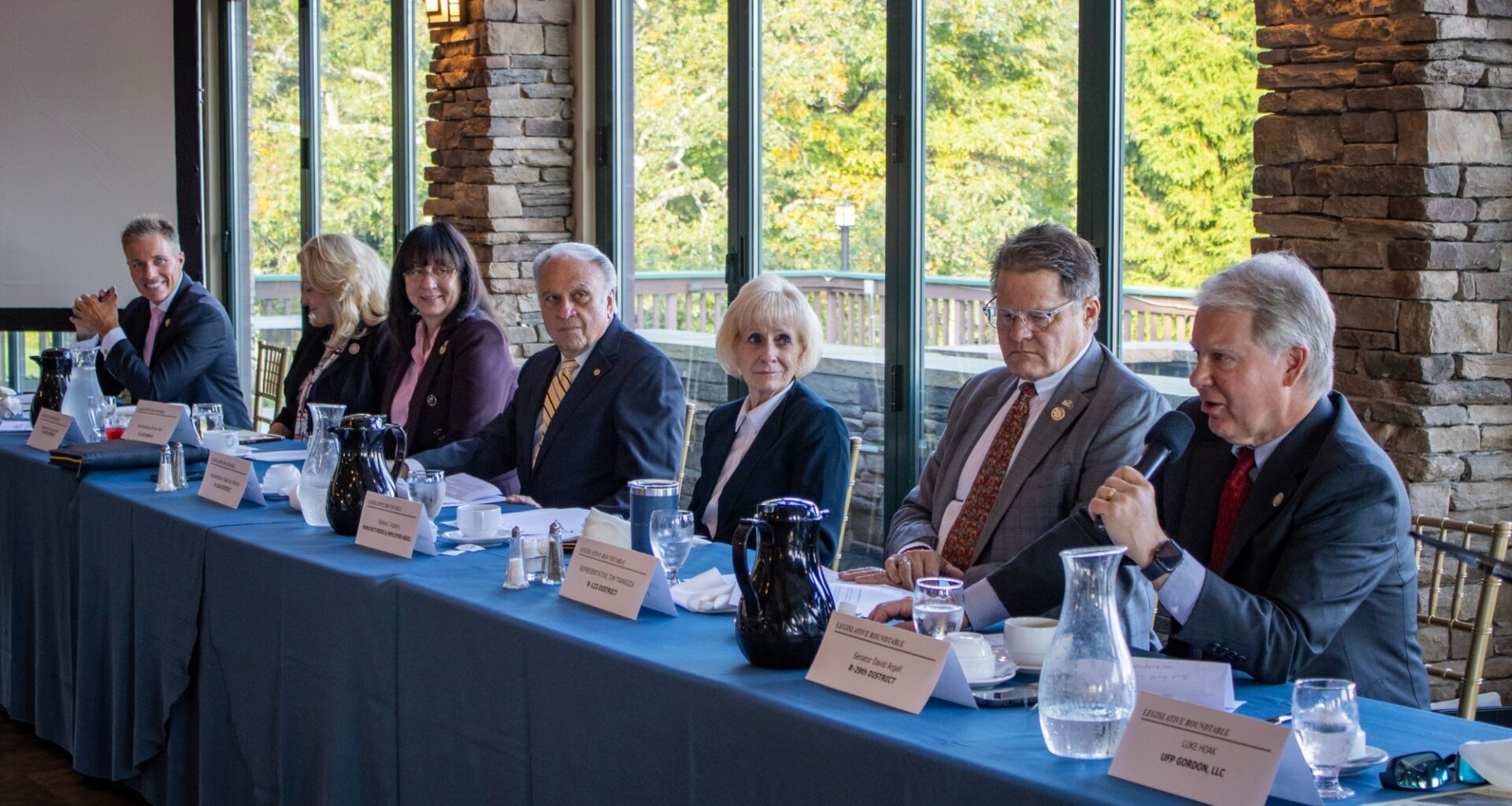
RYAN TWP. — Pennsylvania’s manufacturing businesses are being hampered by federal tariffs, high energy costs, excessive state regulations and a shortage of skilled laborers, state legislators said Friday during a roundtable discussion hosted by a Pottsville-based nonprofit.
Seven state representatives and one senator participated in the Northeast Pennsylvania Manufacturers and Employers Association event at Mountain Valley Golf Course.
While there are things Pennsylvania must improve to help manufacturers and residents, the state continues to head in the right direction, and that progress is causing some of the current difficulties, said state Sen. Dave Argall (R-29).
For instance, the recent population growth in the region reversed a longtime trend, but has also contributed to a shortage of affordable housing, he said.
“But I’d rather deal with the problems of growth than the problems of decline anytime,” he said.
Representatives of businesses in the region attended the event, asking the legislators questions and presenting them with their concerns.
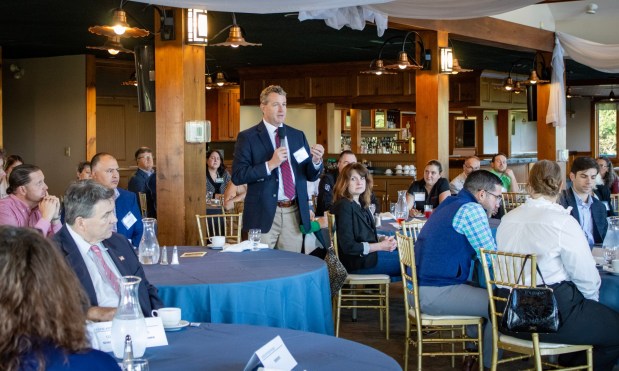 Audience members participate in a question-and-answer session during the MAEA Legislative Roundtable on Friday, Oct. 2. (AISHWARYA BEHL/STAFF PHOTO)
For instance, the general manager of Hydro Extrusions North America in Cressona spoke about how the tariffs imposed by the Trump administration on steel and aluminum imports from Canada continue to be costly to the company, which is one of Schuylkill County’s largest employers.
The company turns aluminum — the vast majority of which comes from Canada — into parts used across the economy, including the automotive, transportation, electrical and building and construction industries, Mike Hammer of Hydro said.
The tariffs have driven up the company’s costs, making expansion more difficult and forcing Hydro to pass on its added expenses to the companies that buy its products, which in turn charge their customers more, Hammer said.
Hammer acknowledged that tariffs were a federal issue, not a state matter, but asked the legislators for any help they could provide with federal lawmakers.
“The situation is ugly and it’s getting worse,” he said of America’s trade relationship with Canada.
State Rep. Eddie Day Pashinski (D-121) said he understood how local manufacturers were being hurt by the tariffs, and said that maybe the federal and state governments could provide financial aid to affected companies, as they’ve done with farmers that the tariffs have impacted.

State Rep. Tim Twardzik speaks during the MAEA Legislative Roundtable on Friday, Oct. 2. (AISHWARYA BEHL/STAFF PHOTO)

State Sen. Dave Argall speaks during the MAEA Legislative Roundtable on Friday, Oct. 2, at Mountain Valley Golf Course. (AISHWARYA BEHL/STAFF PHOTO)
Show Caption
1 of 2
State Rep. Tim Twardzik speaks during the MAEA Legislative Roundtable on Friday, Oct. 2. (AISHWARYA BEHL/STAFF PHOTO)
Among the other topics discussed were energy costs and reliability, workforce development, Pennsylvania’s business climate, housing and economic development.
Legislators on hand in addition to Argall and Pashinski were Reps. Joanne Stehr (R-107), Tim Twardzik (R-123), Robert Leadbeter (R-109), Dane Watro (R-116) and Brenda Pugh (R-120).
The legislators seemed to agree that Pennsylvania’s regulations regarding things like energy generation and business permitting are necessary, but that government should be working to make them less cumbersome for projects that would benefit the state.
Twardzik spoke about how someday solar and wind power will be able to supply more of the region’s electricity, but that in the meantime the state should be making it easier for companies to get natural gas from underground to boost the power grid.
Stehr said that her office is hearing from an increasing number of families who cannot afford their electricity and home heating bills.
“It’s becoming a scary time,” she said.
In terms of permitting for energy and business development projects, Pashinski said that Gov. Josh Shapiro has worked to cut red tape, but that the state must do more of that to encourage investment.
Regarding the workforce, Watro said that Pennsylvania needs 300,000 more skilled laborers than it has. He said that unions, businesses, the state Department of Education and colleges must work together to figure out how to fill that gap.
Pugh encouraged home builders and developers to embrace the idea of 55-and-older communities — which Florida has many of, but Pennsylvania lacks, she said.
Those communities that do exist in the region have yearslong waiting lists, she said.
“Our population is aging, and they need places to live,” she said.