
SpaceX’s initial public offering of $1.8 trillion in June was the largest ever in history. Yet Mars, Elon Musk’s ambitious destination, is an airless desert whose median temperature of negative 80 degrees Fahrenheit makes it neither particularly warm nor inviting. Mars, Pennsylvania, however, is both — but nobody is bidding trillions to get there. Instead, people seem to want to leave.
Going to Mars for a yoga class, or craft beer, or a tomato festival? All are available 20 miles north of Pittsburgh, where Mars has turned its planetary name into neighborly hospitality, local pride, and a joke everyone is invited to share in.
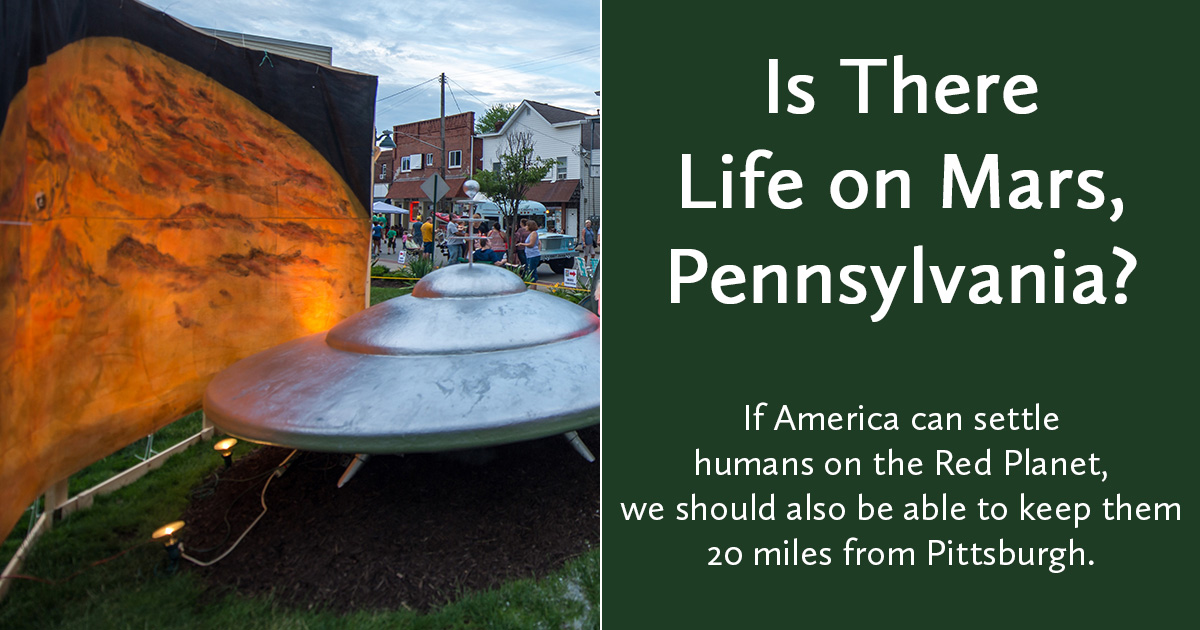
Claire Valentine, a young woman who grew up in Mars, describes it as “a small, safe, family-oriented town” with a “close-knit community full of family-run businesses and local things to do.” One of those things is to visit a 3,000-pound flying saucer created by local businessmen Shorty Davis and Bill Swaney. The spaceship inspired a local tradition: the Mars New Year Festival. The tradition began in 2015 after Mayor Gregg Hartung cold-called NASA to ask when New Year’s Day fell on Mars. The next festival, if not quite the next Martian New Year’s — is scheduled for June 6 and 7, 2027, when locals will fill the streets with rockets, costumes, music, and science exhibits. If you want to attend, you had better save the date. It could be the last time Mars celebrates with much civic pride.
This November, voters will decide whether Mars should merge with neighboring Adams Township in 2028. If the proposal passes, Mars would lose its independent governance in exchange for lower taxes and increased public services. The underlying problem Mars is trying to solve is that it has been losing people for decades. Since the last census in 2020 alone, its population has fallen by 12 percent, to 1,285 residents.
The planet Mars has no residents, but SpaceX’s board has tied Mr. Musk’s compensation package to the goal of settling one million people there in the near future. The real question isn’t whether America can settle Mars. It’s whether America can both build a city one million strong on the Red Planet and at the same time sustain American hometowns nationwide.
The question points to a tension at the center of the American character. One enduring American tradition is mobility. If you are the smartest person in the room, people say you are in the wrong room. Move to a bigger city. Find a better job. Leave your hometown for greater opportunities. Go to Mars. This advice is rooted in optimism and the joy of discovery, and it has helped make America dynamic and successful. Ours is a nation that has always expanded outward, and soon perhaps upward. Every frontier has encouraged ambitious people to leave familiar places.
But mobility comes with a cost. As we build outward and relocate, we often make existing places harder to sustain. As families scatter, social ties thin. And as the most capable residents leave struggling places, those communities lose leadership, entrepreneurship, even the tax base that keeps them viable. So, mobility brings real gains but may also create fragility.
America has a second enduring tradition: not leaving for the next frontier but fostering the “habits of the heart,” to borrow from Tocqueville, that bind people to the place and communities close at hand. Edmund Burke observed that public affections begin with “the little platoon we belong to in society.” Tocqueville found those platoons across America in churches, schools, voluntary associations, and town governments. About a century later, Jane Jacobs famously refused to leave Greenwich Village while fighting Robert Moses’s highway plans. In this tradition, Americans succeed not by exploring new horizons but making their own place better.
These two American traditions, one of exploration and one of rootedness, need not be enemies. Seth Kaplan, a lecturer at Johns Hopkins and the author of Fragile Neighborhoods, argues that helping people move upward is valuable, but so is strengthening the places they might otherwise leave. Kaplan shifts the focus from individuals to the places that shape them. He describes his approach as addressing problems “not one by one but place by place.”
A neighborhood is a “social habitat,” he writes, where families, schools, churches, businesses, associations, relationships, and habits of cooperation reinforce one another. As these become weaker, leaving becomes more attractive. Kaplan’s answer is to strengthen the social habitat so that people have reasons to invest and stay.
Mars, Pennsylvania, already possesses many of the ingredients Kaplan associates with a flourishing community. It has family-run businesses, schools, churches, and festivals. Claire, Shorty, Bill, and Gregg remind us that Mars has people who create and celebrate reasons to stay. The referendum in November is therefore only the most visible choice Mars faces. Its longer future depends on whether those local institutions remain strong enough for families, enterprise, and civic life to grow the deep roots to which young people who leave can imagine coming back.
Mars, Pennsylvania, is hardly alone in facing this challenge. Across America, thousands of communities ask themselves how they can remain places we choose to build up rather than simply leave behind. Their uncertain future raises a larger question about the kind of nation America is becoming. Can America remain a nation of explorers without becoming a civilization of exit?
Someday, I hope, there will be a city of a million people on Mars. But I also hope there will still be a Mars in Pennsylvania. A great civilization should not have to choose between frontiers and hometowns. If America truly honors both of its traditions, exploration and rootedness, perhaps our grandchildren will inherit not one thriving Mars but two.
Keep reading our
Fall 2026 issue
Lab wombs • Zoning alone • Science wars • Against ACs • Subscribe