
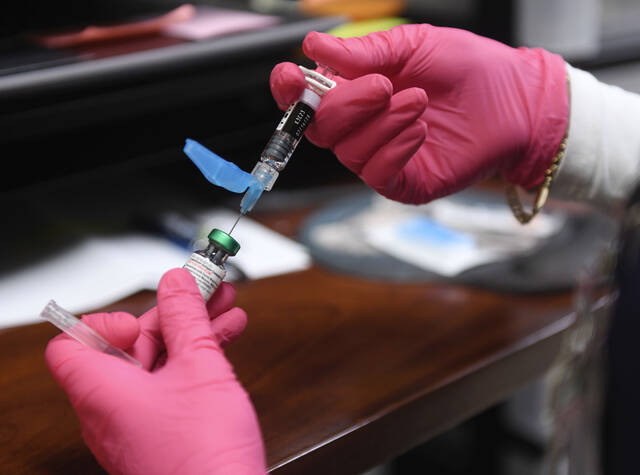
Measles has made a troubling comeback in the U.S. as MMR vaccination rates have fallen.
But the same vaccine protects against two other viruses — mumps and rubella. So why haven’t they made a similar resurgence?
“The simple answer is that measles is the canary in the coal mine,” said Allegheny Health Department medical director Dr. Jillian Irwin. “Measles is significantly more contagious than mumps or rubella.”
The rate of MMR vaccine adherence among U.S. kindergartners declined from 95.2% during the 2019-2020 school year to 92.4% for the 2025-2026 school year (the most recent data available).
Mumps and rubella, however, don’t spread nearly as easily and have lower herd immunity thresholds. That helps explain why falling MMR vaccination rates have allowed measles to emerge first — and why health experts warn mumps and rubella could follow if vaccination rates continue to decline.
In a susceptible population, one person with measles will generally infect 12 to 18 people. For mumps and rubella, that number is around four to seven, according to AHN infectious disease specialist Dr. Tom Walsh.
“If you think about vaccination as building a firewall around our community, as the vaccination rates fall, holes begin to open up,” Irwin said. “And measles is so contagious that it can find the smallest holes and move through them very quickly. Mumps and rubella just cannot do that as efficiently, so it takes certain circumstances for them to cause a problem or a larger outbreak.”
Measles is a virus that infects the lungs and spreads via breath, coughing and sneezing. It remains in the air and on surfaces for up to two hours, even after an infected person moves on. An individual with measles can spread the virus to others four days before and four days after a distinctive rash presents. Symptoms typically start seven to 21 days after exposure.
Mumps can be spread through the air, but because the virus does not linger in the air like measles, it is spread primarily through direct contact with mucous and saliva. Symptoms start 16 to 18 days after exposure, and it’s typically contagious for two days before and five days after it causes the salivary glands to swell. Its herd immunity threshold is 75 to 86%, according to the CDC.
Mumps symptoms include painful swelling of the neck and cheeks that cause difficulty swallowing and talking, earache, jaw pain, fever, headache, muscle aches, tiredness and loss of appetite.
“We do still see most cases in the United States, particularly in college dorms, places where people have prolonged contact that’s close,” said Irwin. “Measles hangs around in the air, so it is incredibly efficient at spreading and very contagious. Mumps is not.”
Similarly, rubella — declared eliminated in 2004 — also spreads primarily through direct contact with mucous and saliva. Symptoms start 14 to 21 days after infection. It’s contagious for seven days before and seven days after a rash develops. Its herd immunity threshold is 83 to 86%.
Rubella symptoms include mild fever, headache, stuffy or runny nose, red, itchy eyes, enlarged and tender lymph nodes, aching joints and a pink-red rash that spreads from the face. According to the CDC, women with rubella in early pregnancy have up to a 90% chance of passing congenital rubella syndrome to their babies, which can cause an array of hearing, vision and heart defects in newborns — 33% of infants with the disease die within a year.
“The vaccine-induced immunity can wane over time more with mumps than it will with measles,” said Irwin. “So, if you get the MMR shot now — you get two of them — it’s 97% effective at protecting people against measles and you’re likely to have that protection for most of your life, whereas the mumps portion may not stick around as long.”
Walsh said that mumps and rubella could already present problems in certain pockets of society where health care is not as accessible or affordable.
“Due to declining MMR vaccination rates in the U.S., estimates now suggest we are below (the 95%) threshold (for measles) and stand closer to 92% nationally. This level still remains sufficient to prevent widespread transmission of mumps and rubella via large outbreaks,” said Walsh. “There should still be heightened concern for spread of these other viruses as well with waning vaccination, as this can be a large setup for outbreaks of these other very serious viruses.”
Neither Walsh nor Irwin endorsed “breaking up” the vaccine, as President Donald Trump and Health Secretary Robert F. Kennedy Jr. have championed.
“Our stance is that people should get the combined MMR vaccine because that is the actual shot that exists as an option in the United States,” said Irwin. “It is the solution that we know works against measles. We don’t want to confuse people by making them think that they can access these separate shots.”
Walsh said there is “no data or scientific rationale” supporting splitting the MMR vaccine into individual shots and said requiring multiple visits could result in delayed or missed vaccinations.