
America’s tradition of volunteerism has long been held up as one of democracy’s quiet superpowers. But these days, finding people with the time to help can be a challenge of its own.
Across nonprofits and community organizations in Western Pennsylvania, volunteerism remains essential, but who is volunteering — and how organizations recruit and retain them — is changing.
Many organizations increasingly rely on retirees and longtime volunteers, while working-age adults struggle to commit amid demanding schedules, financial pressures and family responsibilities. At the same time, structured opportunities for teens and students are growing, suggesting volunteerism isn’t disappearing. Instead, organizations are adapting to connect willing volunteers with opportunities that fit their schedules, interests and skills.
For longtime volunteer Philip Beck, pastor of First United Presbyterian Church in Tarentum and one of the founders of the Tarentum Community Garden, volunteering has become a way of life.
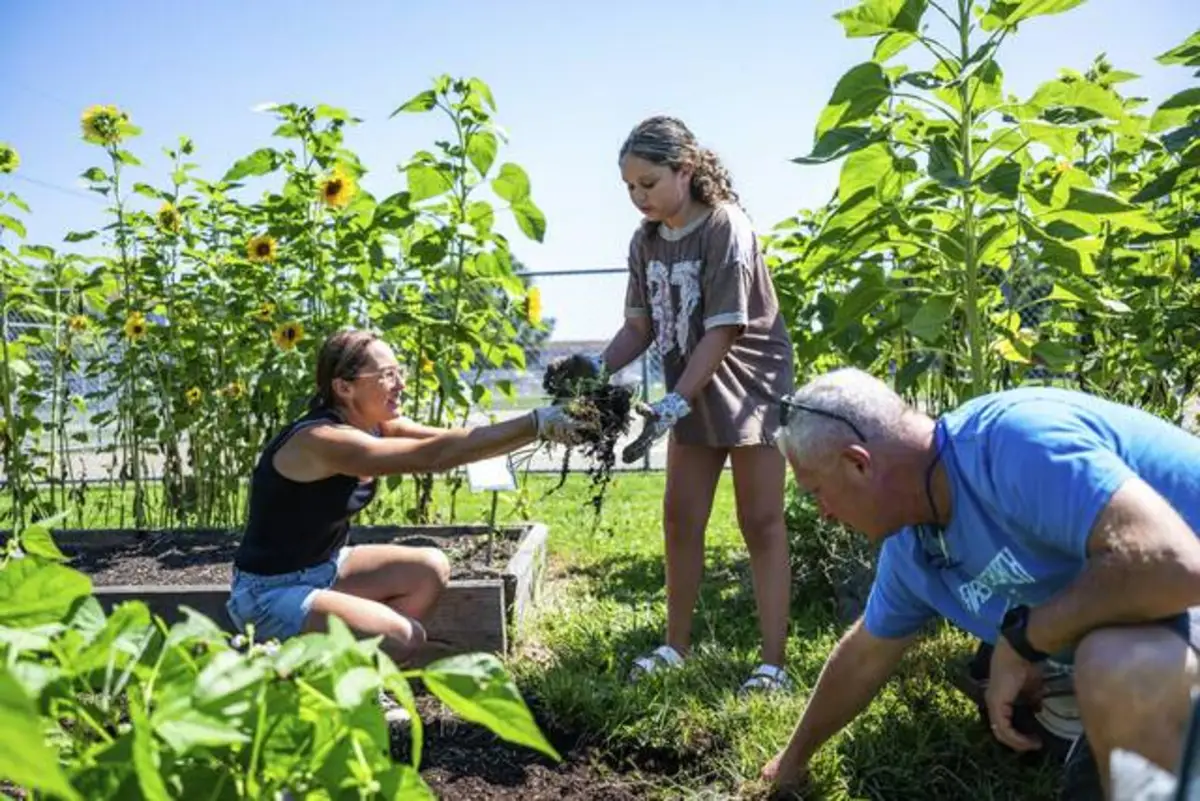
Now in its 11th year, the community garden has grown into more than a place to produce fresh vegetables. It also serves as a neighborhood gathering space where residents stop by to relax, walk their dogs, visit the free little pantry or simply connect with one another.
Beck, who has volunteered at the garden since its founding, said one of the biggest rewards is seeing tangible results.
“The nice thing about the garden, compared with other volunteering at times, is that you see the fruit of your labor,” Beck said. “You plant a tomato plant, you see it grow.”
Unlike serving on committees or boards, Beck said the garden allows volunteers to immediately witness the impact of their work. Schoolchildren regularly help plant vegetables, community members harvest fresh produce and neighbors build relationships simply by spending time together.
“I love the garden for that reason,” he said. “There’s great personal interaction with people one-on-one.”
Beck said his commitment to serving others began in childhood.
“I think it was instilled in me from childhood,” he said. “My parents were active volunteers not only within their church but with the community.”
That example shaped his understanding that volunteerism extends far beyond organized service projects.
“My parents would make meals for folks who were sick or deliver cakes at Christmas,” Beck said. “They were always looking out for their neighbor.”
As a pastor, Beck said that philosophy remains central to his life.
“There’s two things we’re called to: love our neighbor and love God,” he said. “Volunteering is a part of that.”
While many organizations struggle to recruit volunteers, Beck said finding people willing to spend a few hours helping has not been his greatest obstacle.
“The harder piece isn’t getting volunteers,” he said. “It’s finding people willing to lead.”
He said community members, students and church groups regularly volunteer to weed, water or help during workdays, but leadership requires a much greater commitment.
“I can get somebody to come down to the garden for two hours and help me plant things,” Beck said. “But if I said it’s going to take us 30 hours to plan, communicate and organize everything, a lot of people will be out on that.”
For Beck, that reflects a broader challenge facing volunteer organizations. People still care deeply about helping, he said, but increasingly hesitate to take on the long-term planning and leadership roles that keep community programs operating year after year.
For clinicians who observe broader behavioral and economic trends, the decline in volunteering among working-age adults is tied less to willingness than capacity.
Kristen Walker, a licensed professional counselor and clinical director at the Counseling and Wellness Center of Pittsburgh, said many adults simply have less free time than previous generations.
“I don’t know that it’s like they have zero interest in volunteering,” Walker said. “I think for a lot of folks, there’s a lack of time.”
Walker said rising living costs, multiple jobs and side work increasingly compete with volunteer opportunities.
“Economically, sometimes folks are now getting second jobs, third jobs … and time that would have been spent toward a volunteer opportunity is now being spent getting a part-time job or side hustle,” she said.
Featured Local Businesses
She also noted that traditional work schedules no longer reflect the reality for many Americans.
“People don’t typically always work a 9-to-5 schedule. It’s just not so cut and dried anymore,” Walker said.
Denise Head, executive director of the Mount Ararat Community Activity Center (MACAC) in East Liberty, said nonprofits must also rethink how they recruit volunteers.
“People who are looking for volunteers have to be very deliberate and intentional about recruiting volunteers,” Head said.
She has found many people are willing to help once someone personally asks.
“A lot of times when it comes to volunteers, people won’t offer,” she said. “But if you ask, then they will.”
Head, who has worked in nonprofit leadership for more than two decades, said many boards continue to rely heavily on older adults, while younger volunteers are often engaged through mentoring programs and community partnerships.
That philosophy is shared at the Hope Center, a nonprofit serving families throughout the Alle-Kiski Valley.
The organization has 25 to 30 full-time employees, plus 10 to 20 volunteers and an active volunteer board. Their help allows paid staff to focus on helping domestic violence survivors while volunteers support the organization in countless ways, according to Executive Director Erin Gillette.
“Every minute that they can give to us, then we can serve more survivors with that time,” she said.
Gillette said the organization intentionally creates many different ways for volunteers to become involved.
“Volunteerism looks very different here,” Gillette said. “We accept any kind of volunteer. We engage wherever they want to meet us.”
Gillette said social media has become one of the organization’s most effective recruitment tools.
“A lot of people friend us on social media and get to see all the good work that Hope Center is doing and want to contribute and help in some way,” she said.
Unlike many organizations that depend largely on retirees, Gillette said Hope Center attracts volunteers across nearly every age group.
“It’s very diverse,” she said. “Our board is diverse. We have young professionals all the way up to those that are retired.”
She believes offering volunteers meaningful choices is what keeps participation broad.
“They can be in our emergency shelter, they can help us with community events, they can do administrative support; we have a volunteer that runs our social media,” Gillette said. “They can contribute to Hope in many different ways.”
Some organizations require even greater long-term commitments.
At the Library of Accessible Media for Pennsylvanians (LAMP) in Pittsburgh, volunteers narrate, monitor and edit audiobooks for people with print disabilities.
Volunteer manager Simon Rafferty said producing a single audiobook can take months or even a year.
“About 20 hours a week — they come on a pretty consistent basis because volunteering here is quite the time commitment,” Rafferty said. “Producing a book from beginning to end can take anywhere from months to a whole year.”
Although many volunteers are retired adults, students from the Ellis School, SciTech and Obama Academy also participate.
“We’ve had teens record a book from beginning to end,” Rafferty said.
The organization also partners with Pittsburgh Public Schools’ Program for Students with Exceptionalities, providing vocational training while helping operate the nonprofit.
Youth involvement tends to be strongest when volunteer work is structured as education, training or skill development.
Taken together, these experiences suggest volunteerism is evolving rather than disappearing. Traditional drop-in volunteering has become more difficult amid fragmented schedules, multiple jobs and economic uncertainty. In its place, organizations increasingly rely on structured commitments, intentional recruitment and volunteers who see service as part of their long-term identity.
That idea echoes an observation made nearly two centuries ago by Alexis de Tocqueville. In “Democracy in America,” Tocqueville described Americans as uniquely inclined to form voluntary associations to solve community problems rather than relying solely on government. He argued these civic organizations were a defining strength of American democracy because they encouraged neighbors to work together for the common good.
Featured Local Businesses
For many organizations, the future of volunteerism may depend less on finding people who care than on making it easier for people to say yes.
“That’s what it’s all about,” Beck said. “Getting our folks in the community to actually be with each other.”