
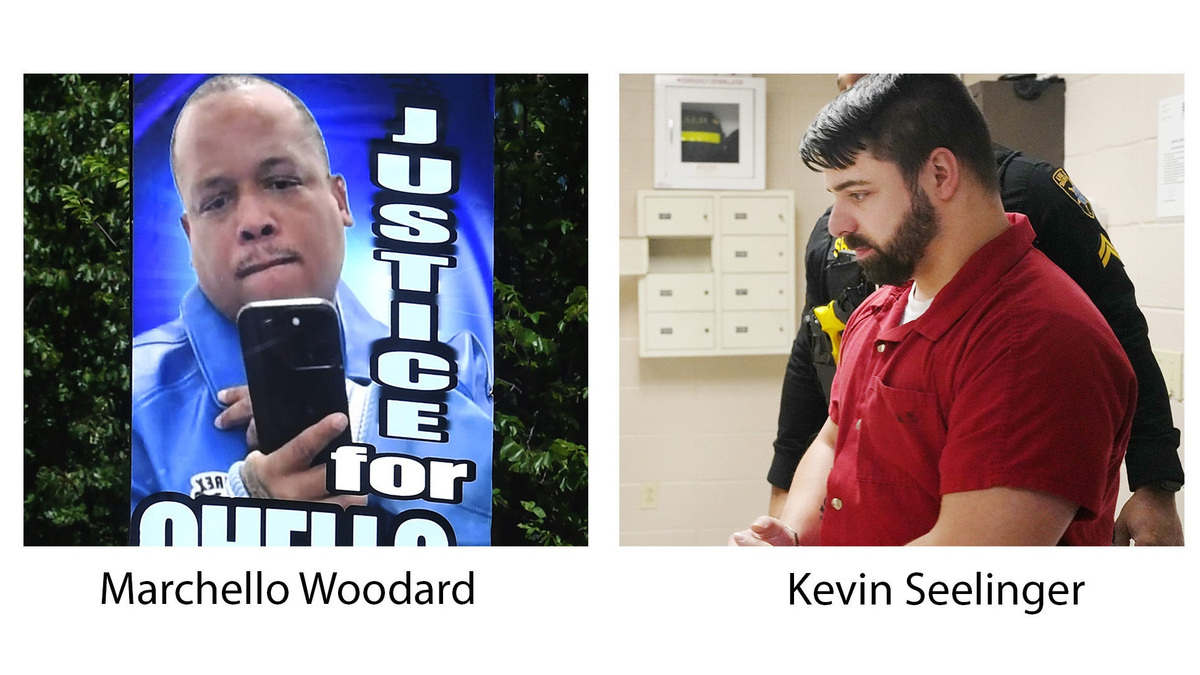
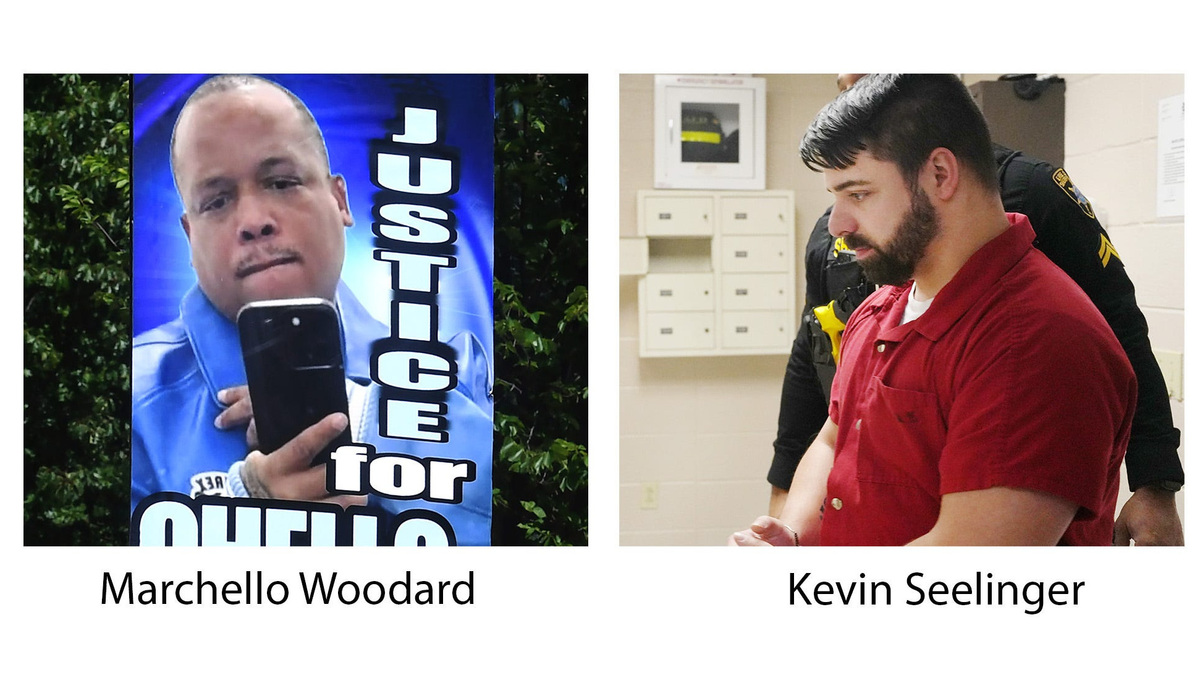
Marchello D. Woodard, left, was shot and killed by Pennsylvania state parole agent Kevin J. Seelinger on July 2, 2025. Erie County District Attorney Elizabeth Hirz is seeking a first-degree murder conviction against Seelinger, whose lawyers contend the shooting was justified. Jury selection concluded in Erie County Common Pleas Court on Oct. 1, with opening statements scheduled for Oct. 5.
GREG WOHLFORD/ERIE TIMES-NEWS
USA TODAY Network, Reuters
Fourteen months after the shooting death of parolee Marchello D. Woodard rattled Erie, the case heads to trial over one pivotal question.
Did Seelinger intentionally kill Woodard, as prosecutors contend, or was the shooting justified, as the defense argues?
A jury in Erie County Common Pleas Court will start hearing evidence the morning of Oct. 5, after the District Attorney’s Office and the defense give opening statements in the trial of the defendant, state parole agent Kevin J. Seelinger.
Seelinger, 46, is charged with criminal homicide in the death of Woodard, a 43-year-old Erie resident whom Seelinger shot during a compliance check on East 27th Street in July 2025.
District Attorney Elizabeth Hirz is contending that Seelinger intended to kill Woodard and is guilty of first-degree murder.
One of her key pieces of evidence is that Seelinger shot Woodard three times, including once in the back, striking the left lung, a vital organ. Pennsylvania law allows intent to be inferred from the use of a deadly weapon upon a vital part of the body.
Seelinger’s lawyers are arguing that Seelinger was justified in using deadly force against Woodard in self-defense and out of fear for his own life or serious bodily injury. The defense contends that Seelinger fired to stop Woodard from driving away while being dragged as he held onto the driver’s side door of Woodard’s car.
Based on pretrial filings, the case centers on two competing narratives:
The defense is arguing that Seelinger shot Woodard to stop him from driving away and harming him. The prosecution is arguing that Woodard attempted to drive away because Seelinger was already firing at him.
“The victim’s flight was a reaction to the Defendant’s use of force rather than the cause of it – in other words, the victim was attempting to escape because he was being shot at by the Defendant, not the other way around,” Hirz wrote in a court filing in March.
Here is a look at the case and the issues that are expected to come up at trial.
When will the trial begin and how long will it last?
The prosecution and defense are scheduled to give their opening statements shortly after 9 a.m. on Oct. 5 before the jury and Judge John J. Trucilla.
Hirz is prosecuting the case along with two of her top assistants: First Assistant District Attorney Jessica Reger and Chief Deputy District Attorney Steven Liboski. Seelinger’s lawyers are Chad Vilushis and Douglas McCormick.
The trial is expected to last at least a week and could run as long as Oct. 14, according to court administration.
Trucilla and the prosecutors and defense lawyers ended two days of jury selection on Oct. 1 with a panel of 16 people- 12 jurors and four alternates, instead of the usual two alternate jurors seated in major Erie County cases.
Another unusual aspect of the case is that the trial will unfold in the historic 250-seat Courtroom H, the largest courtroom at the Erie County Courthouse. Trucilla is using Courtroom H rather than his smaller courtroom to accommodate the large number of attendees expected at Seelinger’s trial.
The case has attracted significant attention from the start.
Woodard’s family and supporters pushed for a charge of murder. The death of Woodard, who was Black, led to protests in Erie, with many demonstrators connecting the case to the Black Lives Matter movement. The Fraternal Order of Police has criticized Hirz’s decision to charge Seelinger.
What happened to Marchello Woodard?
Woodard, known as Chello, was fatally shot as he sat in the driver’s seat of his car about 9:45 p.m. on July 2, 2025. He had parked in front of his girlfriend’s house in the 400 block of East 27th Street, between Parade and Wallace streets. He was not armed, according to the prosecution and the defense.
Woodard’s car continued moving forward after he was shot and slumped over the wheel, according to the prosecution and the defense. Erie police stopped the car at the intersection of East 27th and German streets, a little over a block west of the scene of the shooting.
Seelinger and his partner, Aaron Osborne, another state parole agent, had stopped Woodard as the two were assigned to a local police task force called the Erie Gun Working Group, according to a defense pretrial filing. The filing states that Woodard was on parole from a sentence that included a conviction for unlawful possession of a firearm.
Seelinger and Osborne stopped Woodard because they suspected he had violated his curfew, according to the defense filing. Woodard’s parole in a cocaine case was to expire in 16 days.
Seelinger got out of the unmarked state parole minivan and went up to the driver’s side door of the car, where Woodard was behind the wheel, according to the defense filing. The defense said Seelinger was wearing clothing marked “probation and parole” and identified himself to Woodard, whom he knew.
“Agent Seelinger observed that the decedent was exhibiting unusual behavior,” according to the defense filing, referring to Woodard. “Agent Seelinger intended to perform a search of the decedent’s person and vehicle.
“When the decedent ignored Agent Seelinger’s command, Agent Seelinger reached inside the decedent’s vehicle to unlock his door from the inside. At that point, the decedent began to drive forward.
“Agent Seelinger held on to the vehicle by the driver’s side door as the decedent accelerated forward,” according to the filing. “Agent Seelinger was dragged by the decedent’s vehicle at an estimated speed of 15 mph.
“Fearing for his life or that he was in danger of sustaining serious bodily injury,” according to the filing, “Defendant fired three shots into the area of the left flank of the decedent.”
The defense contends that Woodard drove away to flee because he had cocaine in his car and in his system in violation of his parole.
Police found 26.4 grams of cocaine in Woodard’s shorts and $1,500 in cash following a search of his clothes and car, according to the defense filing. As the filing also states, an autopsy and toxicology tests showed Woodard had a lethal amount of cocaine in his system as well as alcohol, the opioid painkiller hydrocodone and marijuana.
What about video evidence of the shooting?
State parole agents were not outfitted with body cameras at the time of the shooting.
Investigators were able to get a neighbor’s doorbell video of the incident. Hirz played that video at Seelinger’s preliminary hearing in January.
A porch wall blocks the street in the doorbell video. The interaction between Woodard and Seelinger is never clearly visible.
Hirz is relying on witnesses to explain what happened during the shooting. One of the witnesses is Robert Richmond Jr. He testified at the preliminary hearing that he saw the shooting from the porch of a house in the 400 block of East 27th Street.
“I saw the passenger door of the minivan open and a person start to try and catch up to that car,” Richmond testified, according to a prosecution filing. “And when they got close to the back door, I heard him say the same thing, put it in park and get out of the car.
“But a couple of seconds later after that, I just heard shots. And then I hear like a vroom, vroom.”
Richmond, according to the prosecution filing, heard acceleration “after the shots.”
The defense is challenging the credibility of Richmond, who is expected to testify at trial.
In a pretrial filing, Seelinger’s lawyers said Richmond was facing marijuana charges and was the subject of a bench warrant for his arrest at the time he witnessed the shooting of Woodard on July 2, 2025. The Pennsylvania State Police, which investigated the shooting, learned of Richmond’s identity on July 9, 2025, according to the defense filing.
“On July 11, 2025,” according to the filing, “the Erie County District Attorney’s Office vacated Robert Richmond Jr.’s bench warrant and also withdrew the underlying charges. Later that same day, Robert Richmond Jr. presented to Pennsylvania State Police-Erie for an interview with PSP troopers.”
The defense filing also states: “At trial, the defense intends to present the above evidence regarding Robert Richmond Jr.’s charges and the circumstances surrounding the lifting of the bench warrant and withdrawal of the charges to demonstrate his bias.”
What did the state police investigation find?
The defense’s version of events, as outlined in the pretrial filings, shares similarities with the Pennsylvania State Police’s original summary of the case.
The shooting occurred as Woodard was driving away, “dragging a State Parole Agent in the process,” according to the summary released about 24 hours after Woodard’s death. “The agent fired multiple rounds into the driver’s compartment of the vehicle before falling free of the vehicle.”
At the direction of Hirz, state police charged Seelinger in December. Since then, Seelinger, of Edinboro, has been in prison with no bond set because he is charged with first-degree murder.
What about the DA’s focus on the ‘vital organ’?
Some of the most heated pretrial disputes between the prosecution and defense have involved whether the first-degree murder charge is appropriate. The defense is arguing that the prosecution has presented no evidence to date that Seelinger intended to kill Woodard or planned to murder him.
Hirz is arguing that Seelinger’s shooting of Woodard in the lung – a vital organ – supports a charge of first-degree murder.
“Under long-standing precedent, the intentional use of a deadly weapon upon a vital part of the body is an act from which specific intent may be inferred,” according to a prosecution filing.
The defense countered that the prosecution still had yet to offer evidence of intent.
“Because there was no evidence that the Defendant intentionally used a deadly weapon on a vital part of the decedent’s body,” according to a pretrial motion filed in February, “the Commonwealth cannot rely on the deadly weapon inference to establish that the Defendant possessed the specific intent to kill the decedent.”
Seelinger’s lawyers in the filing asked Judge Trucilla to dismiss the charge of first-degree murder.
Trucilla rejected the request at the end of a pretrial hearing in March. He cited the prosecution’s basic, or prima facie, evidence.
The circumstances as the District Attorney’s Office has presented them “support the level of intent,” Trucilla said from the bench.
“The use of deadly force on a vital organ ― the circumstances allow the inference on its face.”
His ruling kept the case against Seelinger on course for trial.
Contact Ed Palattella at epalattella@usatodayco.com or 814-870-1813.
This article originally appeared on Erie Times-News: Murder or self-defense? Trial of parole agent Seelinger set to begin
Reporting by Ed Palattella, Erie Times-News / Erie Times-News
USA TODAY Network via Reuters Connect
Copyright Reuters or USA Today via Reuters Connect
This story was originally published October 3, 2026 at 5:08 AM.