
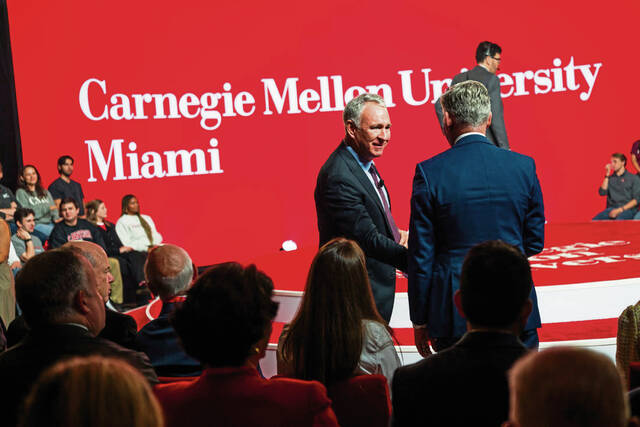
With the announcement last week that Carnegie Mellon University received a $3 billion donation from Citadel hedge fund founder Ken Griffin, we were reminded that once again the future of America can start right here in Pittsburgh.
When steel was essential to the growth of America and eventually to the defense of freedom throughout the world, industrial titans Andrew Carnegie and Andrew Mellon — along with tens of thousands of European immigrants — helped make America a global powerhouse. Now that the future is computers, robotics and artificial intelligence, their namesake university and the city where they settled and prospered are leading the way again.
For Pittsburgh, being in this position is no accident and did not come easy. The city’s leaders anticipated the shift from heavy industry that resulted in the loss of 130,000 jobs in the 1970s, and they started to move the local economy toward education and medicine two decades earlier. That saved the city, and there has been steady growth ever since.
In 1984, with the leadership of CMU President Richard Cyert, the Allegheny Conference, Mayor Richard Caliguiri, and a host of civic and labor leaders, CMU won the competition to lead and administer the new Software Engineering Institute under the Department of Defense. Our congressmen Bill Coyne and Jack Murtha delivered the ample appropriations necessary to get the institute up and running.
The research center gave Pittsburgh international credibility in the fields of software engineering and cyber security, and it bolstered CMU’s role as a world leader. Billions of dollars have been invested in the city since, as both start-ups and established tech companies have been drawn to this gateway to middle America.
Griffin’s gift has been called the largest ever by an individual to an institution of higher learning: $2 billion will be used to establish a CMU campus in Miami, Fla., and $1 billion will stay in Pittsburgh.
“Carnegie Mellon represents excellence in higher education, and it is a privilege and honor to support the leadership team, the faculty and the students here at Carnegie Mellon,” Griffin said. He added that the Miami campus, like CMU in Pittsburgh, will attract the brightest students and scholars from around the world.
If anyone needs a clear sign that America’s place in the global economy depends on attracting and keeping the best and brightest minds right here, Griffin’s gift to CMU is that sign. KDKA-TV’s Andy Sheehan reported in 2025 that international students comprised 44% of CMU’s student body, enriching the city and the nation.
But recent changes to national public policy that affect foreign students who want to study here and remain here after receiving an American education are taking the country in the opposite direction, and that has to change. Griffin’s gift is a repudiation of that new policy.
A recent Brookings report found that even though “high-skill immigrants have long been central to American innovation and economic growth,” the Trump administration’s actions “so far have squeezed multiple segments of the talent pipeline,” which will result in a projected decline in foreign student enrollment at American universities.
Students will no longer be free to extend their studies, earn an advanced degree or a second degree, or pursue post-graduate studies. And once they receive their training and degrees, the new rules send them packing, depriving the American economy of the education and expertise that they acquired here.
We knew better long ago, when immigrants came here in the 19th century to work in the mills and factories. They made America great. Immigrants can do that again.