
A vaccine being tested by University of Pittsburgh researchers could one day prevent some breast cancers before they become invasive — potentially stopping the disease before it truly starts.
The experimental vaccine builds on decades of research by Pitt cancer researcher Dr. Olivera Finn, whose work identifying a molecule associated with cancer has led to a new trial testing whether the immune system can be trained to intercept breast cancer at its earliest stage.
“While people consider (cancer) very different than other diseases that affect us, it’s not that different. The immune system notices that something is wrong and tries to protect,” Finn said. “The best way for the immune system to protect us from something is to be prepared ahead of time.”
The American Cancer Society predicts that, in 2026, nearly 322,000 women will be diagnosed with invasive breast cancer, with more than 42,000 women dying from the disease. Fortunately, more than 60,500 cases will be caught early during the noninvasive
Stage 0, also known as ductal carcinoma in situ, or DCIS.
“The moonshot project here is that — if we can continue to prove the work that we’re using on principle right now — the hope is that we can one day develop a vaccination that prevents cancer,” said the study’s principal investigator, Dr. Emilia Diego, division chief for breast surgery at UPMC.
In the 1990s, cancer research pioneer Dr. Olivera Finn, who is spearheading this particular study, first identified the MUC1 molecule as a unique feature of cancer that induces an immune response from the human body once recognized — an antigen, like the spike of the covid-19 virus. While Finn’s research later found established cancer is able to suppress that immune response, with further study her vaccine could one day prove enough of a boon to the immune system to defeat a significant portion of the 20% of breast cancers the National Breast Cancer Foundation says are caught in the precancerous Stage 0 — before they have the chance to get started — without surgery.
She compared the role of a potential cancer vaccine to those used to combat viruses.
“If you get a vaccine, your immune system is ready to see that virus. And as soon as it sees it, it can prevent the spread of the infection and you get better right away,” Finn said. “With cancer, if we learn — and we have learned a lot about what the immune system sees on cancers that it considers different, foreign and dangerous — then we can prepare the immune system with a vaccine to be ready.
“The immune system can come to the site right away, recognize these cells and kill them as if they were virus-infected cells.”
Time is of the essence
Timing, Finn said, is everything when it comes to the third year of her current window trial, which has so far enlisted 40 women with Stage 0 breast cancer out of its target of 50. As part of the trial, each woman receives the MUC1 vaccine via three shots over 12 weeks or a placebo, then has the problematic tissue surgically removed as is standard.
“None of those very highly immunosuppressive effects of cancer exist in these patients,” said Finn. “So it seems like a very good opportunity to get the immune system revved up right now, before the growth of these abnormal cells can suppress it.”
Despite breast cancer deaths declining by 44% from 1989 to 2024 in the U.S., according to the American Association for Cancer Research, the ACS predicts that overall cancer cases are expected to increase by 67% worldwide from 2024 to 2050 based on population growth and aging. Meanwhile, several recent studies and a report from ACS have shown cancer incidence, including breast cancer, rising in young people.
“Just therapy is not going to solve the problem,” Finn said. “We really need to do both therapy for those we don’t save (with a vaccine) and a lot of prevention. And prevention doesn’t mean that nobody’s going to be diagnosed with cancer. It just means that many fewer people will be diagnosed with cancer, and so we just want to lower the risk of every cancer.”
Massive potential
While no complete results from the trial have been released, it has been encouraging, according to those behind it.
“The vaccination does, in fact, have an effect on the system of the person who’s receiving it,” echoed Diego. “We’re not just looking at whether a person has actually developed antibodies against the vaccination. We’re also looking at the tumor microenvironment, which means we’re looking at the tissue of the person who received the vaccination and had an operation not only to see did the body actually create antibodies, but did these antibodies actually start attacking the cancer in the breast before we removed it? There are also some very positive signals there.”
Results from previously completed studies have also been promising. Data published in 2023 showed that, in vaccinated individuals with polyps, a colon cancer precursor, researchers saw a 38% reduction in expected polyp recurrence 1 to 3 years after removal.
It remains unclear how long the vaccine might grant protection, but there are scientific indications.
“We know that (the vaccine) lasts as long as we’ve been able to test it,” said Finn. “We know that, if we generate a response with the first three shots, that we can boost at six months and at a year. We haven’t done a 10-year booster, but the way the immune system works, if you have a memory at one year, you probably have an immune memory at 10 years.”
Finn said the next trial — which will see the vaccine administered without the follow-up removal surgery — is already “on the books” with the National Cancer Institute.
“We are hoping that in a trial like that we can see how long this immune response will protect them,” Finn said. “Because I would really expect these lesions to eventually disappear, rather than the surgery removing them.”
If that goes well, the next step will be enlisting Big Pharma to scale the trial at a cost Finn informally estimates at around $250 million, compared to the $2-3 million price tag of the current trial.
The current phase is expected to wrap up in March and be published in fall of 2027.
‘Good or Ill’
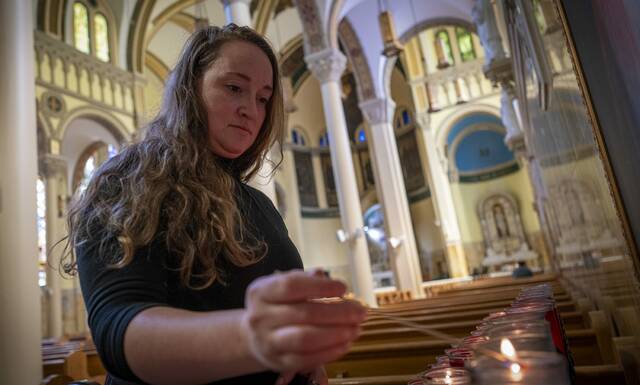
For 38-year-old trial participant Ren Horcher of Friendship, who is program director of the Catholic Studies Department at Duquesne University, the timing of the study is full of meaning.
She was diagnosed with DCIS just two months after her wedding to her husband, Max, at Epiphany Church. During services at the church while she awaited biopsy results — and before understanding the disease to be highly survivable — her emotions poured out.
“By total chance, they played the hymn that we walked up to our wedding together. It’s called ‘O God Beyond All Praising,’” said Horcher. “It’s so beautiful and it’s so emotionally overwhelming. In the second line, there’s this verse that says, ‘Whether our tomorrows be filled with good or ill, we will triumph through our sorrows and rise to bless you still.’
“I just remember having a total breakdown … I would say I cried most of the way through church for three weeks.”
Those who analyzed her last mammogram had advised her to come back when she was 40.
“When I think about that and that it was just this totally-by-chance reason that it ever got found, it can be a little breathtaking,” Horcher said. “Where you’re like, ‘Oh wow, this could have gone so differently.’”
After her diagnosis, Diego informed Horcher that she fit the criteria of Finn’s study, should she choose to participate.
Just six months earlier, Horcher received her first-ever round of vaccines. Though now a practicing Catholic, she’d been raised in a fundamentalist community of 50 to 60 families in Arkansas until she was taken into protective custody at 13.
“Part of that cult’s beliefs were that ‘Western medicine and vaccines were poison intentionally given to us to harm us,’” said Horcher. “When someone tells you your whole life that vaccines are poison, and that if you get a vaccine or you give someone a vaccine, they could develop profound mental illnesses or all these things, it takes a lot to get your first vaccine.”
When she agreed to take part, she put that part of her life even further behind her.
“I just remember thinking there is something very empowering about this that not only am I in this position where I can now make these kinds of decisions for myself, I can develop some amount of trust with medicine, medical research, medical technology and I can also contribute to it,” said Horcher.
Diego called her and others’ involvement “altruistic.”
“If it’s not this (vaccine), then we can move on to trying the next one, right? And that’s a big part of it. Not everything is going to be successful, and so we’re going to contribute,” said Horcher. “It can be so easy to think of that as wasted time or as a disappointment, but it does still matter.”
Horcher has since had both the vaccine and surgery amid the “deeply feminine space” of a lab led by a team of all female, all immigrant doctors.
“It was really therapeutic to have a space where I could go, and it was just sort of acknowledged and known,” Horcher said of her diagnosis. “My external reality matched the internal.”
Though she hasn’t been let in on the results yet either, Diego described to Horcher how they look when they come in.
“If the vaccine is working, it will show up on scans in colors. She said it’s incredible, and she said it looks like ‘Starry Night,’” explained Horcher. “The scans from before the vaccine are completely dark and the scans from after the vaccine are swirls of color.”