
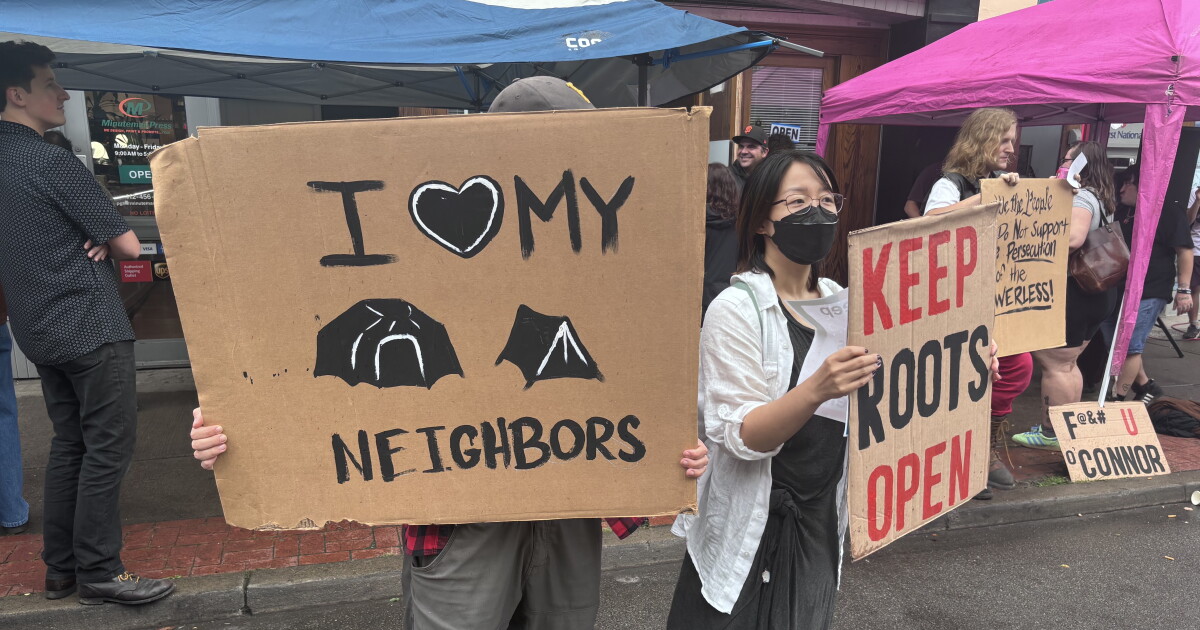
Pittsburgh community members gathered on the city’s North Side on Friday to express frustration over the closure of a homeless outreach center on East Ohio Street.
The Reaching Out On The Streets (ROOTS) Program drop-in center, located in the East Ohio Street business district, has served as a resource hub for unhoused individuals and others needing help with healthcare, mail and housing assistance.
Resident Callie DiSabato said the shuttering of ROOTS will hurt some of Pittsburgh’s most vulnerable community members, despite the city’s claims to assist those in need.
“It is kind of absurd to be saying we’re not disrupting services because closing an on-site space is a massive disruption of services and now people don’t have a space to go,” DiSabato said.
The ROOTS program began as a pilot partnership between the city and Allegheny Health Network, before receiving funding for a major expansion in Dec. 2022.
Earlier this year, Pittsburgh’s Department of Community Health and Safety received an $800,000 grant from Allegheny County to expand the ROOTS program. The funding, according to an announcement, would allow ROOTS to bring on six new full-time employees and four part-time employees in order to expand their team coverage to seven days a week, including evenings and weekends.
Molly Onufer, a spokesperson for Mayor Corey O’Connor’s office, said in September the center is closing because its lease is set to expire.
“We are just looking at our options for continuing to operate the program, and how we can do that and best serve our community,” Onufer said.
O’Connor spoke with WESA in the early days of his administration, stating he wanted ROOTS take a different approach, one focused more on providing outreach than on having centralized drop-in locations.
Julie Armagost, a street outreach coordinator with the nonprofit Bridge to the Mountains, says there is no plan in place and that she has little confidence people will be able to receive the services they need with the recent ROOTS center closure.
“The services people get here are so incredible and life-sustaining,” said Armagost. “The other places where people theoretically can go get these services are not in this neighborhood (North Side) and those places are so overwhelmed.”
Homelessness, both locally and nationally, had been on the rise following the end of the COVID-19 pandemic. Those who’ve used the North Side facility as a return address are being told to use the Second Avenue Commons shelter Downtown instead.
The center was one of the last of its kind, after the shuttering of facilities that had been operating in Downtown and East Liberty over the last couple years.