
💌 Love Philly? So do we. Let’s be friends. Sign up for the Billy Penn newsletter today.
If you ask Ian Dickens if he’s related to the famous novelist, here is his answer: “Yes.”
A great-great grandson of the author of “A Christmas Carol” and “David Copperfield,” Ian Dickens made his first visit to Philadelphia recently, and saw first-hand items related to his ancestor.
“I was surprised by the connections. I knew to a degree the connections, but to be taken around museums and The Free Library and to be shown some of the extraordinary collections face to face, with the handwritten (pages) of “The Pickwick Papers,” and a first edition of A Christmas Carol has been incredible,” said Ian Dickens.
He was in Philadelphia to help the Philadelphia Pickwick Club celebrate its 45 anniversary. (“The Pickwick Papers” follows Samuel Pickwick and members of The Pickwick Club as they travel across England and record their experiences. The novel’s popularity inspired readers to create real-life Pickwick clubs.)
Ian Dickens started professionally as a photographer, “primarily motor sports photography, and I stayed in the photographic industry and joined Olympus cameras, and was there for 21 years as their marketing director.” In 2000, he quit, and took part in traveling around the world in a sailboat race of 6,000 miles that took 11 months. “I was 45, classic halftime moment (or mid-life crisis, as we say in the United States),” according to Ian Dickens.
Charles Dickens visited Philadelphia in March 1842 and January 1868. He wanted to see Eastern State Penitentiary, which opened in 1829. The prison’s approach was to keep prisoners isolated; this would provide them time to think about their crime, and offer penitence.
Jim Baraldi, president of the Philadelphia Pickwick Club, said, “Quite the opposite happened” at the prison.
“It was created by the Quakers with the initial intent that inmates wouldn’t interact with other prisoners,” said Baraldi. “They’d have an opportunity to sit alone and reflect on all the bad things they did, and then they become good people. Well, it didn’t go that way, and, (Dickens) understood that was the initial intent. But when he got here, (he was) absolutely horrified to see these (prisoners) sitting alone in these cells, and he said the look on their faces was as if they’d seen a ghost.”
Scholars believe this experience led to his writing “A Christmas Carol,” in which Ebenezer Scrooge is “isolated” from humanity, and is doomed to suffer; when he rejoins humanity, he is saved.
“And from that, supposedly, (is) where the story comes from,” said Baraldi.
“He wrote it like in six weeks because he was hurting for money,” said Baraldi, “But he was so confident in his own ability that he actually self-published it, spent a fortune (doing) it, and even though it sold very well, it barely covered the cost of the printing.”
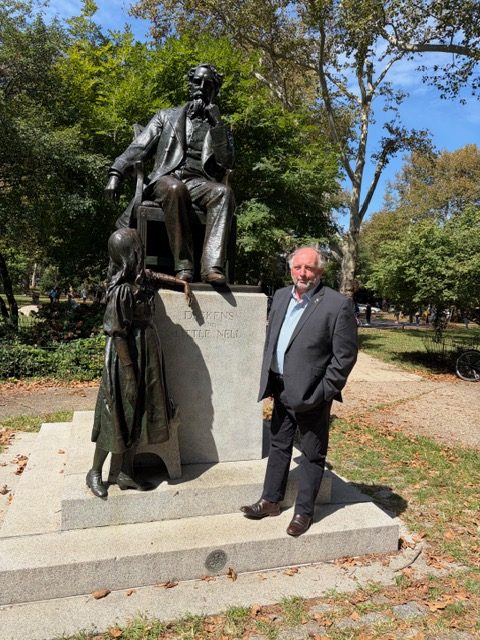 Ian Dickens, a great-great grandson of Charles Dickens, stands by the statue of the author of “A Christmas Carol” that’s in Clark Park in West Philadelphia recently. (Jon Caroulis/for Billy Penn)
According to Baraldi, the Pickwick Club of Philadelphia took Ian Dickens on a “Cultural Walk,” a Stumble (Pub Crawl), a gala at the Union League, and a brunch at Cavanaugh’s Headhouse (formerly The Dickens Inn) before heading to Clark Park. He added that the club has been having their meetings at the same location, which has been The Dickens Inn, then became The Dark Horse, and now is Cavanaugh’s Head House.
In addition to the penitentiary, Ian Dickens visited the Free Library of Philadelphia and the Rosenbach Museum, which have Dickens artifacts in their collections.
At the Rosenbach, in addition to the handwritten pages of “The Pickwick Papers” (very few have survived), Ian Dickens saw a photo of Charles Dickens.
On the back of it “there was his signature, with big flourish and underlines, and very helpfully he dated it, the date is the eighth of June, 1870. By the end of that day, after writing more pages of ‘The Mystery of Edwin Drood’ he came into his house at Gads Hill in Kent and collapsed. He died the following day after suffering a severe stroke,” said Ian Dickens.
Also at the Rosenbach are the earliest surviving manuscript of Dickens, a page from a burlesque entitled O’Thello, which he wrote when he was 20 for his family to perform at home; a first edition of “A Christmas Carol,” inscribed by Dickens to his friend Dr. John Elliotson, who taught Dickens hypnotism (Dickens was a well-practiced hypnotist); and a detailed recipe in Dickens’ hand on how to make his two punches, Innocence and Moonbeams.
While visiting the Philadelphia Free Library, Ian Dickens saw Charles Dickens items such as a letter about Eastern State Penitentiary; Dickens’ notebooks done in shorthand; (the library has a portion of “The Pickwick Papers” manuscript, separate from the Rosenbach’s item; it was given to the Rare Book Department by a group of anonymous donors in 1977). Other Dickens items include a letter opener shaped like a bean pod that was given to Dickens by his sister-in-law Mary Hogarth, Dickens’ inkwell, his silver and mica travel lamp and his green glass letter scale.
There’s also the manuscript of “The Life of Our Lord,” a book about the life of Jesus he wrote for his children, and Grip, Dickens’ pet raven, whom Dickens had stuffed and preserved when it died. Dickens included Grip in his novel, “Barnaby Rudge,” and this talking raven was an inspiration for Edgar Alan Poe (who met Dickens on his first trip to Philadelphia) for his poem “The Raven.” Ian Dickens also saw the original serial issues of “The Pickwick Papers, in the copy Dickens personally inscribed to his sister-in-law, Mary Hogarth, who died during the publication of the serial.
Free Library has a room that was the personal library of William McIntire Elkins, a major collector of Dickens. According to the Free Library’s Rare Book staff, “After Elkins died in 1947, his family gave his collections to the Free Library of Philadelphia. His family also suggested that the library room itself be given to the Library. The 62-foot-long paneled room, along with its furnishings, was removed from the Elkins family home, Briar Hill, in Whitemarsh, and physically moved to the Parkway Central Library, where it was reconstructed on the third floor. The room includes a writing desk owned and used by Charles Dickens for 30 plus years.”
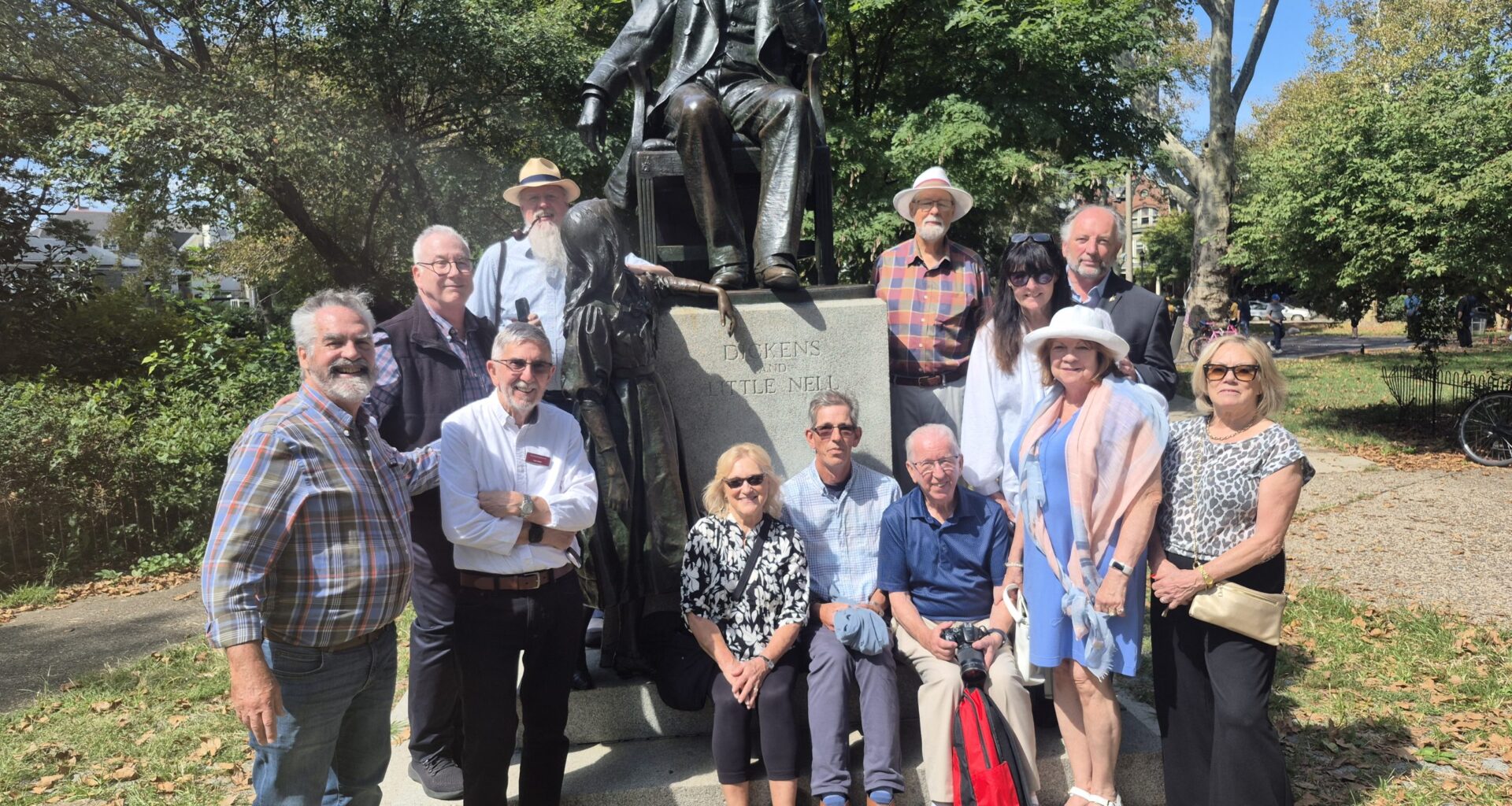
One of Ian Dickens’ final visits was to Clark Park, which has one of three known statues of the writer (Philadelphia’s is the oldest, sculpted in 1890; A second shortly followed in Centennial Park, Sydney Australia; the third is in Portsmouth, United Kingdom, the city of Dickens’ birth and was unveiled in 2014.) Placed atop a granite base, the Charles Dickens statue is 6-foot-8, while he’s sitting in a chair and looking at Little Nell, a character from “The Old Curiosity Shop,” who is standing and is 5-foot-4.
Ian Dickens has seen photographs of it, but seeing it in person was an experience.
“I love it, I love the scale, I love the way he’s looking at such a pretty, adoring face,” he said.
The theme of several Dickens books deal with children who are orphans (“Oliver Twist”), living in wretched conditions (“Bleak House”), or dying young (The Old Curiosity Shop). During his lifetime people didn’t know that his childhood mirrored what he wrote.
When he was 12, Dickens’ father was sent to debtor’s prison. His mother and several siblings accompanied him, leaving Dickens alone.
“And when I go to schools, I talk to nine and 10 year-olds, they’re the same age as him when he’s having to fend for himself,” said Ian Dickens. He tells students if you take the initials of David Copperfield, “DC”, and reverse them, you get “CD”, the author’s initials. “So there’s a clue that it’s autobiographical,” he says. (“David Copperfield” is Ian Dickens’ favorite of Charles Dickens books; it was also Charles DIckens favorite among his works.)
Ian Dickens was joined by his cousin Rowland Dickens, who lives in Mendham Township, New Jersey, about 80 miles northeast of Philadelphia. The pair have stayed in touch, but hadn’t seen each other in 25 years. Rowland Dickens came to the United States in 1979 “for one year,” but wound up staying, working in the financial industry. People often ask him if he’s related to the author, and they’re shocked when he confirms it.
“Sometimes I don’t believe it myself,” he says about being a descendant of one of the world’s most famous authors.
Rowland Dickens’ favorite novel by his great-great grandfather is “A Christmas Carol,” which he describes as “just timeless.” On Christmas Eves, he watched film versions with his three sons while they were growing up. Now that they’re adults, on Christmas Eve they play “a drinking game” while watching the 1992 “Muppet Christmas Carol,” with Michael Caine as Scrooge, Kermit the Frog as Bob Cratchit and Miss Piggy as Mrs. Cratchit
To join The Pickwick Club of Philadelphia, a person must attend as a guest of a member for at least two meetings. An interview with the board occurs with a person who has two member sponsors. Once the board approves, the individual is introduced as the newest member at the next general membership meeting. A Pickwick sobriquet is assigned to the new member prior to their introductory meeting. Baraldi said there are 60 members of the Philadelphia club. Ian Dickens is president of the London Pickwick Club, and he said there are other clubs around the world.
There are great-great-great grandsons of Charles Dickens, the children and grandchildren of Ian and Rowland, so the lineage will continue.
Each boy in the family is given the middle name of Charles.
What Ian Dickens finds interesting is “people often say, do you all write? As a family? No reason why we should, but it’s what I call a communications gene, so marketing is a communication: you take people on a journey, you tell them something they don’t know about and leave them in a better place, which is what writing is,” he said. “My son is a musician, music is a journey. My daughter worked in fashion, clothes, exactly the same (in communication), so it’s very interesting . My brother is an actor; a cousin who’s been an actor and successful in films in ‘Game of Thrones,’ and so it’s all creative professions,” he said.