
This story was originally published by Technical.ly, a news partner of Public Source. You can sign up for their newsletters at technical.ly/subscribe.
Get ahead of development in Pittsburgh.
Subscribe to Public Source’s Develop PGH newsletter.

Economic gains from Pittsburgh’s tech boom are being felt by some but not all — and a majority of locals aren’t confident in the direction their community is headed.
That’s according to new data from market research firm The Harris Poll, focusing on what Americans want from innovation. Local experts from higher education, workforce development and venture gathered at a Mount Washington restaurant last week to discuss the data and possible ways to bring innovation’s benefits to more Pittsburghers.
Local residents living just a few miles away from each other are experiencing two different economic realities right now, according to Petra Mitchell, president and CEO of the economic development organization Catalyst Connection.
“Depending on who you ask, you’re going to get two very different responses,” Mitchell said. “One is, ‘Yeah, everything’s great, it’s amazing,’ and one is, ‘Well, things are really tough for us, it’s very challenging. We live in a neighborhood where there’s blight, where there’s poverty.’”
Less than half of the 200 Pittsburghers surveyed by The Harris Poll are confident in the direction their community is headed.
But nearly 9 out of 10 Pittsburgh respondents say they are more likely to believe in a company’s innovation when they can see how it benefits real communities.
The survey included 2,000 Americans across 10 cities, with about 200 respondents in each.
While the survey’s overall margin of error is low, results for individual cities carry a wider margin of error because of the smaller sample size.
The survey was commissioned by Philip Morris International US (PMI US), an international tobacco company. It’s the maker of ZYN, a popular nicotine pouch that the company markets as a smoke-free alternative to cigarettes. With the survey, PMI US aims to provide a roadmap for business leaders and others to “strengthen trust, expand opportunity and foster innovation in the years ahead,” according to the report.
“Pittsburgh reflects a city that has experienced reinvention, and it believes it’s possible,” Jody Sunna, chief communications officer for PMI US, said during the lunch event, “but only when it’s real and when they can see how it impacts them.”
Where are the good-paying jobs?
There are currently 4,000 open positions in the Pittsburgh metro area’s manufacturing sector and about 60% of those don’t require degrees, according to Mitchell from Catalyst Connection, but there’s a lack of awareness and access to these jobs.
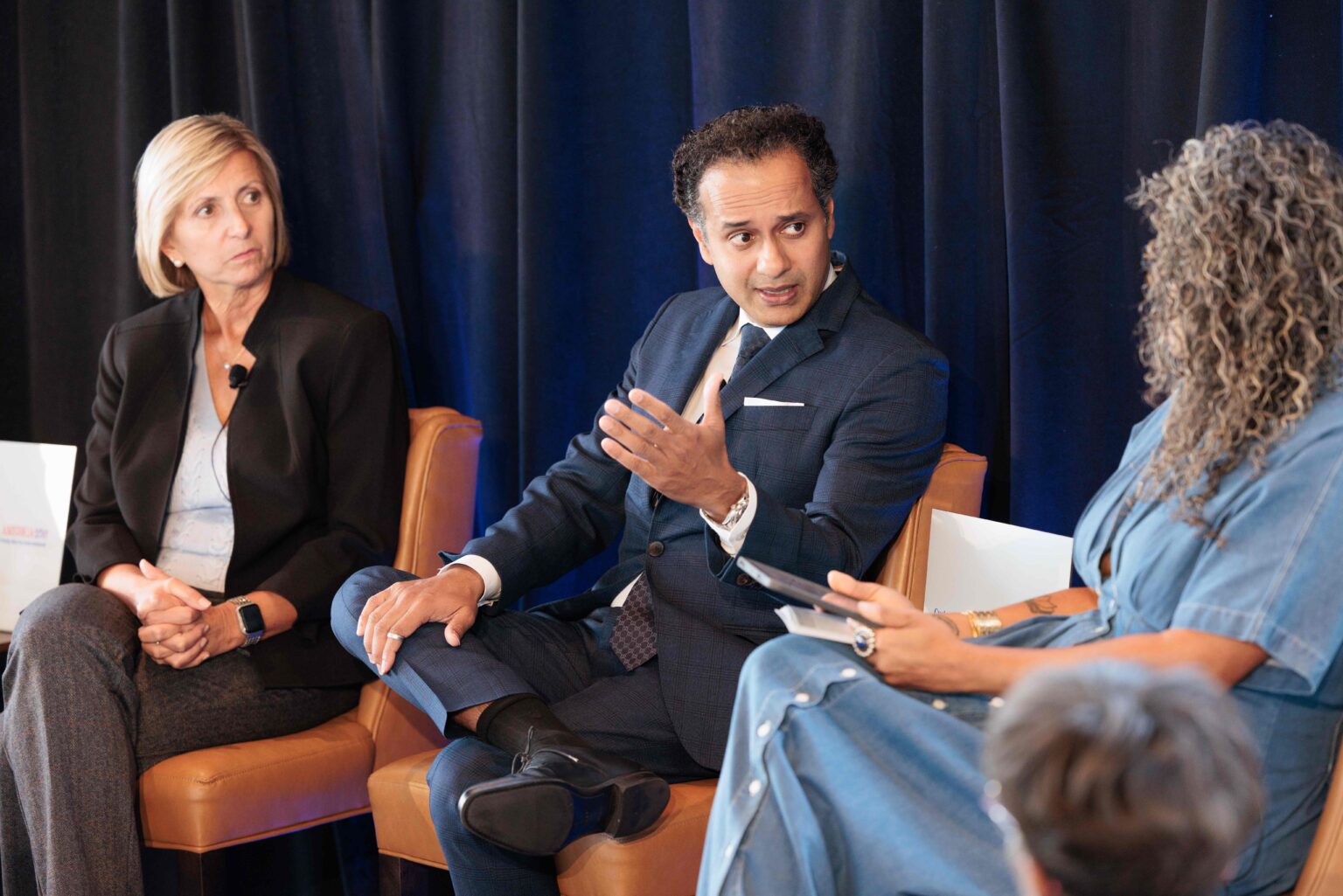 Ven Raju, president and CEO of Innovation Works, speaks on a panel about how Pittsburgh can turn its strengths in research and innovation into broad-based regional growth. (Photo courtesy PMI)

“People that have been living in these communities, where they just really have felt left behind since the decline of the industrial age — so we’re talking 40 years now — they don’t see themselves in these roles,” Mitchell said.
AI could help though, she added. From virtual tours of job sites to practicing tasks in simulated environments, digital tools could expand training opportunities for jobs like machine operators, she said.
The region’s startup retention is also a major issue, according to Evan Facher, the University of Pittsburgh’s vice chancellor for innovation and entrepreneurship. Nearly all net new jobs come from new firms, according to a report from the Kaufman Foundation. When startups leave the area, they take jobs and tax revenue with them.
‘No silver bullet’ for early-stage capital
To get more companies to stay, startups need real estate space that fits their needs, like local wet labs to support life sciences, Facher said.
 Jody Sunna, chief communications officer for PMI US, presents data from The Harris Poll. (Photo courtesy PMI US)
Early capital is one of the biggest issues, agreed both Facher and Ven Raju, president and CEO of Innovation Works (IW), a nonprofit venture development org.
About $2.3 billion of capital flowed to Pittsburgh companies last year — 10 times more than where the region was 10 years ago — but only about 3% came from resident sources, according to Raju, citing a 2025 report from IW and consulting firm EY.
“The vast majority of that comes from IW,” Raju said. “I would be the first one to argue that’s not a healthy ecosystem.”
It’s going to take local funds scaling organically and coastal funds setting up flagships in Pittsburgh, according to Raju: “There’s no silver bullet here.”
A national challenge to innovate
Pittsburgh was the third stop on PMI US’s national tour to discuss how innovation can shape America’s future growth.
 Panelists (from left) Evan Facher, vice chancellor for innovation and entrepreneurship at the University of Pittsburgh; Petra Mitchell, president and CEO of Catalyst Connection; and Ven Raju, president and CEO of Innovation Works, with moderator Raakhee Mirchandani of The Wall Street Journal. (Photo courtesy PMI)
The tour is part of PMI US’s Community Futures Challenge, a national initiative to award five $50,000 grants to nonprofits that develop solutions to challenges facing their communities and help local ideas achieve broader impact.
The Harris Poll found that about 80% of Americans surveyed believe the country is currently innovating in the wrong areas.
Healthcare, housing and good-paying non-degree jobs mattered most to these Americans, but a majority of respondents said when companies talk about innovation it often feels disconnected from daily problems.
“We see and believe that communities have ideas,” PMI US’s Sunna said, “and we want to support the future of this country.”
Alice Crow is the lead Pittsburgh reporter for Technical.ly. She joined the newsroom in September 2024 after working as a reporter for the Waco Tribune-Herald, where she covered city government, health and education.
MORE STORIES
Help us continue telling stories like this one.
We’re Pittsburgh’s Public Source, an independent, nonprofit newsroom. That means we rely on donations from readers like you to help us report accurate, timely and impactful stories for the Pittsburgh region — available to everyone without paywalls.
Everyone deserves access to credible information to understand and help shape the region they call home, which is why we work hard everyday to deliver fact-checked stories on education, environment, health, local government and more.
We’ve seen our journalism prompt widespread change in the Pittsburgh region — but none of it would be possible without the support of our community. If you found this story valuable, consider “paying it forward” by making a gift today.