

1. Immigrants make up a growing portion of the workforce in Philadelphia and its suburbs
Immigrants make up a greater percentage of the labor force than their share of the population in Philadelphia and its four collar counties.
“Immigrants across the region are more likely to be in the workforce, and they are substantially younger,” Gupta said.
Statewide, the immigrant workforce has grown by 150% since 1990, while the workforce among native-born workers has remained stable, the report found.
“I think the the problem is that immigrants are like the seeds that then produce a little shoot, and then the plant grows, and then we pick the sweet fruit and we love to eat it, but we don’t think of the seed that produced that,” said Zeke Hernandez, a professor at University of Pennsylvania’s Wharton School of Business, in a panel discussion Tuesday moderated by WHYY’s Cherri Gregg.
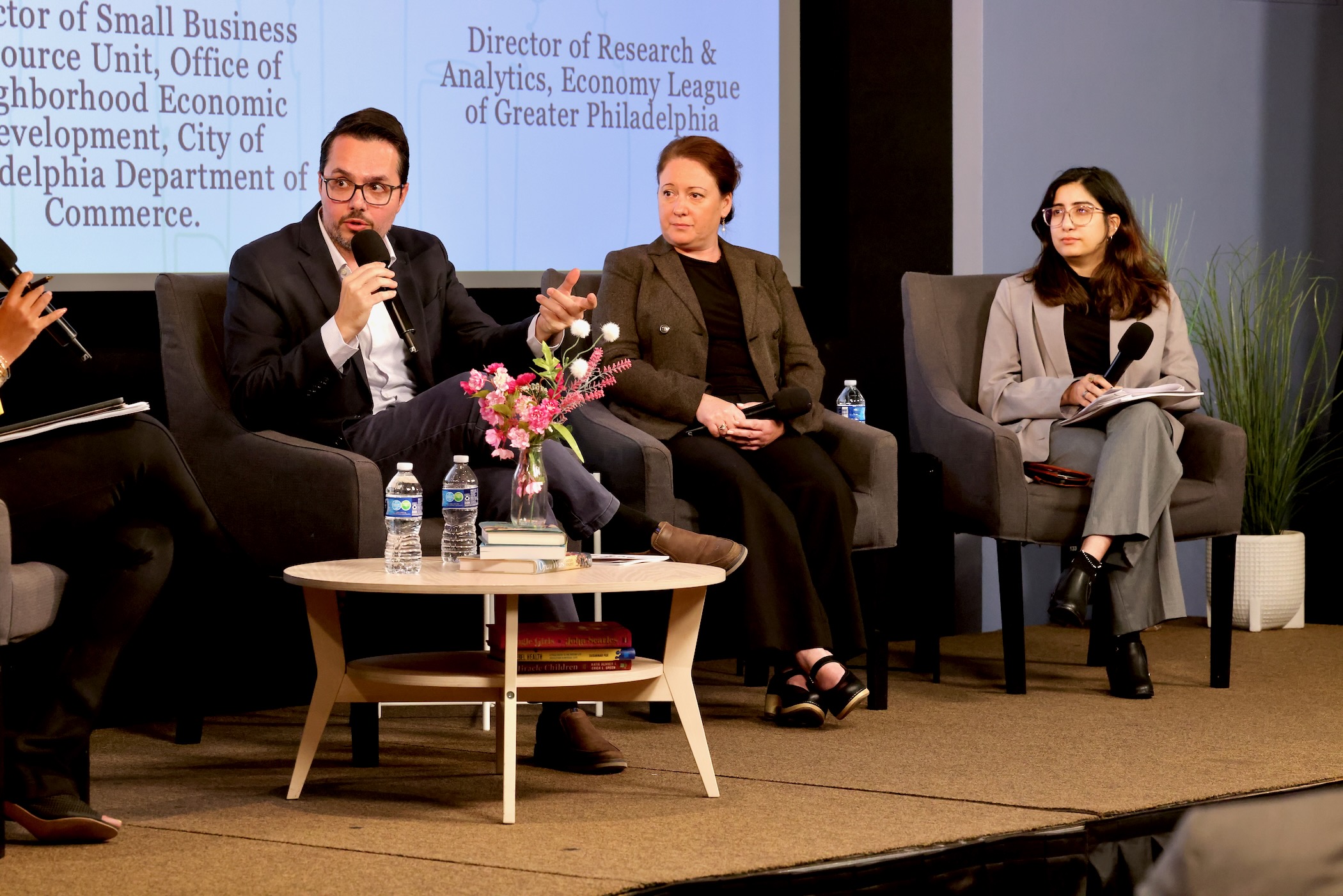 Panelists (from left) Zeke Hernandez, Nicole Marcote, and Saloni Tandon offer their views on immigration during ”Exploring Trends: Immigration’s Regional Impact,” a presentation and panel discussion about The Welcoming Center’s latest report hosted by WHYY. (Emma Lee/WHYY)
The contributions of immigrants are all the more important in the Pennsylvania workforce, said Saloni Tandon, director of research and analytics at the Economy League of Greater Philadelphia. The commonwealth is an “aging state,” she said, with 1 in 5 residents over the age of 65.
“This basically means that these people are going to withdraw from the labor force,” Tandon said. “They’re going to stop producing the kind of goods and services they were producing, and they also will need different types of services and infrastructure to be able to maintain their standard of life. Now, if you don’t have an addition to the labor force to really balance this out, you’re essentially looking at higher prices, longer wait times in say, service centers, like hospitals. You’re just looking at more pressure in the economy.”
That’s where immigrants have stepped in, Tandon said. Between 2000 and 2024, foreign-born workers fueled 60% of the net population growth in Philadelphia and the four surrounding Pennsylvania counties, she said.
“People just look at immigration as this added pressure on an economy, taking away jobs, just adding more stress,” Tandon said. “That’s not the case. They’re trying to fill a lot of gaps also while creating a lot of value as well.”
She added that immigrants in many industries, including the care economy, also bolster native-born workers’ productivity and ability to do their jobs.
“Just think of it in this hypothetical scenario,” she said. “You’re looking at a father who needs long-term care at home, right? Because this family is able to get this care at home, the daughter of this father is able to go work the hours she needs to work or wants to work. Her employer is able to benefit from the fact that he is able to retain her, and so is able to benefit from her skills and expertise. The family is able to earn money. This money is then spent in the neighborhood on buying goods and services, which then supports a lot of other businesses.”