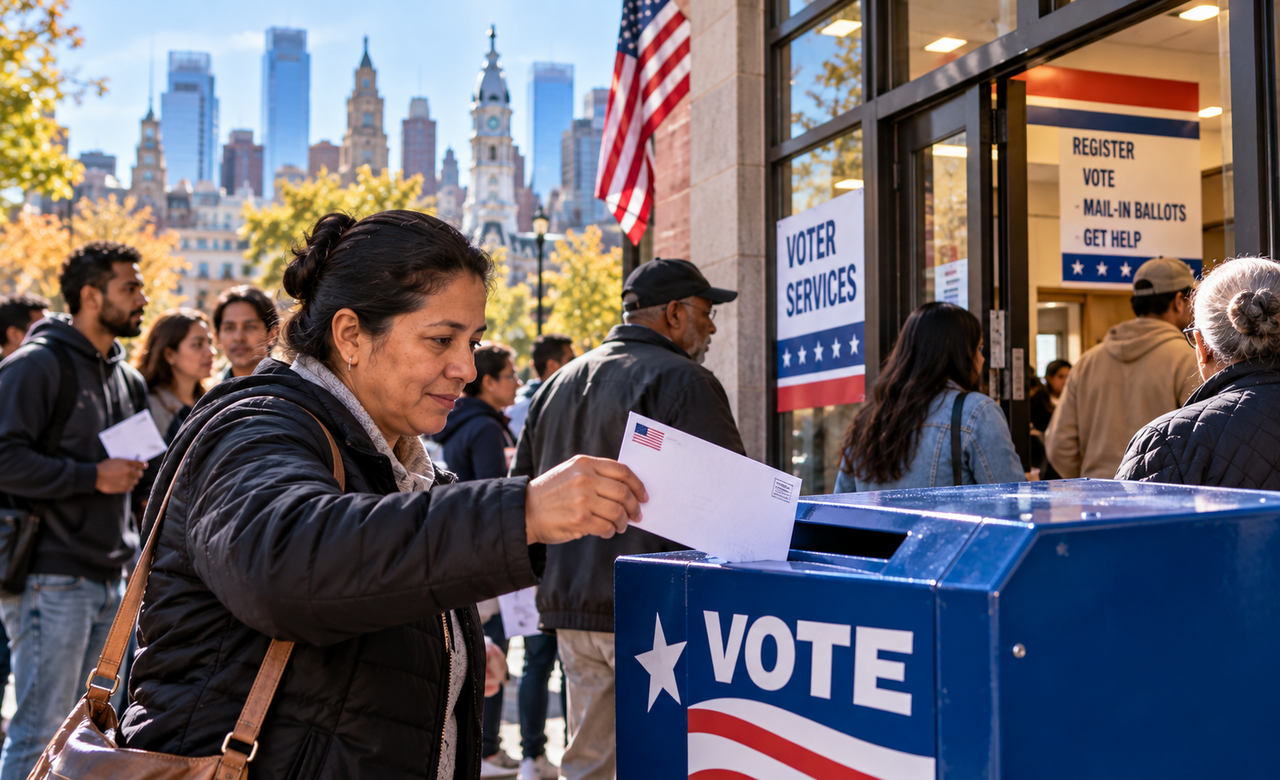
As Philadelphia prepares for the November 3 general election, Commissioner Omar Sabir is bringing part of the city’s election operation directly into neighborhoods. The strategy seeks to bring government closer to residents in a city shaped by decades of immigration and an increasingly diverse population.
In Philadelphia, democratic participation begins long before Election Day. For many residents, their first contact with the electoral system comes when they try to register to vote, request a ballot, update their information, or find an election office nearby. Physical distance, administrative procedures and, in some cases, language barriers can make participation more difficult. That is why the Philadelphia Board of Elections has expanded access through satellite offices, an initiative Sabir highlighted during a visit on October 5.
Philadelphia has ten permanent satellite election offices, one in each City Council district. Residents can register to vote, update their information, request and complete a mail-in ballot, return it in person, and receive assistance throughout the process. The goal is straightforward: reduce the need to travel to City Hall and bring election services closer to the communities where voters live.
The election calendar makes that access particularly important. October 19 is the deadline to register to vote, while October 27 at 5 p.m. is the deadline to request a mail-in ballot. Those ballots must be received by election officials by 8 p.m. on Election Day; a November 3 postmark is not enough. What may seem like simple administrative details can determine whether someone is able to participate in the election.
At the same time, the city is preparing election workers through training sessions in different parts of Philadelphia, including locations such as Masterman School, West Philadelphia and Germantown. They represent one of the less visible sides of democracy: welcoming voters, verifying information, handling election materials and explaining procedures during an Election Day operation involving hundreds of polling locations.
Sabir’s office has also promoted initiatives such as Vote Philly Vote and the Octavius Catto Taskforce, focused on voter registration, election education and civic participation. The broader goal is to reduce barriers that can keep citizens away from the electoral process, particularly in neighborhoods where access to information, transportation and public services can vary.
A City Shaped by Immigration
Philadelphia’s electoral history is closely connected to its immigration history. Irish, German and British immigrants were followed by Italians, Eastern European Jews, Poles, Asians, Caribbean communities and Latin Americans. Each group transformed the city through its neighborhoods, businesses, churches and community organizations, eventually becoming part of its political life.
Integration, however, was never simple. Philadelphia experienced periods of hostility toward immigrants and conflicts over citizenship and political participation. Today, the context is different, but one fundamental question remains: Who has meaningful access to the institutions that govern their community?
That question has become increasingly relevant as Philadelphia’s Latino population has grown. Between 2000 and 2022, the city’s Latino population increased from approximately 130,000 to 252,400, with significant growth among communities from the Dominican Republic, Mexico, Guatemala and Colombia.
For immigrants who become U.S. citizens, voting is one of the most direct ways to influence decisions affecting their families and neighborhoods. For those who are not yet citizens, civic participation can take other forms, including organizing, attending community meetings and helping others understand public policies.
The satellite offices are based on a simple principle: if government wants people to participate, it must also come closer to them. Not everyone can leave work to travel to Center City, and not everyone has a car or feels comfortable entering a government building. For some residents, language and technology can create additional obstacles.
On October 5, Sabir visited a satellite office in Germantown and deposited his own mail-in ballot there, offering a practical demonstration of one of the voting options available to residents. The city has also extended hours at certain locations to make services more accessible before key deadlines.
Philadelphia has changed with every generation of newcomers. Its languages, businesses and neighborhoods have evolved, as have the ways people participate in political life. As November 3 approaches, bringing election services closer to residents sends a broader message: democracy does not happen only on Election Day. In a city built by people who came from elsewhere, it can begin much earlier when a public institution opens a door close to home and makes participation a little easier.