
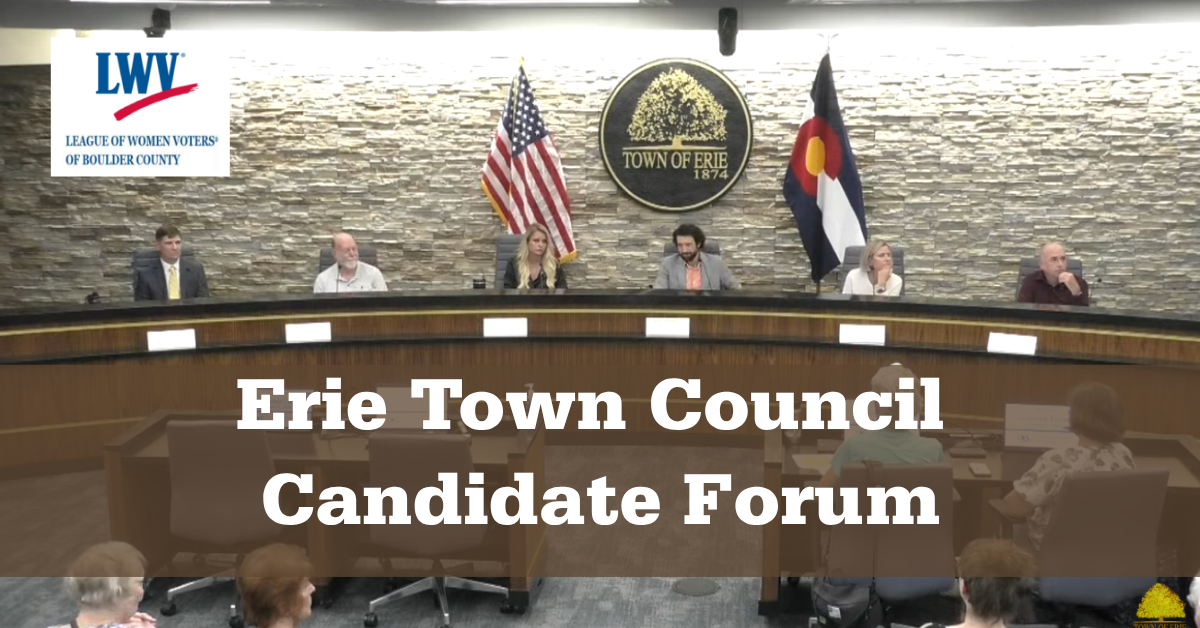
Six candidates at a League of Women Voters forum laid out sharply different visions for Erie’s future, with recurring disagreements over development, the SM Energy mineral-rights deal, Red Tail Ranch and the Northern Integrated Supply Project.
The forum showed essential differences in how candidates think Erie should grow: some candidates emphasized adding housing and commercial activity while keeping infrastructure in step, while others focused more heavily on limiting new costs, tightening oversight or slowing decisions until residents have better information.
The summaries below capture each candidate’s answers, with fact checks where claims could be independently tested. The biggest differences emerged on three questions: whether Erie should have approved the mineral-rights deal, whether Red Tail Ranch should have moved forward, and how aggressively the town should commit to NISP.

Bob Braudes, candidate for Erie Town Council District 1.
Opening statement
Braudes said his priorities are affordability, government accountability and building for the community rather than pursuing growth for growth’s sake. He pointed to his work with St. Vrain Habitat for Humanity and said people who work in Erie should have the option to live there. He also called for walkable neighborhoods where homes and businesses can coexist.
What should Erie do about housing, utilities and other affordability issues?
Braudes said Erie needs more housing that teachers, first responders and service workers can afford. He argued that more housing choices could strengthen the town’s tax base and pointed to his work helping people with utilities and eviction prevention.
Did you support the SM Energy mineral-rights agreement, and how should the process have been handled?
Braudes strongly opposed the agreement. He said the process was badly flawed and went further, arguing that the council’s vote violated the Colorado Constitution. He also argued the financial deal favored SM Energy because the company could recover 200% of certain development costs before Erie began receiving its share of production revenue.
Braudes also cited U.S. Energy Information Administration data, saying oil and gas production can fall about 90% during the first 24 months. His argument was that much of the most productive period could be over before Erie began collecting production payments.
Fact check
Claim: The mineral-rights vote violated the Colorado Constitution and was therefore illegal.
Designation: False
Reasoning: The available records do not support that conclusion. Erie’s Home Rule Charter allows Town Council to sell interests in real property by ordinance. Ordinance 028-2026 also directly addressed whether the charter required voters to approve the sale and concluded that its voter-approval rule for designated open-space land did not apply to mineral rights. Council records show the council approved the deal by ordinance.
Fact check
Claim: SM Energy could recover 200% before Erie received any money.
Designation: Mostly true
Reasoning: The 200% figure is real, but “any money” is too broad. Under the agreement, SM Energy had to recover 200% of certain Draco development costs before Erie’s 3% production payments began. Yellow Scene reported on that payment structure, and it was also discussed during the June 23 council meeting.
Fact check
Claim: EIA data show oil and gas production falls about 90% within 24 months.
Designation: Mostly true
Reasoning: Braudes was right about the larger trend: individual shale and tight-oil wells often lose production quickly during their first one or two years. EIA specifically describes high early decline rates, and its well-production models use decline curves that vary by well and formation.
Would you have approved Red Tail Ranch?
Braudes voted to recommend the project while serving on the Planning Commission but said he now regrets that vote. He said commissioners were initially told to judge the application under the Unified Development Code and later learned they could consider other information, including the site’s contamination history. He said he would have voted against it had he understood that at the time.
How should Erie support small businesses?
Braudes said Erie has little open commercial space and needs more buildings for businesses. He also called for a faster review process, with departments working on applications simultaneously instead of waiting on one another.
How should Erie address its future water supply?
Braudes said Erie should not leave NISP before knowing what other options are available. He also discussed Chimney Hollow Reservoir and uranium in rock used to build its dam, saying water treatment can address the issue.
Would you push for stronger oil and gas protections at the state level?
Yes. Braudes said he has already advocated before the ECMC over the Draco Pad and has worked with officials in other Front Range communities.
Should Pride and Juneteenth flags be displayed at Town Hall?
Braudes supported displaying both flags and said Erie could use flags and banners to recognize different groups.
What issue have you changed your mind about?
Braudes initially supported the Thompson Thrift development but changed his position after learning more about traffic and drainage. He said development should not move ahead until needed infrastructure is ready.

Andrew Sawuch, candidate for Erie Town Council District 1.
Opening statement
Sawusch pointed to six years of service in Erie government as a planning commissioner, council member and Planning Commission chair. He said his priorities include managing growth, infrastructure, town finances, transparency and putting residents first.
What should Erie do about housing and affordability?
Sawusch said housing is one of residents’ biggest costs. He argued that Erie built mostly single-family homes for years and needs more housing types. He also opposed adding new utility fees.
Did you support the SM Energy mineral-rights agreement?
Sawusch criticized the process and said residents should have learned about the deal sooner. But he said Erie should have reached a deal because drilling would still affect residents and the town should receive something in return.
He also supported letting residents vote on future sales of town mineral rights.
Would you have approved Red Tail Ranch?
Yes. Sawusch said the project met Erie’s approval rules and that state and federal environmental agencies had accepted the cleanup. He argued the town should have followed those findings.
Fact check
Claim: CDPHE signed off on the project, financed the cleanup, the developer cleaned the property to EPA standards, regulators issued a no-action decision, and the contaminated area is separate from the residential lots.
Designation: Mostly true
Reasoning: Most of the environmental history is supported, but not every part of Sawusch’s statement is. Federal court records show EPA and CDPHE were directly involved in the cleanup. CDPHE’s cleanup program records also provide the framework for its environmental review.
How should Erie support small businesses?
Sawusch said Erie is difficult to do business in and that the permit process creates barriers. He also questioned slow commercial growth at projects such as Town Center and Four Corners.
Fact check
Claim: Erie’s sales-tax growth has become stagnant, Erie began relying on internet sales taxes around 2022-23, commercial growth has slowed and Town Center and Four Corners have not produced the expected growth.
Designation: Mostly false
Reasoning: The town is heavily dependent on internet sales, but the rest of the statement goes too far. Erie’s financial reports and 2023 budget do not show sales-tax growth simply becoming stagnant. Internet sales are important — they made up 29% of non-vehicle sales-tax receipts in 2025 — but Erie was collecting major internet-sales revenue before 2022.
How should Erie address water and NISP?
Sawusch said Erie should not commit more money to NISP until it has studied other water projects. He said Erie owns 23% of NISP, estimated the project at $1.7 billion to $2.3 billion and warned current residents could end up paying for water needed for future growth.
Fact check
Claim: Erie holds 23% of NISP and the project is expected to cost $1.7 billion to $2.3 billion.
Designation: False
Reasoning: Northern Water’s participant records show Erie was allocated 6,500 acre-feet out of NISP’s 40,000-acre-foot annual yield. That’s 16.25%, not 23%. Erie is still the project’s largest participant.
Would you push for stronger oil and gas protections?
Yes. Sawusch said Erie has been heavily affected by oil, gas and older coal mining. He said operators can locate facilities outside town limits, where Erie’s rules do not directly apply, and Erie needs to work with the state and Weld County.
Should Pride and Juneteenth flags be displayed?
Sawusch focused on legal concerns. He said opening a government flagpole to one private group can raise questions about whether other groups must receive similar access.
What issue have you changed your mind about?
Sawusch did not give one specific example. He said officials should enter development hearings without a set position and let the evidence guide their vote.

Ben Hemphill, candidate for Erie Town Council District 2.
Opening statement
Hemphill pointed to more than four years on Erie boards and commissions, including the Sustainability Advisory Board, Home Rule Charter Commission and Planning Commission. He said his priorities include financial and environmental sustainability, transparency and public health.
What should Erie do about affordability?
Hemphill supported more housing types and mixed-use development. He said bringing businesses closer to homes could expand the sales-tax base and ease pressure on property taxes.
Did you support the SM Energy agreement?
No. Hemphill said he had already opposed the Draco Pad before state regulators. He criticized the consultant hiring process and said the final deal appeared to favor SM Energy’s timeline.
Would you have approved Red Tail Ranch?
Hemphill voted to recommend the plat while serving on the Planning Commission. He said commissioners had to judge it under the Unified Development Code and that the project met those standards. He did not support the later lawsuit settlement.
Fact check
Claim: Erie’s Unified Development Code had narrow approval criteria, and Red Tail Ranch met them.
Designation: True
Reasoning: UDC § 10-7-7(D) lists seven specific rules for preliminary plats, including zoning, health and safety, environmental impacts and connections to nearby development.
Town staff found that Red Tail Ranch met those standards, and the Planning Commission voted 7-0 to recommend approval with technical corrections. The property had also been zoned Low-Density Residential since its 2007 annexation.
How should Erie support businesses?
Hemphill said Erie should improve permit times and ensure departments have enough workers to review applications quickly. He also suggested using the Urban Renewal Authority to attract commercial development.
How should Erie address water and NISP?
Hemphill said new development should bring water with it and supported Erie’s water-allocation policy. He also called for more water-wise landscaping rather than grass that may later be removed through the town’s turf program.
Fact check
Claim: Erie has a water-allocation policy tied to growth, and its turf program can result in the town paying to remove grass installed with new development.
Designation: Mostly true
Reasoning: Erie adopted its Water Allocation Policy in May 2026. It controls how much town-owned water is available for different kinds of new development while Erie waits for major new water supplies. Developers can also bring their own approved water.
Would you push for stronger oil and gas protections?
Yes. Hemphill said he has advocated at the state level. He pointed to Draco as an example of an operator putting a pad just outside Erie’s borders, where local rules do not directly control the site.
Fact check
Claim: Draco is outside Erie’s boundaries, which lets the operator avoid Erie’s municipal oil and gas rules.
Designation: True, with a qualification
Reasoning: The Draco Pad is in unincorporated Weld County, outside Erie. Official ECMC records identify Weld County as the local government with direct authority over the surface site. Erie is listed as the nearby, or “proximate,” local government.
Should Pride and Juneteenth flags be displayed?
Yes. Hemphill pointed to the charter’s inclusivity language and said he would change the policy to allow the flags again.
What issue have you changed your mind about?
Hemphill pointed to executive sessions. He once trusted they would be used properly but now thinks as much information as legally possible should be public.

Delaney Dreckman, candidate for Erie Town Council District 2.
Opening statement
Dreckman described her work as a rural appraiser dealing with farms, ranches, water rights, land use and conservation. She also served as vice chair of the Planning Commission. She said she is running because Erie is her children’s hometown and she wants it to remain a good place to grow up.
What should Erie do about affordability?
Dreckman questioned whether subsidized affordable housing should be a major focus if existing units have vacancies or stay on the market longer than regular homes. She instead supported many kinds of housing, including apartments, townhomes and single-family homes.
Fact check
Claim: Erie has affordable housing units sitting vacant, and those units stay on the market longer than regular housing.
Designation: False
Reasoning: There was no independent data available to back that claim. Erie’s Affordable Housing program and Housing Needs Assessment point in the other direction.
The town found that only about 1.3% of Erie’s housing stock was affordable and identified a shortage of housing for lower- and middle-income households. The full needs assessment says Erie will need new affordable units to close that gap.
Erie’s Cheesman Street Residences also provides a recent example. The affordable housing development opened in 2025, and 33 of its 35 deed-restricted homes have since sold, leaving two available as of September 2026.
The town is also planning for more affordable housing rather than treating the existing supply as more than Erie needs. In September, Town Council approved a commitment to add 30 affordable units during the 2027-29 Proposition 123 cycle and adopted a faster review process for some affordable-housing projects. The commitment keeps Erie eligible for state affordable-housing funding.
Individual affordable units can sometimes sit empty or take longer to sell because buyers or renters must meet income rules. But there was no townwide data showing affordable units generally have higher vacancy or longer days on market than regular housing.
Did you support the SM Energy agreement?
Yes. Dreckman said she believed the agreement was good for Erie and would have supported it, but criticized how the town reached it. She said residents learned about it too late and the consultant hiring process did not follow town policy.
Fact check
Claim: Erie did not properly seek bids or follow its purchasing policy when hiring Alameda Mineral Advisors.
Designation: True
Reasoning: This is backed by both town records and a later audit. Yellow Scene reported that Town Attorney Breena Meng said the normal purchasing process was not followed.
Erie’s own mineral-rights records say no RFP was conducted, no proper sole-source form was completed, Alameda’s credentials were not properly checked and the Finance Director did not review the contract before it went to council.
Would you have approved Red Tail Ranch?
Yes. Dreckman voted to recommend approval as a planning commissioner. She said she had concerns about fencing around the contaminated area, but the project met the town’s approval rules and the cleanup met state requirements.
How should Erie support businesses?
Dreckman said many small-business owners want to stay in Erie but struggle with red tape and communication. She said town staff and council should be easier for them to reach.
How should Erie address water and NISP?
Dreckman said she would not decide whether Erie should stay in NISP until the town has better cost numbers. She also said the comprehensive plan’s population figures are not goals and Erie should secure water before pushing more growth.
Would you push for stronger oil and gas protections?
Yes. Dreckman said Erie should advocate at the local, state and federal levels and said the town’s oil and gas team had increased regulations, protections and enforcement during 2026.
Fact check
Claim: Erie increased oil and gas protections in 2026 and increased citations and enforcement.
Designation: Mostly true
Reasoning: Erie clearly expanded its oversight in 2026. The town’s 2026 budget and legislative agenda called for stronger oil and gas regulation and enforcement.
The town’s inspection program included quarterly inspections of active facilities, yearly full inspections, checks of plugged wells and a new soil-vapor testing program. The first-quarter 2026 report found 34 cases of noncompliance across 88 wells at 31 locations.
Should Pride and Juneteenth flags be displayed?
Dreckman said residents should feel represented, but criticized the old policy’s wording and said it needed major changes.
What issue have you changed your mind about?
Dreckman said talking to local business owners changed how she thought about small businesses and made her a stronger supporter of business-friendly policies.

Amy Becker, candidate for Erie Town Council District 3.
Opening statement
Becker, an oncology physician assistant, said she decided to run after nearly a year of speaking during public comment and feeling residents were not being heard. She said council should put residents’ needs ahead of personal agendas.
What should Erie do about affordability?
Becker said people who work in Erie should have a chance to live there. She cited a home price of about $800,000 and supported more starter homes and mixed-use development.
Fact check
Claim: Erie’s average home price is about $800,000.
Designation: True, with a qualification
Reasoning: The number has a real basis, but Becker used the wrong term and an older figure. Erie’s Housing Needs Assessment found a median sale price of $808,000 for detached single-family homes during the first half of 2022. That’s a median, not an average, and it does not cover every kind of home.
Did you support the SM Energy agreement?
No. Becker said the mineral-rights issue was a major reason she decided to run. She said the process lacked transparency and residents did not have enough time to weigh in.
Would you have approved Red Tail Ranch?
No. Becker pointed to the property’s contamination history, resident opposition and traffic concerns around Vista Ridge. She said she would accept the risk of a lawsuit rather than approve the project.
Fact check
Claim: Residents overwhelmingly opposed Red Tail Ranch, the site involved toxic waste and the project would add traffic to an already busy Vista Ridge area.
Designation: Mostly true
Reasoning: The project clearly faced substantial public opposition. Yellow Scene documented resident concerns, and town meeting records contain extensive public comment. But there was no townwide poll or full count available that proved an “overwhelming” majority of Erie residents opposed it.
The contamination claim is well supported. Federal court records document hazardous waste and buried drums on the property. The key detail is that the known contamination area is separate from the planned home lots.
Traffic concerns also have evidence behind them. Erie says Vista Parkway carries more than 6,000 vehicles a day, and the town has documented traffic and speeding concerns in the area. A 524-home project would add vehicle trips. However, the town’s traffic engineer found that the added traffic did not require more mitigation under the standards being used at the time. So the added traffic is real; how serious that added burden would be is more open to debate.
How should Erie support businesses?
Becker said Erie needs to support businesses already in town while creating more commercial space for new ones. She said there is not much space available.
Fact check
Claim: Erie has very little available commercial space.
Designation: Mostly true
Reasoning: Town data show a tight market. Erie’s 2024 economic-development analysis found about 804,000 square feet of retail space with a 3.1% vacancy rate, meaning roughly 97% was occupied. Separate town market data also showed low office and industrial vacancy.
How should Erie address water and NISP?
Becker said Erie has few strong alternatives if it leaves NISP and leaned toward staying while the town studies the cost. She also called for conservation, reclaimed water and water-wise landscaping.
Would you push for stronger oil and gas protections?
Yes. Becker said Erie should use every available tool to protect air, water and soil and support stronger state oversight.
Should Pride and Juneteenth flags be displayed?
Yes. Becker strongly supported both and said moving away from flags was hurtful to parts of the community.
What issue have you changed your mind about?
Becker said she once thought Bonanza Drive should connect all the way through. After talking with Erie Air Park residents, she changed her view.
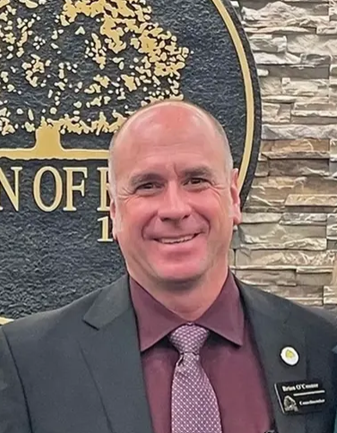
Brian O’Connor, candidate for Erie Town Council District 3.
Opening statement
O’Connor, the only incumbent at the forum, discussed living in Erie since 2001 and serving on the Tree Board, Home Rule Charter Commission and Town Council. He said his priorities include protecting open space, limiting required fees and making infill development fit existing neighborhoods.
What should Erie do about affordability?
O’Connor focused on keeping new costs off residents’ bills and supported making accessory dwelling units easier and cheaper to build or legalize.
Did you support the SM Energy agreement?
Yes. O’Connor voted for it but said the process was flawed. He said town attorneys limited what council members could say publicly because some information was confidential.
Would you have approved Red Tail Ranch?
He said the property could have been kept from residential development years earlier, that environmental agencies had accepted the cleanup and that homes were not being built on the area where IBM-related barrels had been buried.
He also said town officials had been warned that continuing the lawsuit could expose Erie to between $23 million and $80 million, though Town Council was split on whether Erie would have won the lawsuit.
Fact check
Claim: The council action settled litigation; the property had been rezoned from heavy industrial to residential; the 2014 and 2019 comprehensive plans could have stopped it; IBM-related barrels contaminated the site; regulators accepted the cleanup; homes are not being built on the barrel area; and Erie faced $23 million to $80 million in possible exposure.
Designation: Mostly false
Reasoning: Several important parts are right, but some of O’Connor’s history is wrong or too certain.
The December 2025 action was a settlement of litigation, as shown in the settlement agreement. The contamination is also well documented. Federal records document IBM-related hazardous waste, and EPA/CDPHE records in the town packet show the cleanup was accepted. The planned homes are also separate from the known barrel/remediation area.
The developer’s roughly $23 million investment is documented in the litigation record. There was no available document proving that Erie definitely faced a 23million-to-80 million loss. The higher figure needs to be attributed as an estimate, not stated as a settled fact. Yellow Scene’s coverage of the settlement provides more background on the dispute.
How should Erie support small businesses?
O’Connor said Erie should shorten approval times and improve communication between town departments so business applications move through the system faster.
How should Erie address water and NISP?
O’Connor supported staying in NISP for now but said Erie should not make a final commitment until it knows what residents would pay. He said Northern Water had told him the project could potentially double residents’ water bills and that better engineering plans would allow firmer cost estimates.
Fact check
Claim: Northern Water said NISP could double Erie residents’ water bills, 90% construction drawings were expected in fall 2026, and those drawings would allow better bids and financial estimates.
Designation: Mostly true
Reasoning: The concern about major rate increases was real. Erie officials publicly discussed the possibility that NISP could sharply increase bills, including a scenario where bills could double. Water Education Colorado reported on those discussions.
But there was no Northern Water document available that confirmed O’Connor’s specific statement that Northern Water itself told him bills could double.
Would you push for stronger oil and gas protections?
Yes. O’Connor said he would support town staff working with the ECMC and give staff the equipment, training and council support needed to identify problems and seek penalties.
Should Pride and Juneteenth flags be displayed?
O’Connor focused on the town’s policy rather than either flag. He said the old policy lacked clear rules for deciding which flags would fly and for how long, and he preferred Erie’s banner program.
Fact check
Claim: The old policy listed some groups but not others, lacked rules for timing and rotation, and Erie later switched to banners.
Designation: Mostly false
Reasoning: The old policy did not give a list of specific identity groups allowed to fly flags. Instead, it allowed categories such as the U.S. and Colorado flags and flags tied to official presidential or gubernatorial proclamations. The town’s policy record shows that clearly.
O’Connor was right about the banners. Erie changed the policy in August 2025 to formally include banners, and the town continued using banner programs in 2026, including its Hometown Hero program.
What issue have you changed your mind about?
O’Connor pointed to the SM Energy vote. He said council heard little public support before voting, but afterward several people told him they supported the deal and had been afraid to speak publicly. He said those conversations led him to call for the matter to be reconsidered.
Editorial Summary
Across the forum, candidates agreed on affordability, transparency and infrastructure but sharply disagreed on how Erie should grow, regulate development, affordable housing, oil and gas operations and pay for water.
In today’s corporate world, finding true, honest journalism is getting harder, and that includes local news, too. From corporate takeovers to the nonprofit industry, finding reporters willing to ask the hard questions seems like a thing of the past.
Which is why Yellow Scene remains fiercely independent and never, ever accepts quid pro quo. We are only beholden to our readers, not funders.
The truth is, we really cannot do this without you. If you value our journalism, become a sustaining supporter for $8 a month. Your support keeps honest reporting alive and gets the hard copy delivered to your home.
