
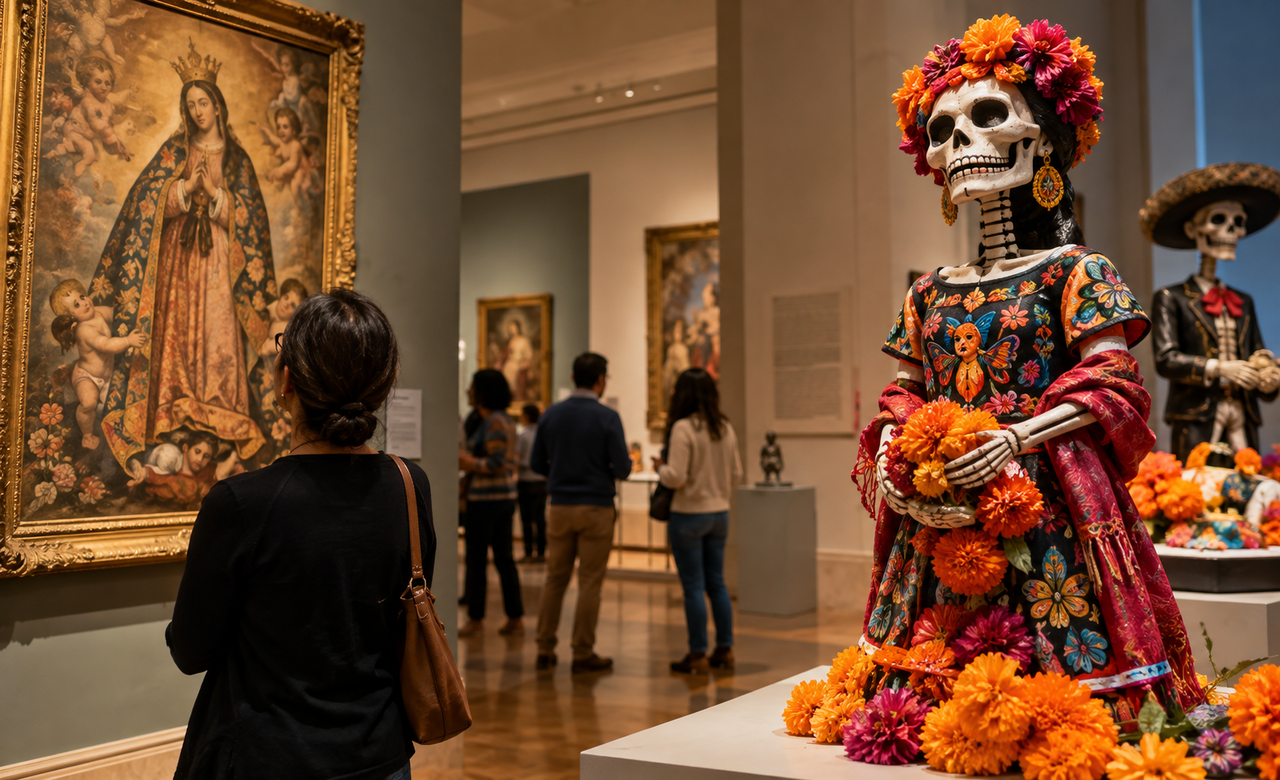
In Philadelphia, Latin American art is no longer a marginal presence on the October cultural calendar. This week, two institutions are bringing different expressions of a tradition spanning centuries, borders, and generations into the spotlight: while the Philadelphia Museum of Art offers a tour devoted to the artists and visual traditions of Latin America, Philadelphia’s Magic Gardens continues to host an exhibition by Mexican artist Ivette Chaires, whose work is deeply connected to memory, death, and Mexico’s popular traditions.
The contrast between the two spaces is revealing. At one, the perspective begins with a museum collection that allows visitors to trace more than 300 years of Latin American artistic production. At the other, a contemporary artist uses a traditional Mexican technique to transform memories of the dead into sculptures that engage with the present. Together, the two programs show that Latin American culture in Philadelphia cannot be reduced to a folkloric celebration: it is also history, heritage, identity, and contemporary creation.
Three Centuries of Latin America Inside a U.S. Museum
The Philadelphia Museum of Art is scheduled to offer the “Art and Artists of Latin America Tour” this Thursday, October 8, from 2 to 3 p.m. in its main building. The program explores more than three centuries of Latin American visual traditions and the work of its artists. The tour is included with museum admission and is limited to 20 participants, with entry on a first-come, first-served basis.
The importance of the tour lies precisely in its breadth. It is not simply a matter of bringing together paintings created by Latin American artists, but of examining how different periods, territories, and traditions have shaped a complex visual identity. The museum’s collection allows visitors to move from colonial art to Mexican modernism and then toward other ways of understanding representation, religion, everyday life, and identity.
Among the works associated with the tour is “Our Lady of Valvanera,” painted in 1762 by Mexican artist Miguel Cabrera. The painting is particularly significant because it shows how a religious image of European origin was reinterpreted in the Mexican context. Cabrera depicted the Virgin with the features and skin tone of a young Mexican woman, a decision that speaks to the processes of cultural adaptation that shaped art in colonial Latin America.
Another work is “Bicycle Race,” by Antonio Ruíz, a 1938 scene set in Texcoco, Mexico, which transforms a sporting competition and popular celebration into a portrait of everyday life. The work demonstrates that Latin American art cannot be understood solely through major historical events. It is also found in streets, festivals, ordinary people, and the small scenes that build a society’s collective memory.
The presence of these works takes on added significance in a city like Philadelphia, where Latin American communities are becoming an increasingly visible part of cultural, economic, and social life. The museum is not simply displaying objects from another region; it is creating a space to understand histories that are also part of the experience of millions of people living in the United States today.
When Death Becomes Memory
A few miles from the Parkway, Philadelphia’s Magic Gardens offers another perspective on Mexican culture. The exhibition “Viviendo a través de la muerte: Obras de Ivette Chaires / Living Through Death: Works by Ivette Chaires” remains on view through November 8.
Chaires, originally from Puebla, works in sculpture, printmaking, and photography, but one of the central elements of her practice is cartonería, a traditional Mexican technique based on creating figures from papier-mâché. For years, the artist has used the practice to create skulls and other figures connected to Mexican popular traditions.
The exhibition does not present death as an ending. Instead, it transforms death into a conversation about those who remain, about memory, and about how a community preserves its connections with those who are no longer here.
That approach is particularly relevant in a city accustomed to welcoming communities from different parts of Latin America. In this context, Día de los Muertos moves beyond a decorative image of skulls and flowers to reclaim its cultural dimension: remembering the dead also means reaffirming who we are as the living.
A Culture That No Longer Asks Permission to Take Up Space
The coincidence of these programs reveals something deeper than an October cultural calendar. Philadelphia is expanding the spaces from which Latin American history is being told.
The Philadelphia Museum of Art provides an institutional and long-term perspective: three centuries of artistic production make clear that Latin America does not have a single aesthetic tradition, but rather multiple visual languages shaped by encounters among Indigenous, European, and African peoples, as well as later migrations from different regions.
Magic Gardens, meanwhile, introduces a contemporary voice directly connected to a Mexican popular tradition. There, culture does not appear behind a glass case. It emerges through figures, materials, and stories that remain relevant today.
The difference between the two spaces matters, but so does what connects them. Both challenge the idea that Latin American art belongs exclusively in Latin America. In Philadelphia, these expressions are also part of the American cultural landscape.
And perhaps that is the most significant element of this programming: in a city preparing to celebrate 250 years of its own history, cultural institutions are incorporating other memories into the conversation about who Americans are and which stories deserve a place in the galleries of their museums.
This October, Latin American art is not arriving in Philadelphia as a visitor. It is showing that it has been part of the city for a long time.