
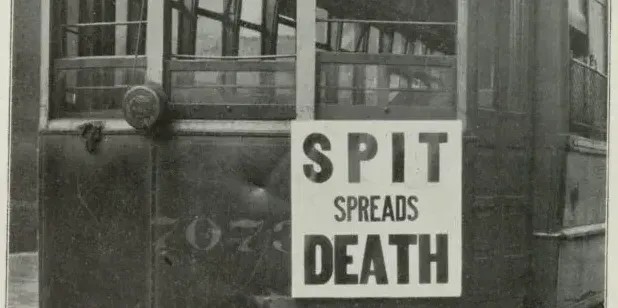
While spitting in public happens all over the world, the unpleasant custom has always been a special problem in Philadelphia.
When Charles Dickens visited Philadelphia in 1842 during his American tour (in which he visited cities like Boston, Baltimore, Washington, and Louisville), he noticed something odd: Philadelphians have a tendency to spit on the sidewalk. This fact did not endear Dickens to the city, especially after his criticism that the city, although “handsome,” was “distractingly regular.”
“After walking about it for an hour or two,” Dickens wrote, “I felt I would have given the world for a crooked street.”
Dickens also could not understand why Philadelphians at that time were mystified with his penchant for physical exercise. Dickens, after all, was known to walk at least six miles a day. This was considered “freakish” by Philadelphians in 1842.
It is wise to recall that in colonial Philadelphia, the streets were covered in animal waste and discarded oyster shells. Because tobacco chewing was in fashion, spitting in public was more or less a “necessity.”
If Dickens were to return to the city today, he’d find the topography changed but he’d still encounter hordes of public spitters. Today’s spitters are mostly men, most are young. Some who spit do so in groups who use spitting as a form of posturing, a tactic to make them appear “stronger” than they really are. I’m sure that Dickens would be aware of the symbolic nature of spitting — spitting as an act of purging, or even as an act to rid oneself of a bad feeling or some kind of fear.
Spitting might also be seen as a kind of “editorial comment,” in that it is also used as “non-verbal” commentary when the spitter walks near someone he dislikes or takes an instant dislike to.
Emergency spitting – those rare instances when one has a sudden phlegmy cough and is on the verge of choking – might be okay if done discreetly. By all means, spit if your life is in danger, but how many spitters fall into this category? Practically zero.
What strikes me as most mysterious is why Dickens didn’t see much public spitting in any of the other cities he visited.
What is it about Philadelphia that makes so many men want to crank up their throat engines and shoot protoplasmic projectiles high into the air?
One possible reason is tobacco chewing. Experience tells me that chewing tobacco is still very popular in the city. Wait in any Wawa checkout line and you’ll be amazed at how many men, young and old, you might spot asking the cashier for various types of chewing tobacco.
Another reason: Could it be Philadelphia’s hard-core identification with sports, such as baseball? Well, Boston is every inch the sports town that Philadelphia is, but the public spitting problem there doesn’t seem to be as epidemic as it is here.
The supreme irony in all of this is that section 10-601 of the Philadelphia Code (enacted in 1903) prohibits spitting on city streets, sidewalks, subways and floors and passageways of public buildings. This law of course is not enforced today although it made perfect sense in 1903 when millions of people were dying of tuberculosis: those infectious droplets created a real public health problem.
Almost every other major American city repealed its anti-spitting law: New York struck down the law in 1971, San Francisco in 1966, and Boston in 1973.
Philadelphia held onto the law but, perversely, produced more spitters.
The curious case of tobacco-chewing baseball players spitting when they go up to bat causes one to ask: why don’t tennis players, golfers, or basketball players take up the habit? Tennis and basketball are no less stressful than baseball. Can you imagine watching a tennis match on a court filled with colonial era-like phlegm?
Public spitting does have cultural roots.
Were Dickens alive today and traveled to China, he’d be appalled because the spitters in that country number in the millions. In fact, public spitting is such a problem in China that when the 2008 Olympic Games were held in Beijing, city officials hired former U.S. swimmer Mark Spitz to help the city in its anti-spitting campaign. Spitz was paid $5,000 to appear in commercials and ads advising residents not to spit.
I wasn’t in London long enough to tell you whether Londoners spit, but I can tell you for sure that people do not spit in Scandinavia. I also never saw it in Rome or Paris but maybe I wasn’t looking hard enough. Growing up in the country, the only public spitters were old farmers who chewed tobacco or boys from the wrong side of the tracks who also got tattoos.
Confession: I once had a good friend who was a compulsive public spitter. The man was my mentor when I was in my twenties. He was a former priest, a learned and educated man, which made his spitting like a longshoreman all the more perplexing.
“Why do you spit?” I asked him once. “Does your mouth produce that much saliva? Please, tell me. I’ve never known an educated person like yourself to spit in public.”
I don’t remember what he told me, but now when I think about it, his spitting may have had something to do with what we were discussing at the time: Bill Clinton’s sexual antics in the White House. It is quite plausible that my friend was punctuating his comments with a symbolic act of contempt.
Politics will do it every time.