
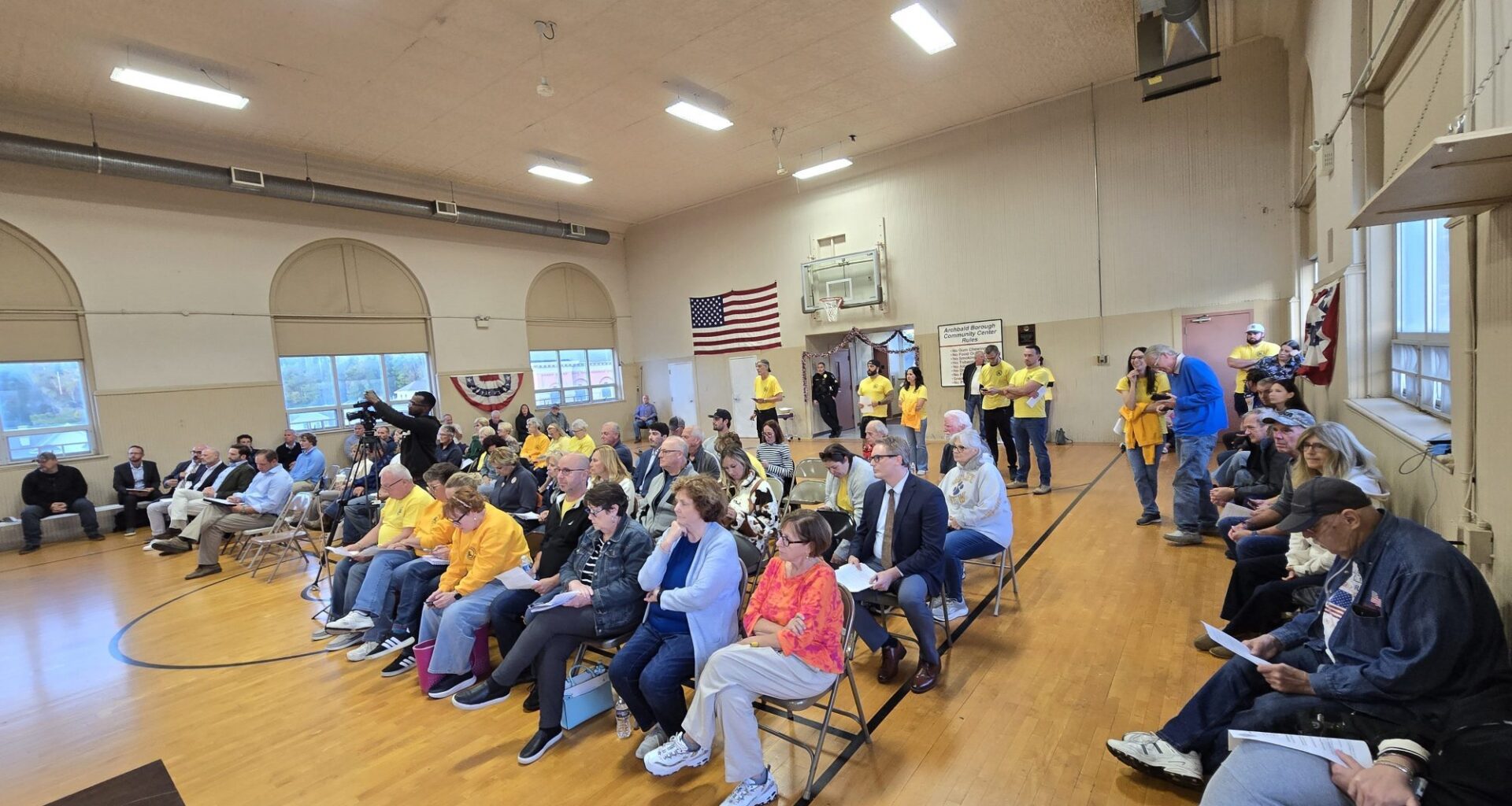
ARCHBALD — Residents, data center opponents and neighbors bombarded Project Gravity representatives with concerns Wednesday about data centers backed up by 430 megawatts of batteries and urged the Archbald Planning Commission to deny final land development plans for the 180-plus-acre campus.
Project Gravity officials tried to assuage the crowd of about 70 in attendance at the planning commission meeting in the third-floor gymnasium of Archbald’s Borough Building. The officials presented renderings of their data center campus nestled behind trees a few hundred feet from homes in Archbald and Jermyn and emphasized the safety of modern battery energy storage systems, or BESS.
“I think there’s a misconception between some of the projects and all of the noise that’s out there in the data center industry, between the speculative projects, the more Bitcoin mining-driven projects, and what I consider ourselves to be: serious developers, well-funded developers who have a longstanding reputation to uphold,” said Erik Draaisma, an executive vice president at Corscale Data Centers, the Texas-based developer behind Project Gravity.
They know that zoning laws govern what can be on the site, Draaisma said.

The Archbald Planning Commission presides over a meeting at the Borough Building on Wednesday, Oct. 7, 2026. (FRANK WILKES LESNEFSKY / STAFF PHOTO)

Moosic resident and Stop Archbald Data Centers member Derek Sutcliffe shares his concerns about Project Gravity during an Archbald Planning Commission meeting at the Borough Building on Wednesday, Oct. 7, 2026. (FRANK WILKES LESNEFSKY / STAFF PHOTO)

Archbald resident Tina Verrastro, who lives on Gibson Street near Project Gravity, opposes the development during an Archbald Planning Commission meeting at the Borough Building on Wednesday, Oct. 7, 2026. (FRANK WILKES LESNEFSKY / STAFF PHOTO)

Erik Draaisma, an executive vice president at Corscale Data Centers, addresses residents during an Archbald Planning Commission meeting at the Borough Building on Wednesday, Oct. 7, 2026. (FRANK WILKES LESNEFSKY / STAFF PHOTO)

Archbald resident Kelsey Pazanski Wargo challenges Project Gravity’s zoning during an Archbald Planning Commission meeting at the Borough Building on Wednesday, Oct. 7, 2026. (FRANK WILKES LESNEFSKY / STAFF PHOTO)
Show Caption
1 of 5
The Archbald Planning Commission presides over a meeting at the Borough Building on Wednesday, Oct. 7, 2026. (FRANK WILKES LESNEFSKY / STAFF PHOTO)
“We don’t go in and try to push development where it isn’t approved by zoning,” he said. He cited his company’s experience developing data centers in Northern Virginia, with two data centers under construction and six campuses across the United States and Europe in active predevelopment, such as Project Gravity.
The crowd challenged the development throughout the night, from its zoning status to its batteries and stormwater basins.
The three-hour meeting ended Wednesday without a decision from the planning commission.
‘Consider the residents’
Developed by Corscale and funded by Texas-based Affinius Capital, Project Gravity submitted final land development plans for its data center campus to Archbald late last month.

A rendering of Project Gravity is presented during an Archbald Planning Commission meeting at the Borough Building on Wednesday, Oct. 7, 2026. (FRANK WILKES LESNEFSKY / STAFF PHOTO)

Valley View School District Solicitor Kyle Callejas addressed Project Gravity both on behalf of the school district and as an Archbald native during an Archbald Planning Commission meeting at the Borough Building on Wednesday, Oct. 7, 2026. (FRANK WILKES LESNEFSKY / STAFF PHOTO)

Archbald resident Meg Nudelman speaks about Project Gravity during an Archbald Planning Commission meeting at the Borough Building on Wednesday, Oct. 7, 2026. (FRANK WILKES LESNEFSKY / STAFF PHOTO)

Planning Commission Chairman Scott Gilland addresses Project Gravity representatives during an Archbald Planning Commission meeting at the Borough Building on Wednesday, Oct. 7, 2026. (FRANK WILKES LESNEFSKY / STAFF PHOTO)

Archbald resident Kim Nudelman shares her concerns about Project Gravity during an Archbald Planning Commission meeting at the Borough Building on Wednesday, Oct. 7, 2026. (FRANK WILKES LESNEFSKY / STAFF PHOTO)
Show Caption
1 of 5
A rendering of Project Gravity is presented during an Archbald Planning Commission meeting at the Borough Building on Wednesday, Oct. 7, 2026. (FRANK WILKES LESNEFSKY / STAFF PHOTO)
Because Project Gravity’s initial plans predate the borough’s November zoning amendment to regulate data centers, it is proceeding as a principal permitted use in a general commercial zoning district. Archbald’s legacy zoning from March 2023 permitted data centers in commercial and industrial zones throughout the borough without defining them. The Valley View School District is challenging that designation in county court.
As a permitted use, Project Gravity only needs approval at the borough level from Archbald’s planning commission. The conditional-use hearing process used to govern other data center proposals culminates in final approval from borough council.
Project Gravity’s final land development plans propose five two-story data centers and two one-story data centers, each with a 138,000-square-foot footprint, between Eynon Jermyn Road and Business Route 6. Rather than rely on 260 backup generators, each producing 3 megawatts, Project Gravity downsized to 45 1.25-megawatt generators, Draaisma said. There would be 42 generators for its data centers and three generators for its stormwater pumps, he said. Reducing the backup generators also reduced the diesel fuel stored on site, bringing it down from 2.4 million gallons to under 200,000 gallons, he said.
The rest of the backup power would come from 430 megawatts of batteries, with 78 megawatts of BESS yards for the two-story data centers and 20 megawatts for the one-story buildings.

Lackawanna County Commissioner Bill Gaughan called Project Gravity’s plans “absurd” during an Archbald Planning Commission meeting at the Borough Building on Wednesday, Oct. 7, 2026. (FRANK WILKES LESNEFSKY / STAFF PHOTO)

Mark Cornell, who lives on Callahan Drive near a Project Gravity stormwater basin, said the data center campus exploited the borough’s intentions during an Archbald Planning Commission meeting at the Borough Building on Wednesday, Oct. 7, 2026. (FRANK WILKES LESNEFSKY / STAFF PHOTO)

A rendering of Project Gravity is presented during an Archbald Planning Commission meeting at the Borough Building on Wednesday, Oct. 7, 2026. (FRANK WILKES LESNEFSKY / STAFF PHOTO)
Show Caption
1 of 3
Lackawanna County Commissioner Bill Gaughan called Project Gravity’s plans “absurd” during an Archbald Planning Commission meeting at the Borough Building on Wednesday, Oct. 7, 2026. (FRANK WILKES LESNEFSKY / STAFF PHOTO)
Archbald’s zoning prohibits an “electricity grid storage battery facility” in commercial zones such as Project Gravity’s, limiting the battery facilities to industrial zones and mining districts as conditional uses. Project Gravity’s representatives contend the prohibition does not apply to their project because they’re building a data center campus as a permitted use with the BESS as an accessory to that use. The batteries would only serve their data centers and could not discharge to the grid, Draaisma said.
Archbald resident Kelsey Pazanski Wargo cited Valley View’s lawsuit as she challenged Project Gravity’s rights to operate in a commercial zone under Archbald’s legacy zoning. Archbald’s general commercial zoning district no longer permits data centers, meaning if Project Gravity’s plans are denied, it cannot reapply in the same location.
“Today, we are more well informed about hyperscale AI data centers, and we know that we are not here considering an internet server building when we look at this application,” she said, advocating that data centers only belong in Archbald’s heaviest industrial zoning.
Tina Verrastro, who lives on Gibson Street and is one of Project Gravity’s closest neighbors, challenged the data centers’ rights to operate under Archbald’s original zoning, pointing out the site was sold in December to a new a limited liability company. She also worried about Project Gravity’s batteries near her home.
“Project Gravity replaced over 100 diesel generators with 430 megawatts of lithium batteries,” she said. “If these batteries catch fire, they are very hard to extinguish, and they reignite hours or days later and can release harmful gases that pose health risks to nearby residents and first responders. My home literally borders this wildly inappropriate project.”
Referencing recent reporting in The Times-Tribune on Project Gravity’s batteries, Draaisma said BESS have gone through a “tremendous evolution” in recent years, with past incidents informing significant regulation and design changes. Those new strategies include no longer concentrating the batteries into one location, he said.
“There’s been a drop in incident rates between 2018 and 2025 of 99% because of these regulations and because of these designs,” he said.
Planning Commission Chairman Scott Gilland criticized Project Gravity’s plans for placing infrastructure in a residential zone near the outskirts of the campus, and the changing nature of the plans.
“I have never worked on a project where every time that I look at a new set of prints, something has totally changed,” Gilland said. “And I’ve implored you people to consider the residents. I’ve implored you to do that, and by just what you’re trying to put on that (residential) area, seems to me that maybe I didn’t implore you enough, or maybe I wasn’t clear enough or respectful enough with my request.”
‘This is our home’
In total, 15 Lackawanna County residents spoke out against Project Gravity on Wednesday, the majority of whom were Archbald residents.
Mark Cornell lives on Callahan Drive near a massive stormwater basin at the top of Project Gravity’s site near Business Route 6.
“Project Gravity chose to exploit our intentions,” Cornell said. “Somehow, Project Gravity got to determine its own definition of a data center, and despite a mountain of opposition, continues to exploit our neighborhood, our schools, and our parks, and the citizens of Archbald and Lackawanna County for their own benefit.”
Stop Archbald Data Centers member Derek Sutcliffe of Moosic, who frequents data center and power plant meetings throughout Northeast Pennsylvania, said Archbald’s planning commission is one of their only defenses for community standards. Batteries aren’t a safe alternative, they’re a different kind of hazard, he said.
“If a thermal runaway event occurs, we are looking at difficult-to-extinguish toxic battery fires right in the backyards of our residents and our local schools,” Sutcliffe said, wearing a backward baseball cap affixed with a “No Data Centers” button across his forehead. “Protect our neighborhoods from this unprecedented battery hazard.”
The Moosic resident also raised concerns over whether the scale of earth-moving work to develop the site would risk structural instability on former mine lands, litigation against the project, stormwater runoff and Project Gravity’s removal from Gov. Josh Shapiro’s permit fast track program due to a lack of transparency.
Kyle Callejas addressed the planning commission both as a Valley View School District solicitor and as someone born and raised in Archbald. He referenced objections the district sent to Archbald regarding Project Gravity and challenged the zoning for the batteries.
Speaking as an Archbald native, Callejas said there are two sides of the debate.
“On one side, you have billion-dollar companies seeking to drastically and permanently alter the landscape of our town for their own benefit. On the other side are the people of Archbald — people whose parents and grandparents grew up here, whose children will grow up here, and who love this town and call it home,” Callejas said, asking the planning commission to remember who they serve. “To the developers, this is a business opportunity. When their work is done here, they will leave Archbald and never return again. To us, though, this is our home, and we are the ones who will live with the consequences: our families, our students, our community.”
Sisters Meg and Kim Nudelman, who live in the Highlands Archbald development off Eynon Jermyn Road less than a mile from Project Gravity, both criticized the battery proposals. Kim Nudelman worried about where residents will go if they have to evacuate and whether local first responders could handle a major BESS incident.
“If the commission does not have significant evidence to determine that this BESS is compatible with surrounding land uses and can be safely accommodated at this location, then there is a reason very straightforward to deny approval,” Kim Nudelman said. “We should not approve first to try to resolve fundamental questions afterward.”
Lackawanna County Commissioner Bill Gaughan called the project absurd, describing features of the data center campuses and its plans to use 30- and 40-foot walls to reduce sound.
“At some point, common sense ought to interrupt your engineering,” Gaughan said. “When your solution requires walls of the height of buildings, massive stormwater infrastructure and specialized emergency planning, maybe the problem isn’t that you need another consultant — maybe the problem is where you’re trying to put it.”
The development asks the community to sacrifice their quality of life so the developer can make money, he said.
“Project Gravity may be an engineering marvel. It may be a financial marvel, but as a matter of planning, it is absolute madness,” Gaughan said. “No amount of engineering can make it make common sense.”