
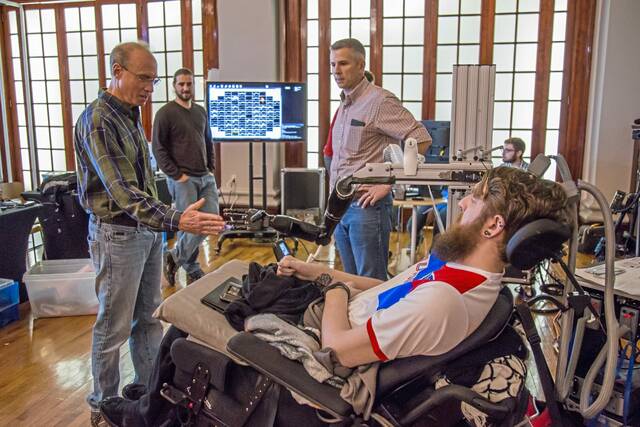
Brain implants that can restore a sense of touch to people with paralysis remained safe through years of use and millions of electrical pulses to the brain, according to a long-running study by University of Pittsburgh and University of Chicago researchers.
During a recently completed decade-plus study published in Science Translational Medicine, five participants with spinal cord injuries that left them largely paralyzed from the neck down received surgically implanted brain-computer interfaces.
Collectively, those devices delivered 168 million pulses of brain stimulation to the parts of their brains that control hand and arm movement, as well as touch sensation across a total of 27 years, during what Pitt characterizes as the first study of its kind and the longest-running study of the safety of intracortical microstimulation in
humans to date.
In 2012, the Pitt team became one of the first teams to surgically implant electrodes in the motor cortex to allow a paralyzed person to control a robotic arm with their mind. In 2015, it pioneered the approach of stimulating the sensory cortex to pair movement with touch, implanting the latter for the first time in 2020.
“We know, in fact, from these unusual medical cases where people sort of spontaneously lose a sense of touch or proprioception (the body’s ability to sense its own position and movements) that even if people can move effectively — their muscles are just fine — they can become almost effectively paralyzed,” said senior author Dr. Robert Gaunt, a member of Pitt’s Rehab Neural Engineering Labs. “If you can’t feel, it’s incredibly difficult to do anything. Just imagine trying to pick something up and you can’t feel it.”
None of the participants reported experiencing any serious adverse events, which marks a major hurdle cleared for a technology that could one day offer a variety of sense-restoring applications if eventually approved for public use.
The study primarily addressed questions of duration of efficacy, safety and side effects regarding BCIs made by Blackrock Neurotech of Salt Lake City.
“What it really did is set a sort of benchmark, at least for that particular device technology, about how long these devices could last,” Gaunt said. “Because this has very much been an open question — everybody expects these devices to fail, including us. They will fail at some point. Nobody really knows how long that will take.”
The devices communicate with individual or small groups of the brain’s 80 billion neurons via electrical signals.
“We are able to listen to and then decode sort of the patterns of activity (in those neurons). It’s almost like a Morse code pattern that the brain is playing, and we can turn that Morse code into control commands for a robot, and then we can also sort of inject Morse code patterns into the brain with very, very tiny pulses of electricity,” Gaunt said. “If we do that in the right way, people can feel things.”
Nathan Copeland, 40, of Dunbar, Fayette County, understands the value of the technology with which he’s helped make history.
In November 2004, just months after his 18th birthday, Copeland was involved in a car accident. He had just started classes toward a nanofabrication degree at Penn State. He broke his neck at the C5 level and was left with no movement or sensation from the chest down.
“Going from being independent in your life to really needing help with basically everything was a big thing to get used to,” Copeland said. “But at the same time, it’s like you have to just accept that your life has changed.”
Asked to participate in the trial in the early 2010s, he’d eventually become the first person to have a BCI implanted in his sensory cortex.
“It felt really good to just have a purpose in life again, after feeling like there really wasn’t anything going on,” said Copeland. “I wasn’t really nervous and as soon as they asked, I knew I was going to do it. It felt like a duty.”
His experience was cutting edge: he now has two implants in his sensory cortex and one in his motor cortex.
“At the beginning, we just started doing stuff with a robotic arm, so I could move an arm around and pick up objects. But they can stimulate directly to my brain, and it will create a sensation that feels like it’s coming from my own hand,” said Copeland. “They combined that with the robotic hands, so when the robot would grab an object, I would feel sensations on my own hand. Then we moved on to controlling a computer cursor, and one of the things that came about from that was it let me draw, which is something I always kind of liked doing. And also playing basic video games: I have a joystick controller with big buttons that I can play Sonic 2 with. I have enough arm movement that I can still wiggle a joystick and push one button, but it’s way cooler to do it with my brain.”
And while researchers determined the stimulation “stayed safe, stable and localized” after 10 years in Copeland’s case, the research team is still aiming to improve longevity because of the risky nature of surgical replacement. Electrodes became less sensitive with time, and device degradation was observed.
“At the top of pedestals that are mounted to my skull, where all the little pins are that connect to the cables that they screw on, they’re just really worn down from so many times connecting and unconnecting,” Copeland explained.
Having already been reimplanted in 2015, but undeterred and hoping for a replacement surgery — which he said grows riskier each time and might eventually become impossible because of scar tissue buildup — Copeland is in it for the long haul.
“No one expected it to last this long in humans. When I joined the study, it was a one-year safety and efficacy study. And they said, if I got to the end of the year and things were still working okay, then there would probably be the option to continue,” said Copeland. “I’ve always said I’ll use them till they’re completely broke because you don’t really know how durable or long they last if you don’t take them all the way to the end.”
Copeland’s involvement has taken him to conferences as far away as Japan and France, where academics know his contributions to the field.
“I didn’t join the study to be famous or anything,” said Copeland. “So just knowing that I got to do all this stuff and that at some point it will have made a big difference in people’s lives, I think that’s really cool.”